Security Audit Checklist: Safeguarding Your Digital Ecosystem
.avif)
A security audit is a structured review of how well your security controls protect the systems and data your business depends on. This checklist covers the eight steps that make up a complete audit: scope and asset inventory, access control review, configuration and patching, logging and monitoring, backup and recovery, vendor access, policy and training, and evidence capture. It is written for IT managers, security engineers, and compliance owners who need to run an internal security audit or prepare for an external one. Work through the steps in order, because each step depends on the one before it: you cannot review access to systems that never made it into your inventory.
The same checklist applies whether the trigger is a customer security questionnaire, a cyber insurance renewal, a past incident, or an upcoming SOC 2 or ISO 27001 engagement. What changes is how much evidence you keep and who reviews the results.
Why Run a Security Audit
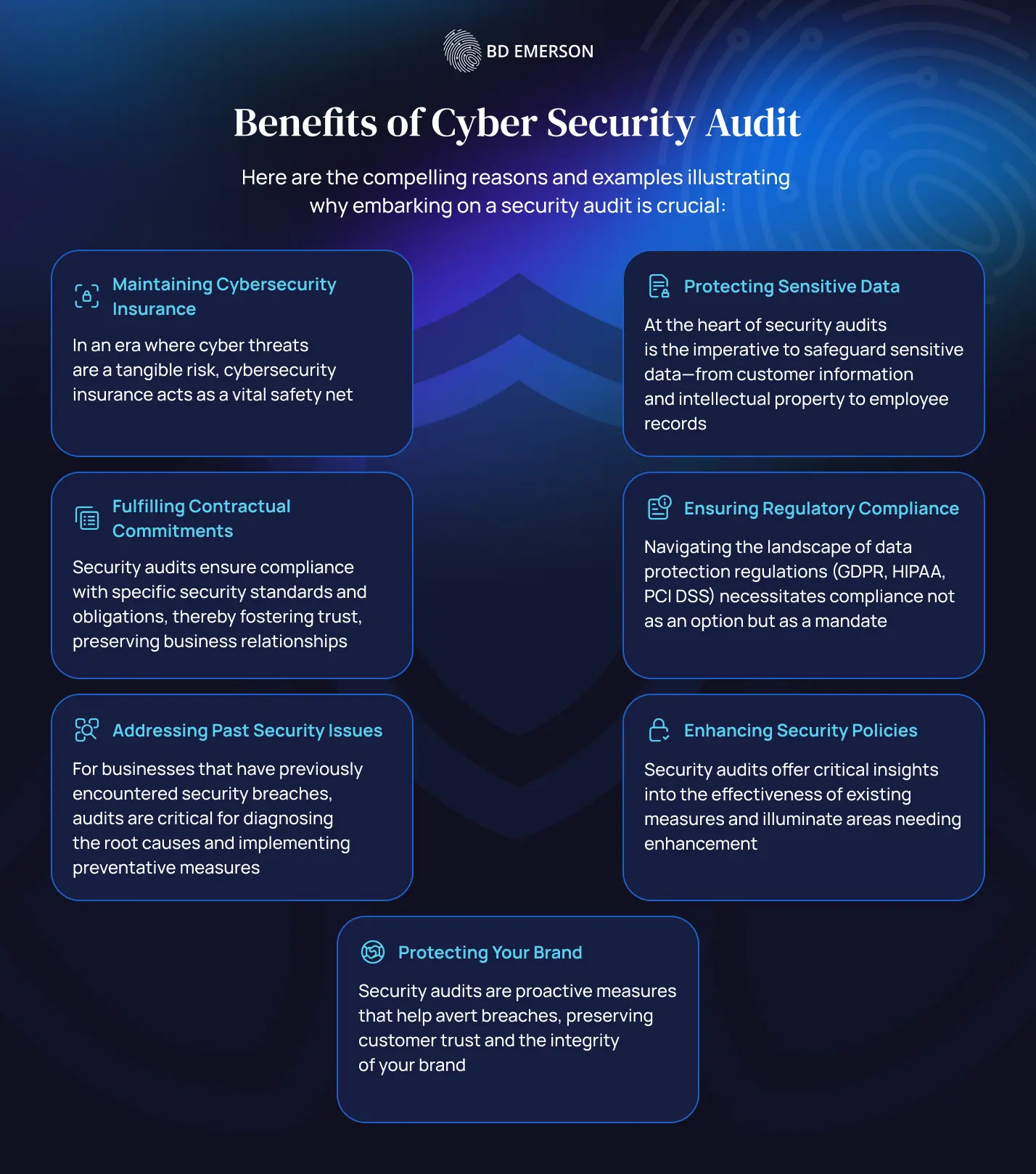
Most audits start with an outside forcing function. Cyber insurers now ask for proof of specific controls before they will write or renew a policy: multi-factor authentication, endpoint detection, tested backups, and offboarding discipline are the usual list. An audit gives you documented answers instead of guesses, and a documented risk profile is what moves premiums.
Customer contracts are the second driver. Enterprise buyers routinely require adherence to a named standard, and they verify it through questionnaires or their own assessors. Auditing yourself first means you find the gaps before your largest customer does.
Regulation is the third. HIPAA, PCI DSS, and GDPR all require periodic evaluation of security controls, and a documented audit is the evidence that the evaluation happened. The fourth driver is a past incident: after a breach, an audit validates that the root cause is fixed and that the corrective actions actually hold under inspection rather than only on paper.
Even without an external push, the audit earns its time. It is the cheapest way to find the stale admin account, the unpatched server, or the backup job that has been failing silently for six months.
The 8-Step Security Audit Checklist
.webp)
Work the steps in this order. Each produces the input the next one needs.
- Scope and asset inventory: List every system, application, data store, and network segment the audit will cover, including cloud accounts, SaaS applications, and endpoints. Flag which assets hold sensitive data such as customer records, payment data, or health information. Name the boundary explicitly, because an audit scoped to everything usually covers nothing well.
- Access control review: Pull user lists from your identity provider and from each in-scope application, then compare them against your current employee roster. Verify that multi-factor authentication is enforced everywhere it can be, that access follows least privilege, that offboarded accounts were disabled within your stated target, and that admin accounts are separate from daily-use accounts.
- Configuration and patching: Compare system configurations against a hardening baseline such as the CIS Benchmarks. Check that critical vulnerabilities are patched within your stated service level, that no unsupported operating systems remain in production, and that patching is automated wherever the environment allows it.
- Logging and monitoring: Confirm logs from identity, network, endpoint, and cloud sources flow to a central location, that retention meets your regulatory and contractual requirements, and that alerts fire on the events that matter: failed admin logins, privilege changes, and unusual data movement. Confirm a named person owns alert triage.
- Backup and recovery: Verify backups run on schedule, are encrypted, and are stored separately from production so ransomware cannot reach both at once. Confirm a restore was actually tested within the last quarter, with the time to recover recorded. A backup that has never been restored is an assumption, and assumptions fail during incidents.
- Vendor access: List every third party with access to your systems or data, including your managed service provider. Confirm each has a contract with security terms, received a security review at onboarding, holds access scoped to what the work requires, and loses that access when the engagement ends.
- Policy and training: Check that security policies exist, were reviewed within the last 12 months, and describe what your team actually does rather than an aspiration. Verify security awareness training completion rates, recent phishing test results, and that the incident response plan was exercised in a tabletop within the past year.
- Evidence capture: For every item above, save the artifact that proves the answer: a screenshot, an export, a ticket, a signed review. Date each one and store the set in a single location. This evidence is the raw material for any external audit that follows, so capturing it now saves the work later.
How to Run the Audit
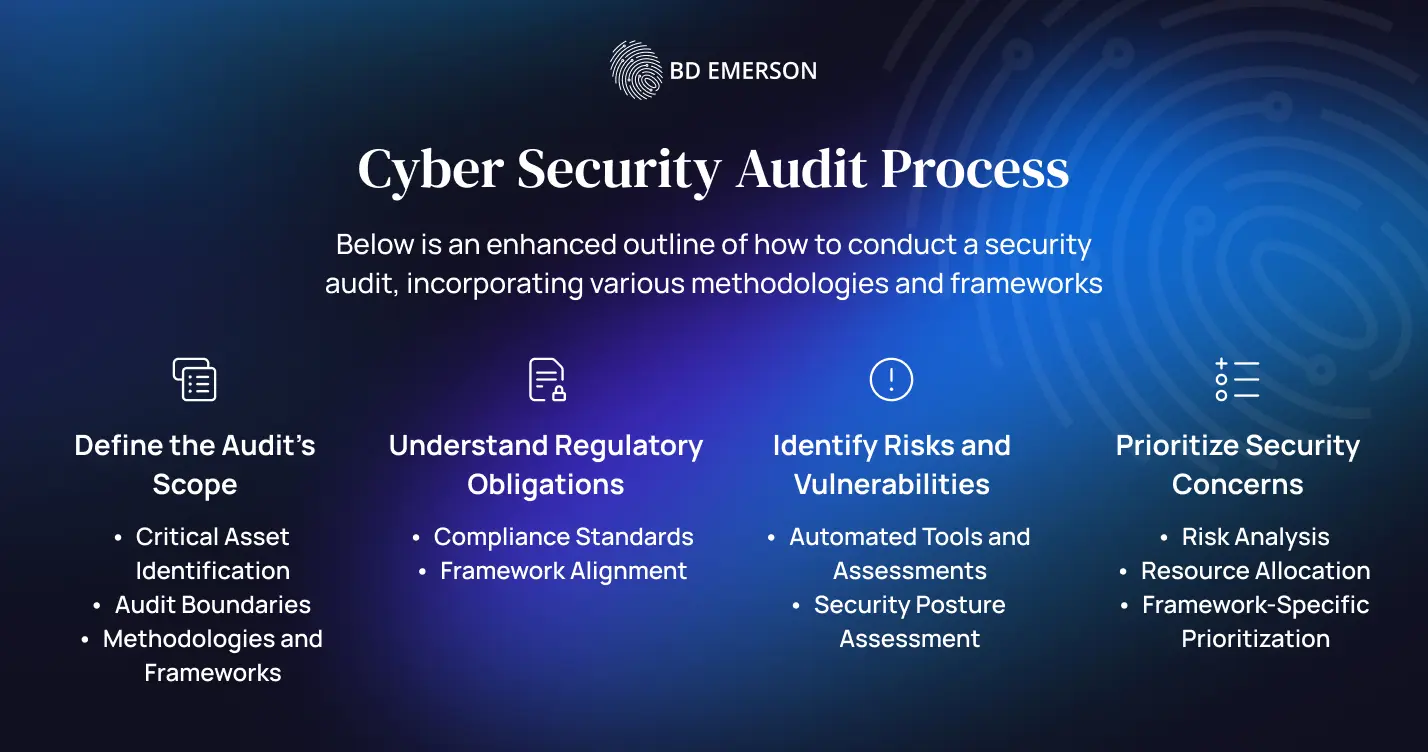
Anchor the audit to a framework before you test anything. NIST CSF 2.0, CIS Controls v8, and ISO 27001 Annex A are the common choices for a general audit; if a regulation binds you, its control set comes first. The framework turns the audit from a collection of opinions into a comparison against defined criteria, and it determines what evidence an external assessor will later expect.
Then test rather than ask. Interviews tell you what people believe is true. The audit needs what is actually true, so pull the real configuration, export the real user list, and sample real tickets. When an answer and an artifact disagree, the artifact wins.
Rank what you find by risk, using likelihood and impact, so remediation effort lands on the exposures that matter most. A missing MFA enforcement on the email tenant outranks an out-of-date policy document every time. Give every finding a named owner and a due date, then retest the closed items rather than accepting a verbal confirmation that they are done.
Timebox the work. A company of 50 to 200 people can complete this checklist in two to four weeks with a single owner coordinating and each control area answered by the person who administers it. Longer than that usually means the scope was too broad; split the environment and audit the highest-risk segment first. Whoever runs it needs enough independence to report findings without editing them, which is the reason many companies hand the first pass to an outside firm even when internal staff could do the mechanics.
Internal vs. External Security Audits
An internal security audit is run by your own staff or by a consultant you hire, on a scope you choose, producing findings you act on privately. It is the right tool for finding and fixing problems before anyone outside the company looks, and it is the standard preparation for any external engagement. Our internal security audit guide walks through the mechanics in detail, and BD Emerson runs these audits for clients through its audit practice.
An external audit is performed by an independent party and produces a report that customers, insurers, or regulators can rely on. The most common example for US service companies is a SOC 2 examination, which must be performed by a licensed CPA firm; BD Emerson performs SOC 2 examinations directly through its CPA attest arm. If SOC 2 is the destination, the SOC 2 compliance checklist maps this audit's evidence to the Trust Services Criteria. ISO 27001 certification works differently: an accredited certification body issues the certificate, and firms like ours handle implementation and internal audit on the way there.
A penetration test complements either type. The audit checks whether controls exist and operate; a penetration test checks whether a skilled attacker can get around them anyway. Mature programs run both.
How Often to Run a Security Audit
The findings themselves follow a pattern worth knowing in advance. Across the audits we run, the same three issues surface most often: former employee accounts still active in at least one SaaS application, backup restores that were configured but never tested, and vendor access that outlived the vendor relationship. If time is short, check those three first.
Run the full checklist at least annually. In between, keep three items on a shorter cycle: access reviews quarterly, vulnerability scanning monthly or continuously, and restore tests quarterly. These are the areas that drift fastest between audits.
Add an event-driven audit after any material change: a cloud migration, an acquisition, a new product that touches regulated data, or a security incident. Compliance obligations set their own floor as well. A SOC 2 Type II report covers a defined period and is typically renewed annually, and PCI DSS requires annual assessment, so companies carrying those obligations end up on an annual external cadence with internal audits in between.
Where BD Emerson Fits
BD Emerson runs internal security audits, performs SOC 2 examinations through its CPA attest arm, and delivers penetration testing, so a client can move from first checklist to external report without switching firms. If you want a second set of eyes on your audit scope or results, contact us at info@bdemerson.com.

About the author