The Best Penetration Testing Companies in 2026
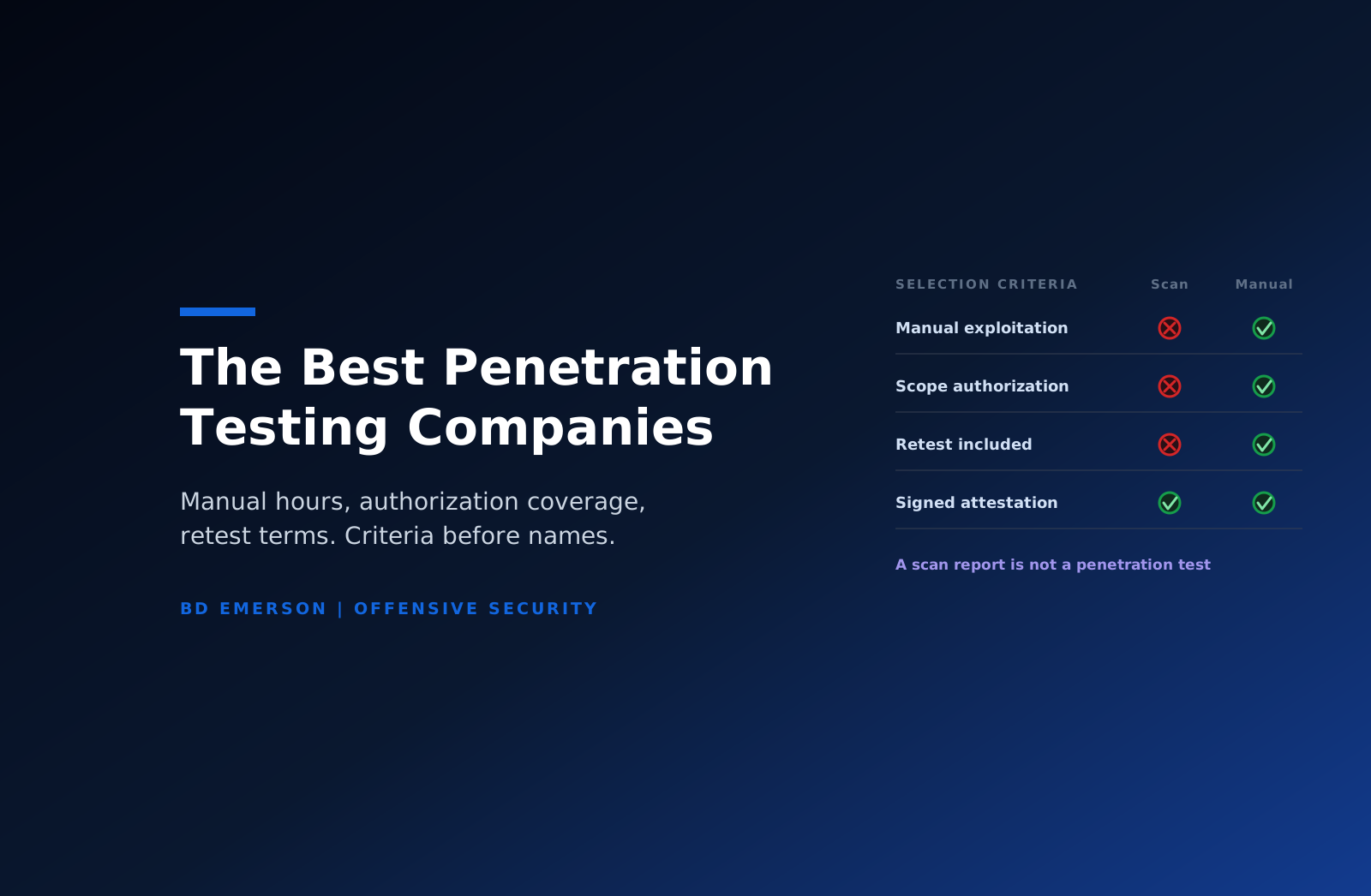
The best penetration testing company depends on what the test has to do: satisfy a SOC 2 auditor, clear an enterprise security review, meet FedRAMP requirements, or find the flaws a motivated attacker actually would. Our shortlist for 2026: BD Emerson (our own firm, disclosed up front), Bishop Fox, NetSPI, Cobalt, Synack, and Rapid7, plus a serious argument that a boutique beats a platform more often than buyers expect. Criteria come before names, because most bad pentest purchases were criteria failures: nobody asked how many manual hours would touch the target, whether authorization testing was in the plan, or whether the report would survive an auditor's review. Fix the criteria and the shortlist mostly picks itself.
How to evaluate a penetration testing company
Six criteria separate the field:
- Manual depth. Ask how many human testing hours your scope gets and what fraction of findings historically come from manual work rather than tooling. Anything under roughly 60 to 80 hours for a production web application is a scan with commentary.
- Authorization coverage. Broken access control tops the OWASP Top 10 for a reason. The test plan should name multi-role, multi-tenant, and cross-account testing explicitly, not bury it under methodology.
- Retest policy. Included or billed, time-boxed or open. A retest letter is what closes findings for customers and auditors, so its cost and turnaround belong in the quote.
- Report quality. Request a sanitized sample before signing. It should show reproduction steps, business impact, and remediation detail that satisfies SOC 2, ISO 27001, or FedRAMP reviewers without translation.
- Tester credentials and staffing. OSCP as a floor, OSEP or OSWE on complex scopes, and named testers rather than a pool lottery. Ask who, specifically, will be on your engagement.
- Scoping honesty. A firm that pushes back on your scope, or tells you a smaller test is sufficient, is showing you how the whole engagement will run.
BD Emerson
BD Emerson is our firm, so weigh this entry accordingly and hold it to the criteria above like every other name here. We run manual-first penetration testing across web applications, APIs, external and internal networks, cloud environments, and AI systems, with senior testers holding OSCP and OSEP credentials, fixed-fee quotes against real scope, and retesting included within the engagement window. Because the firm also operates compliance and audit practices, reports are written for the people who actually read them: SOC 2 and ISO 27001 auditors, FedRAMP assessors, and enterprise security reviewers. Authorization testing across roles and tenants is standard rather than an add-on. Where we are not the fit: thousand-asset enterprise portfolios needing 24/7 platform operations and global staffing, which is where the larger firms below earn their position.
Bishop Fox
Bishop Fox is one of the largest independent offensive security firms, founded in 2005, with a deep bench across application security, red teaming, and cloud. Its Cosmos platform pairs continuous attack surface management with human-operated testing, and the firm's sustained research output, public tooling, advisories, and conference work signal real technical depth rather than marketing. Large enterprises with sprawling external footprints and mature security programs get the most value. The tradeoffs are premium pricing and an enterprise-shaped sales motion that can be heavy for a company that needs one application tested well. If you are consolidating continuous attack surface coverage and deep offensive engagements with a single vendor, Bishop Fox belongs on the shortlist.
NetSPI
NetSPI, founded in 2001 and headquartered in Minneapolis, operates at enterprise scale with hundreds of in-house testers and a proprietary platform that consolidates findings, retests, and attack surface management alongside breach and attack simulation. It is a fixture in banking and other regulated industries, and it handles very large multi-team scopes, hundreds of applications, sprawling networks, recurring program work, better than almost anyone. Reports and workflows are built to feed enterprise vulnerability management programs. The tradeoff is the inverse of the boutique: process weight and engagement economics tuned for large accounts. Mid-market buyers can get excellent work here, but should confirm exactly who staffs their test and how continuity works across years.
Cobalt
Cobalt effectively created the PTaaS category in 2013 and remains its reference implementation: a vetted freelance tester community, launches in days rather than weeks, findings streaming into the platform as they are confirmed, integrations into Jira and Slack, and credit-based pricing that procurement understands. For SaaS companies that need a competent test and a presentable report on a compressed timeline, it works as designed. The structural tradeoffs are the category's: tester rotation between engagements, depth bounded by credit sizing, and authorization and logic coverage that depends heavily on which testers the draw produces. Buyers with complex permission models should size credits generously and request testers with directly relevant history.
Synack
Synack pairs a vetted researcher crowd, the Synack Red Team, with a platform that handles scoping, traffic control, and finding validation, and it carries government-grade credentials including a FedRAMP Moderate authorized platform. The model delivers continuous, incentive-driven coverage: hundreds of researchers probing a defined perimeter over time beats any fixed team for breadth. It suits organizations that want ongoing adversarial pressure on an external attack surface, and public sector buyers with clearance requirements. It is less suited to deep, collaborative testing of a single complex application, where a named two-person senior team working alongside your engineers tends to produce more actionable findings per dollar spent.
Rapid7
Rapid7 is a broad security vendor, vulnerability management, detection and response, cloud security, that also sells penetration testing services. The pitch is consolidation: one vendor, one MSA, pentest findings feeding the same console as scanner and detection data. For organizations already running InsightVM or Rapid7 MDR, that integration is real convenience, and the services team is competent across standard scopes. The caution is structural: services are an adjacent line for a product company, bench depth varies by region and quarter, and penetration testing is not the center of gravity. Treat it as a solid option inside an existing Rapid7 relationship rather than a destination for your hardest scopes.
What these firms cost
Expect $8,000 to $25,000 for a single-application engagement at a boutique or mid-tier firm, $15,000 to $60,000 per year for platform subscriptions depending on asset count and cadence, and six figures annually for enterprise programs at the large independents. Within those bands, quotes for identical scope routinely vary by a factor of two, which is why the sanitized-report comparison matters more than the price column. The full breakdown of what drives those numbers, scope, methodology, tester seniority, retest terms, is in our penetration testing cost guide.
When a boutique beats a platform
Platforms win on logistics: launch speed, dashboards, retest turnaround, procurement fit, and scale across many assets. Boutiques win on the test itself more often than market share suggests: named senior testers who stay on your account year over year, scope shaped by conversation rather than credit tiers, authorization and business logic work that requires holding your whole system in one head, and partner-level attention when a critical lands mid-engagement. Pricing frequently favors the boutique too, since you are not funding a platform and a sales machine. The working rule: the more your risk concentrates in one complex application, the more a boutique earns its fee; the more it spreads across hundreds of assets, the more a platform does.
Running the selection
Ask two or three firms for a sanitized report and a scoping call, then compare what each proposes for the same scope: manual hours, staffing by name and credential, the authorization test plan, retest terms, and price. Misalignment across those five tells you everything you need. Schedule backwards from the deadline driving the purchase, audit fieldwork, customer review, contract renewal, and remember that good firms book four to eight weeks out; rushed scoping is where bad tests begin. A penetration test is, in the end, 60 to 200 hours of someone's undivided attention against your most important systems. Buy the someone, not the brand.

About the author