What Palantir Costs
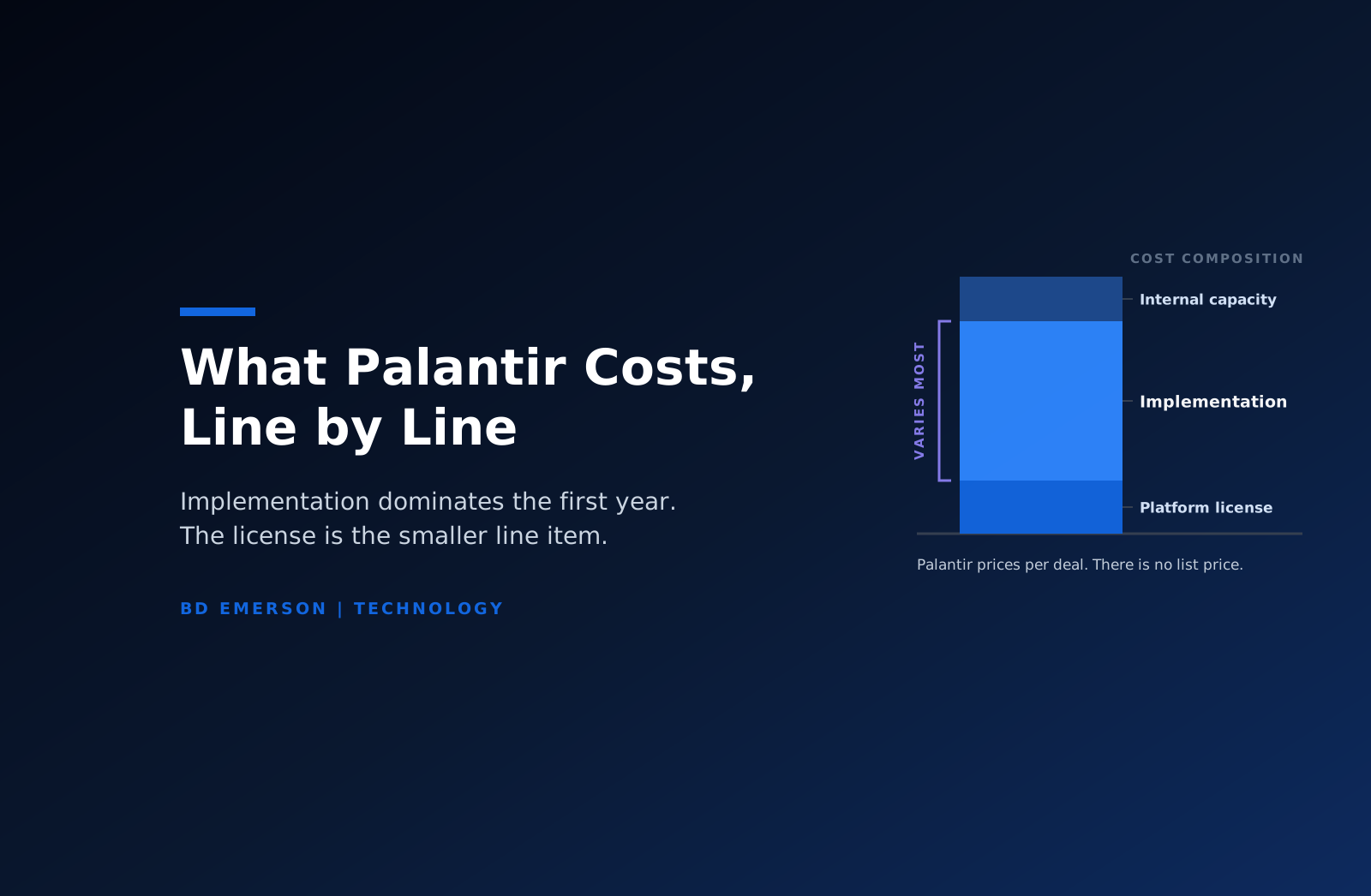
Palantir does not publish list prices and it prices per deal, so any number you find online is somebody's contract rather than a rate card. The ranges we see in commercial Foundry and AIP engagements run from roughly $250,000 a year for a narrow single-use-case deployment to several million for an enterprise program, with most first contracts at mid-market and large enterprises landing between $500,000 and $2 million annually. Government and defense contracts run larger and are partly visible in public award data. Then add implementation and internal capacity, which together frequently exceed the license in year one.
How the commercial model works
Palantir sells subscriptions to platforms rather than seats to a product, and contracts are usually multi-year with annual commitments. Three things vary from deal to deal: which platforms are in scope, how much compute and storage the deployment consumes, and how much Palantir delivery capacity is attached to it.
The company's own reporting describes a motion that starts small and expands. Palantir runs short paid pilots, marketed as AIP Bootcamps, that put a working use case in front of a customer in days rather than months, then converts them into production contracts that grow as more workflows land on the platform. That shape matters for budgeting, because your first contract is a starting point rather than a steady-state cost, and the expansion is the point of the model. Palantir has reported net dollar retention well above 100 percent for years, which is the financial signature of exactly that pattern.
There is also a low end. Palantir has offered free and low-cost developer tiers aimed at individuals and small teams, useful for learning the platform. They do not resemble the contracts an enterprise signs, and they should not be used as a pricing anchor in a business case.
What drives the number
Six variables move the price more than anything else.
Scope of platform is the first. Foundry alone prices differently from Foundry plus AIP, and Gotham and Apollo carry their own commercial treatment. Most commercial buyers are pricing Foundry with AIP attached.
Consumption is the second. Data volume, pipeline frequency, object counts, and the compute behind transformations and agent calls all feed the number. A deployment with hourly pipelines across twenty source systems costs materially more to run than one with nightly loads from three.
Users are the third, though less directly than in seat-based software. What matters is the population of operators using applications and the concurrency behind them rather than a headcount line item.
Deployment environment is the fourth. Palantir-hosted cloud is the baseline. Customer cloud, on-premise, air-gapped, and classified environments add cost, and the delivery complexity rises faster than the license does.
Delivery capacity is the fifth. Palantir attaches its own forward deployed engineers to most new deployments, and that labor is part of the commercial conversation. More attached delivery means a larger contract and, usually, a faster start.
Term and commitment are the sixth. Longer terms and larger annual commitments buy better unit economics, which is the normal enterprise software trade, and it cuts both ways if adoption stalls.
What the public numbers tell you
Palantir's own disclosures are the most reliable pricing signal available. The company reports customer counts and revenue concentration each quarter, and average revenue per customer across its base has run in the low millions of dollars. Federal awards are searchable in public contract data, which gives a concrete sense of the top of the range, though those contracts bundle delivery and environment requirements that commercial buyers do not carry.
Two conclusions follow. The large numbers in the press are enterprise-wide, multi-year, delivery-heavy contracts, and they are a poor comparison for a first commercial deployment. And the growth in those accounts came from expansion rather than from large initial signatures, which supports starting narrow.
What we see in practice
Treat these as observed ranges rather than a rate card, because the variance inside each band is wide.
A single-use-case commercial deployment, meaning one operational workflow, a handful of source systems, and a small operator population, tends to start in the low to mid six figures annually. A departmental deployment with several workflows and a real user base typically runs $750,000 to $2 million. An enterprise program spanning multiple business units runs from a few million upward, and at that size the contract usually includes significant attached delivery.
What surprises people is the ratio rather than the license itself. In the first year, implementation and internal capacity commonly match or exceed the subscription, which means a $1 million platform decision is a $2 million to $2.5 million program decision. Business cases that model only the license get revised in month four.
The costs behind the license
Implementation is the largest of them. Somebody has to connect the source systems, build the pipelines, design the ontology, build the applications, configure the security model, and get operators to change how they work. Whether that is Palantir's engineers, a partner like us, your own team, or a mix, it is labor measured in months.
Internal capacity is the cost most often left out. A Foundry deployment needs a product owner who can settle definitional disputes, data owners for each source system, and engineers who will eventually maintain and extend the ontology. Programs that plan for platform-only spend end up buying that capacity later at consulting rates, which is the expensive way to get it.
Security and compliance work belongs in the budget from the start. Markings, purpose-based access, audit routing to your SIEM, and evidence for whatever framework you report against are configuration decisions with a labor cost attached. We cover the substance of that in securing Palantir deployments. Doing it in the first arc is cheaper than retrofitting classifications onto a populated platform.
Change management is the last one, and the one finance teams struggle to size. An operational platform returns value only when operators use it instead of the spreadsheet they trust. Training, process redesign, and the political work of retiring the old way are real line items.
How to price your own case before you talk to a vendor
Build the number from the workflow. Pick the operational decision you want to change, count the source systems it depends on, estimate the operator population, and decide whether the deployment needs to be Palantir-hosted or something more restrictive. Those four inputs determine most of the license, and they also determine the implementation effort.
Then set the value side against it. If the decision you are targeting is worth less than about three times your all-in first-year cost, the program will not survive its first budget review, whatever the platform does. If it is worth ten times that, the license stops being the interesting question.
Compare the whole program rather than the platform. The relevant alternatives and their own multi-year costs are in Palantir competitors and alternatives.
Where BD Emerson fits
We implement Foundry and AIP as a partner and take no resale margin on Palantir licenses, so our view of scope is not tied to the size of the contract. Most of our work starts by narrowing the first arc to one workflow that can ship in six to twelve weeks, which is also the cheapest way to find out whether the platform fits before the commitment gets large. Our Palantir consulting practice handles the implementation, and the ontology and security work that decides whether year two costs less than year one.

About the author