How Much Does a Quality of Earnings Report Cost?
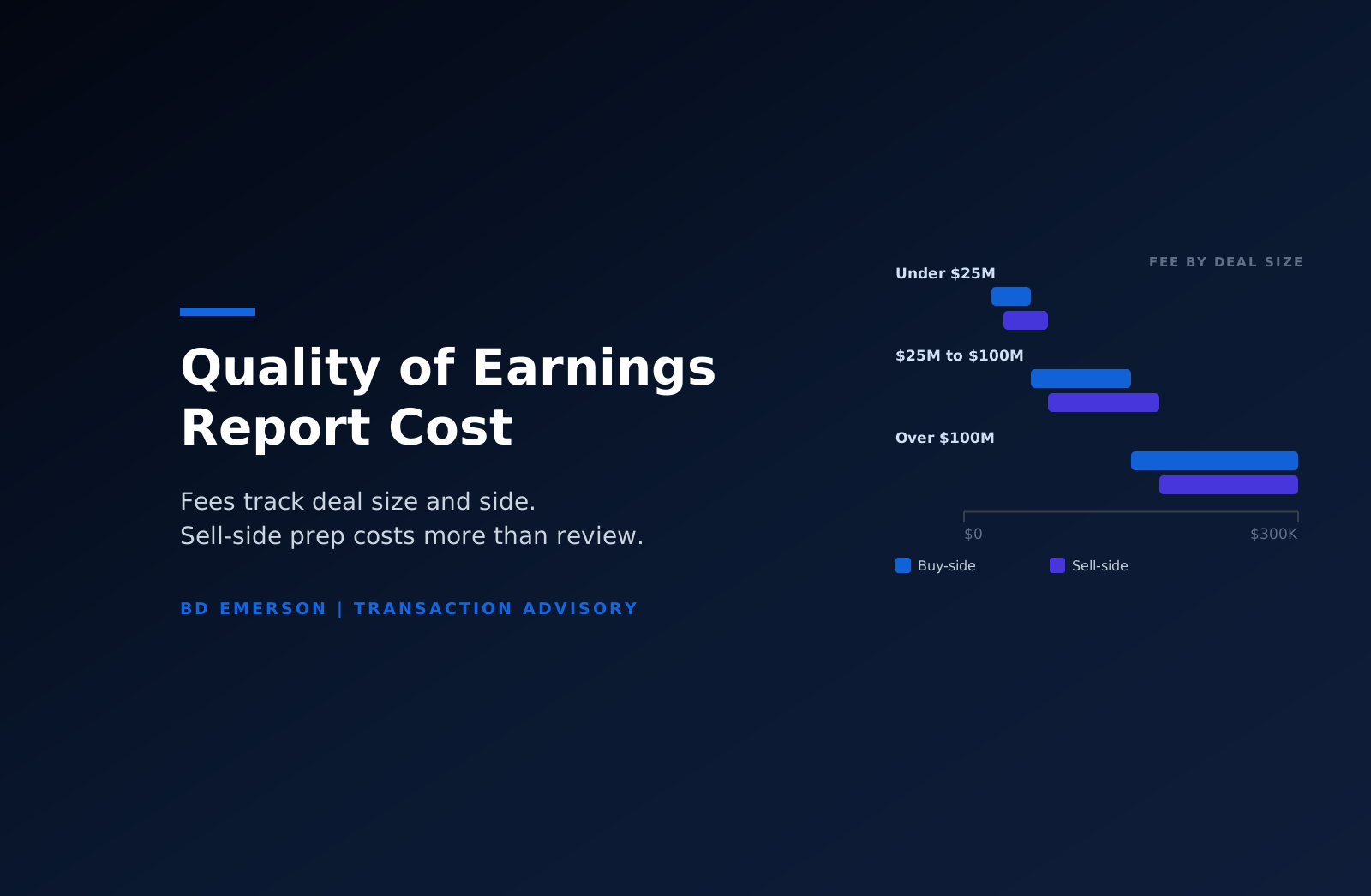
A quality of earnings report typically costs $25,000 to $150,000, and the range is wide because fees track complexity rather than deal size alone. A buy-side QoE on a $5 million to $15 million enterprise value deal with clean accrual books usually runs $25,000 to $50,000. A $15 million to $75 million deal lands at $45,000 to $90,000. Above $150 million of enterprise value, with multiple entities or cross-border operations, expect $150,000 to $400,000. Sell-side QoE runs 10 to 30 percent higher than the equivalent buy-side scope because the workbook has to survive every buyer who reads it. Record quality moves the number more than revenue does.
Fee ranges by deal size
Approximate all-in fees for a standard buy-side QoE on a four to six week timeline, single target, single closing:
- Under $5M enterprise value. $20,000 to $35,000, usually a limited-scope review rather than a full QoE.
- $5M to $15M. $25,000 to $50,000. One entity, one revenue stream, accrual books.
- $15M to $75M. $45,000 to $90,000. The mid-market core, where most QoE work happens.
- $75M to $150M. $80,000 to $150,000. Usually multiple entities, often multi-state or multi-country.
- Above $150M. $150,000 to $400,000 and up, frequently with tax and carve-out workstreams running alongside.
Those ranges assume a seller who responds to information requests. Each assumption in that sentence has a price when it fails.
What actually drives the fee
Record quality and basis of accounting. This is the single largest driver. Cash-basis or hybrid books add 20 to 50 percent to the fee, because the team rebuilds accrual monthly financials before any analysis starts. A target with no monthly close discipline, no cutoff controls, and revenue recognized when cash arrives is a reconstruction project wearing a diligence label.
Entities and systems. Each additional legal entity, ERP instance, or point-of-sale system adds roughly $5,000 to $15,000. Consolidation done in a spreadsheet outside the accounting system adds more, because every elimination has to be traced.
Revenue model complexity. Subscription with usage tiers, multi-element arrangements, percentage-of-completion contracts, channel sales with rebates, and deferred revenue balances all require recognition testing rather than trend analysis. A single-product business with one pricing model is materially cheaper to diligence than the same revenue split across four models.
Add-back volume. Management-adjusted EBITDA with 30 add-backs costs more to test than one with five, because each adjustment needs support and a judgment on whether it is truly non-recurring. Owner compensation normalizations, related-party rent, and one-time items that appear in three consecutive years are where the hours go.
Timeline compression. A two-week turnaround carries a 15 to 40 percent premium because it means staffing a team out of sequence and working weekends. Exclusivity windows shorter than four weeks reliably cost more than the same work planned properly.
Scope beyond core earnings. Working capital analysis and a proof of cash are usually included. Quality of revenue testing at the transaction level, customer cohort and retention analysis, debt-like item identification, and carve-out financials are usually not. A full-scope engagement letter should name each of those explicitly, because they are the items providers price differently and the ones buyers assume are covered.
Buy-side and sell-side price differently
A buy-side QoE is scoped to one reader and one thesis. The provider answers the questions the buyer and its lender care about, and the deliverable is a report plus a databook for the deal team.
A sell-side QoE is written for readers you have not met yet. It has to anticipate the questions every bidder will ask, defend a management-adjusted EBITDA figure through months of diligence Q&A, and hold up when a buyer's own accountants attack it. That means a broader scope, more documentation, and a longer engagement, typically five to eight weeks. Expect 10 to 30 percent more than the buy-side equivalent.
Sell-side work usually pays for itself anyway. Running it three to six months before launch finds the revenue cutoff error, the unsupported add-back, or the working capital seasonality problem while you can still fix it or frame it. The same finding surfaced by a buyer in week four of exclusivity becomes a repricing conversation, and repricing costs a multiple of the fee. If you are unsure what the report covers before commissioning one, start with what a quality of earnings report actually is.
Why QoE pricing does not work like audit pricing
An audit is priced against a standard. Scope is set by professional standards and a materiality threshold, the deliverable is an opinion, and the required procedures are largely defined before anyone quotes. That makes audit fees fairly predictable inside a revenue band.
A QoE has no such standard. It is a negotiated set of agreed-upon procedures with no opinion and no attestation, so the scope is whatever the engagement letter says. Two providers can quote the same target $45,000 and $95,000 and both be reasonable, because they are selling different amounts of work. A company with $30 million of revenue might pay $60,000 to $120,000 for a financial statement audit and $50,000 to $85,000 for a QoE: similar magnitude, entirely different pricing logic.
One practical consequence. Audited financials do not replace a QoE, because an audit tests whether statements are fairly stated at a materiality threshold, while a QoE asks whether earnings are sustainable and what the buyer is actually paying for. But audited financials do reduce QoE cost by roughly 10 to 25 percent, because the underlying records have already been tested and the provider spends less time establishing that the numbers tie.
When a lighter scope is enough
A limited-scope review in the $20,000 to $30,000 range is defensible in specific cases. Small add-on acquisitions where the purchase price is three to five times EBITDA and the absolute exposure is bounded. Targets the buyer already knows well, such as a long-standing supplier or a competitor whose numbers have been visible for years. Asset deals where liabilities do not transfer and the real question is revenue durability rather than historical EBITDA. And platform investors closing six add-ons a year, who standardize a short procedure set and accept the residual risk deliberately.
A limited scope usually covers a proof of cash, revenue by customer with concentration analysis, gross margin by product line, the top ten add-backs tested, and a working capital trend. It drops the monthly accrual rebuild, cohort analysis, full contract review, and transaction-level revenue testing.
Do not go light when the deal has an earnout tied to future EBITDA, a working capital peg in the purchase agreement, cash-basis books, a roll-up story that depends on comparability across acquired entities, or debt financing where the lender will run its own diligence anyway. Every one of those mechanisms depends on the numbers a limited scope skips, and the add-backs you did not test are the ones argued about at closing. Our guide to EBITDA adjustments covers which ones get challenged most.
What raises the invoice after you sign
Four patterns account for most overruns. Seller data arriving in stages, which forces the team to redo analysis as new months and new entities appear. Deal delays that require rolling the analysis forward, typically $5,000 to $15,000 per additional month. Entities or business lines discovered mid-engagement that were not in the original scope. And scope added on the fly, most often quality of revenue testing or a carve-out view that nobody asked for at kickoff.
Ask two questions before signing the engagement letter: how change orders are approved, and what a monthly roll-forward costs. Both are cheap to agree in advance and expensive to negotiate in week five.
How to control the cost
Organize the data room before kickoff. This is the largest single lever available to a seller or a buyer with seller cooperation, worth 10 to 20 percent of the fee, and it costs nothing but sequencing. Second, agree a written scope that names what is excluded, not just what is included. Third, give the provider read-only access to the accounting system rather than trading exports, which removes entire rounds of reconciliation. Fourth, run tax and financial diligence with one coordinated team so the trial balance is rebuilt once instead of twice.
Finally, price the engagement as a fixed fee against a defined scope with a stated hourly rate for anything outside it. Hourly-only arrangements on a messy target are how a $50,000 estimate becomes $85,000 with nobody having behaved badly.
Where BD Emerson fits
We scope financial due diligence against the actual deal rather than a revenue band, quote a fixed fee, and tell you in the first conversation when a limited scope is the right answer and when it is not. For sellers, we run sell-side QoE early enough that findings are still fixable, and coordinate with the rest of the transaction advisory workstreams so the same trial balance supports the tax, technology, and working capital analysis instead of three teams rebuilding it separately.

About the author