Stranded Costs After a Divestiture: What They Are and How to Eliminate Them
Stranded costs are the expenses that stay with a company after the business they supported has left. In M&A they are the seller's problem: a divested unit takes its revenue and its people on the closing date, but its share of corporate overhead, shared systems, enterprise licenses, and leased space stays behind and keeps billing the parent every month. Across deals, stranded costs typically run 20 to 40 percent of the cost that had been allocated to the divested business, and left untreated they land directly on the seller's operating margin. The term originated in utility deregulation, where it described plant investments left uneconomic when captive customers gained a choice. In corporate finance it now means any cost orphaned by a separation, and this article covers the seller-side program for sizing and eliminating it.
Why stranded costs exist
Stranded costs are structural rather than accidental. They exist because a corporate center is built as shared infrastructure, and shared infrastructure does not shrink in proportion when one user leaves.
The mechanics repeat across five areas. Shared overhead, meaning corporate finance, legal, HR, real estate, and the executive function, was charged to the divested business through an allocation formula; the allocation disappears at closing and the underlying cost does not. Headcount in shared services was sized for the old scope, and the work drops by less than the staffing would need to drop to match, because much of what those teams do scales with the number of processes rather than the volume through them. Enterprise software agreements were priced on seat counts or revenue tiers that included the divested unit, most do not shrink mid-term, and the next renewal reprices the smaller company at a worse volume tier. Facilities sit on multi-year leases signed against a headcount that just fell, and subletting takes time and rarely recovers the full rate. And the IT estate, meaning data centers, networks, ERP capacity, and support contracts, was engineered for two businesses and keeps running at that scale for one.
A concrete version: a division contributing 30 percent of revenue leaves, and the parent expects roughly 30 percent of shared cost to leave with it. What actually leaves in year one is the divested unit's direct spend plus whatever contracts happen to renew. The ERP still runs, the help desk answers the same phone, the headquarters lease has four years left, and the finance team that closed the books for both businesses still closes them for one. The gap between the expected reduction and the actual one is the stranded cost.
Size the exposure before signing, not after
Most sellers meet their stranded cost as a surprise in the first full-year budget after the separation ends. The number belongs in the board paper at the decision to sell, and producing it takes weeks rather than months.
The method starts from the allocation. Pull everything the divested business was charged for shared services and overhead in the last full year, by function, and add the shared costs it consumed but was never charged. That total is the ceiling on what could leave. Then test each line for what actually varies when the business goes: a per-seat license varies at renewal, a data center lease does not, and a shared services team varies partly, with the honest fraction depending on how the work is distributed rather than on the allocation percentage. What fails the variability test is the stranded cost estimate, and it belongs in the deal model as a reduction to the seller's post-deal earnings, right next to the sale proceeds it qualifies.
Sizing early changes behavior as much as it changes forecasts. A board that sees the stranded number at approval can weigh it against price, push for transition services pricing that recovers more of it, and start the elimination program at signing instead of at the end. Buyers run the same analysis from the other side when they build the standalone cost model, which is one reason the gap between allocated and standalone cost gets negotiated in every carve-out, a dynamic covered in our guide to the corporate divestiture process.
Who should own the elimination program
Stranded cost programs fail on ownership more than on analysis. The deal team disbands at closing, and business unit finance has no mandate over corporate cost, so by default the orphaned spend belongs to everyone and is eliminated by no one.
The structure that works assigns the program to a named executive, usually the CFO or a transformation lead reporting to the CFO, with the baseline from the pre-signing sizing, a dated elimination target in the operating plan, and a monthly review that tracks run rate rather than initiatives. The program owner also needs the buyer's transition services exit calendar, because much of the surplus capacity only becomes removable when the service it delivers terminates. A seller whose cost takeout is planned against the same milestones as the buyer's migration removes capacity the month it goes idle. A seller who waits for the agreement to end starts 12 to 24 months late and carries a full year or more of cost for a business it no longer owns.
What a realistic elimination curve looks like
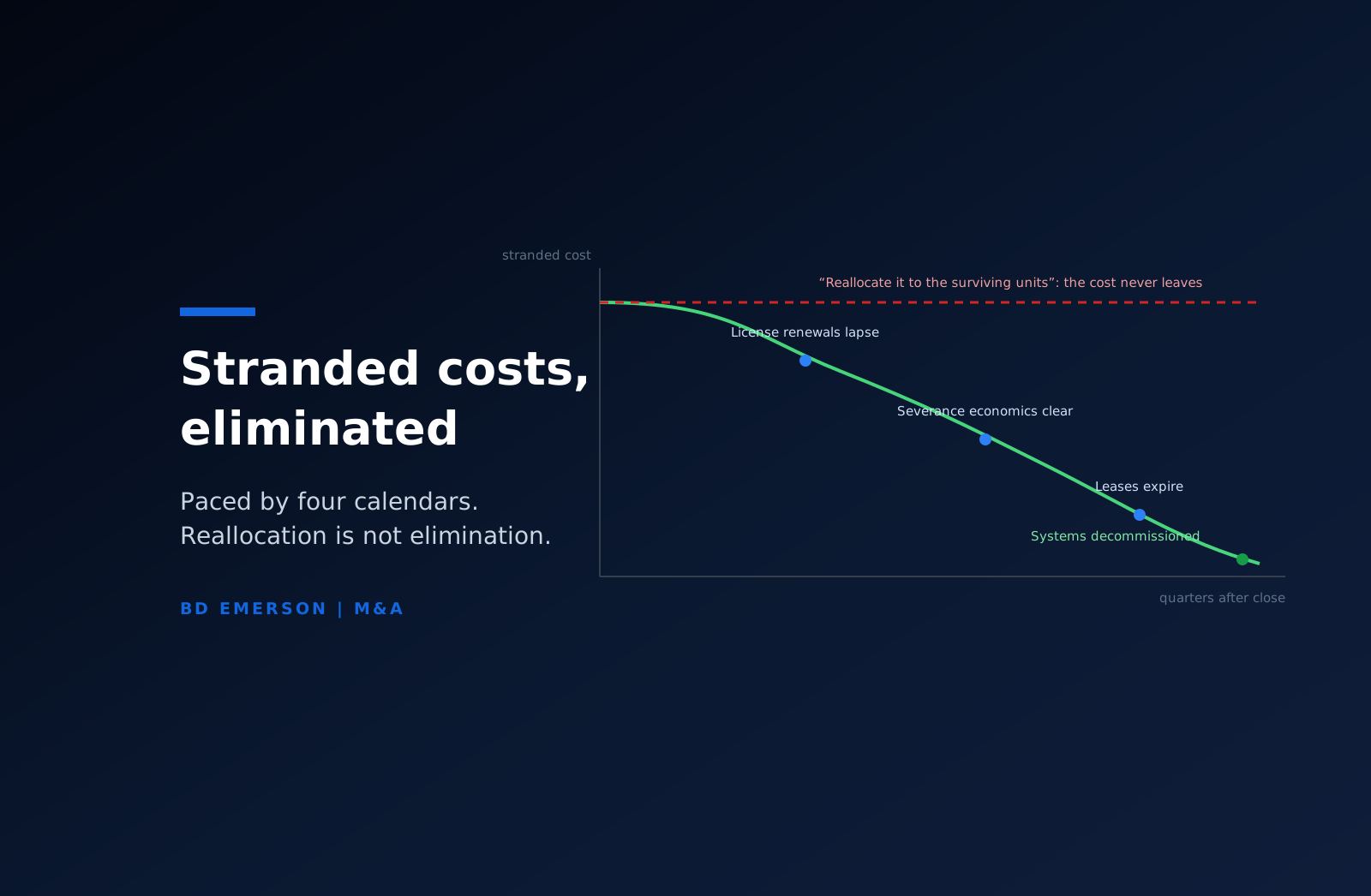
Stranded cost does not come out on a straight line, and a plan that assumes it will is a plan to miss. The pace is set by four calendars, none of which the program controls.
Lease expiries and break clauses govern facilities: nothing accelerates them except paying to exit early, which usually costs more than waiting, so the property line of the curve is simply the lease schedule read forward. License renewal dates govern software: mid-term reductions are rare, so the savings arrive at each renewal, and the negotiating position is strongest when the renewal calendar was mapped at signing. Severance economics govern headcount: notice periods and works council processes set the earliest dates, and the cash cost of a reduction lands one to two quarters before the savings do, which the program's cash forecast has to show plainly. System decommissioning governs the IT estate: a platform cannot be switched off until its last dependent user has migrated and its data has been archived to whatever retention the regulator requires, so the decommissioning line trails the migration plan by design.
Laid against those four calendars, a realistic curve removes 10 to 20 percent of the total in the first six months, the spend that stops by decision alone, takes out the bulk across months 6 to 18 as services exit and capacity goes idle, and carries a contract-bound tail to month 36. A steeper curve is available only by buying it: early lease exits, license buyouts, and enhanced severance, each of which trades cash now for run rate later and deserves its own approval.
The reallocation trap
The most common failure is also the quietest: the orphaned cost gets spread across the surviving business units through the next allocation cycle, and the problem disappears from view without getting smaller. Every surviving unit's margin dilutes a little, unit leaders treat the increase as corporate weather they cannot influence, and no line item anywhere says stranded cost, so nothing prompts anyone to eliminate it. The company then runs its next divestiture carrying the last one's overhead, and the layers compound.
The discipline that prevents it is visibility. Hold the stranded cost in a central bucket, unallocated, with the program owner's name on it and a decay target against it, until it is actually eliminated. The bucket is uncomfortable to look at in every monthly review, and that is the point: reallocation makes the cost painless in exactly the way that makes it permanent.
The TSA connection
Transition services revenue complicates all of this in one specific way: while the agreement runs, the buyer's payments partially cover the stranded base, so the seller's income statement understates the exposure until the last service exits and the revenue stops against an unchanged run rate. Designing exit dates, pricing step-downs, and the seller's takeout plan as one calendar is the subject of our guide to TSA exit planning, the companion piece to this article for the TSA-specific angle.
Where BD Emerson fits
We size stranded costs before signing, build the elimination curve against the real lease, renewal, severance, and decommissioning calendars, and run the takeout program alongside the buyer's transition services exits so capacity comes out the month it goes idle. The work sits inside our divestiture consulting practice, and on deals where the separation itself is the harder problem, our carve-out advisory team runs the two programs on one calendar. If a divestiture is heading to the board, the stranded cost number belongs in the paper that approves it.

About the author