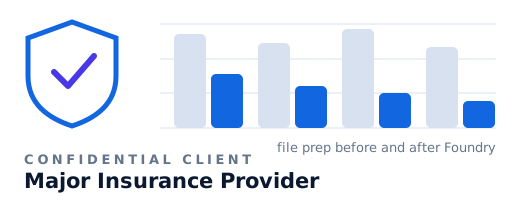



A major insurance provider watched its underwriters spend their expertise on assembly work. Each submission meant gathering broker documents, internal exposure history, and third-party data from separate systems before judgment could even begin, and the assembled picture lived in files that quality review and audit could not easily reconstruct.
BD Emerson rebuilt the underwriting workflow on Palantir Foundry. An ontology modeled the objects underwriting actually reasons about, accounts, submissions, exposures, policies, and losses, and pipelines assembled each incoming submission into a single working file with the supporting data already joined and traceable to its source. Where models assist the process, their use is logged, reviewable, and bounded by the governance the client's regulators expect, and the audit trail assembles itself as underwriters work rather than being reconstructed afterward.
The build started with one line of business and the underwriters who worked it, because a workflow tool that underwriters route around is an expensive way to change nothing. Their corrections shaped the ontology before it scaled to further lines. The client's own team operated the platform before the engagement ended, with the documentation and access model in production shape.
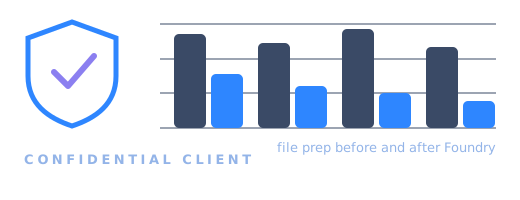
Underwriters now open a complete working file instead of building one, so their time concentrates on risk judgment, which is the work the business actually pays for. File quality is consistent across desks because the assembly is systematic rather than personal. Referrals and reviews move faster because everyone reads from the same picture. And the governance stands up to the scrutiny insurance operates under, with data access and model use logged by design.
Our confidentiality obligations do not allow us to name this client or publish underwriting metrics. The pattern is the one described in our work on Palantir in insurance underwriting, delivered through our Foundry implementation practice, and we are glad to go deeper under NDA.