DPO as a Service Pricing: What Drives the Number
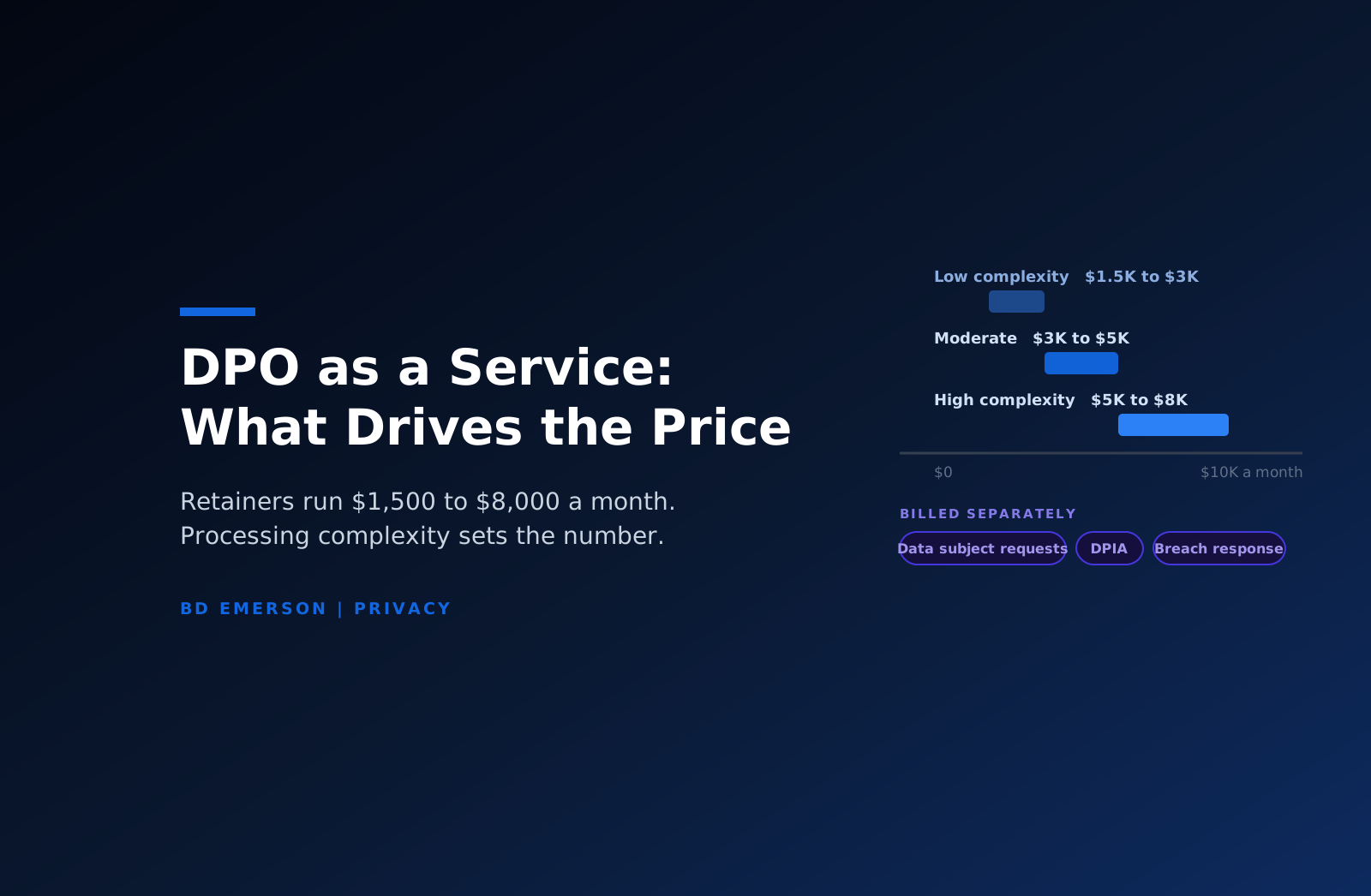
DPO as a service typically costs $1,500 to $8,000 a month, and the number tracks processing complexity far more closely than company size. A single-jurisdiction business with a narrow data footprint and a handful of data subject requests a year sits at $1,500 to $3,000. A company handling special category data, running international transfers, or operating across several EU member states sits at $4,000 to $8,000, and multi-entity groups with high request volume run above that. Set either figure against $140,000 to $230,000 loaded for a qualified full-time DPO and the retainer arithmetic is straightforward for most organizations under roughly 1,000 people. What separates a real engagement from a cheap one is not the hours in the contract. It is what happens when a regulator writes.
What the monthly number is actually buying
A DPO retainer is not a block of consulting hours. It is a statutory role, and Article 39 defines its tasks: informing and advising the organization on its obligations, monitoring compliance, advising on data protection impact assessments, cooperating with the supervisory authority, and acting as the contact point for both regulators and data subjects. A properly built retainer maps onto those duties rather than to a timesheet.
In practice that means a formally designated named individual whose contact details are published and notified to the relevant supervisory authority, a monitored contact channel for data subjects, a review cadence over the record of processing activities and the policy set, a defined advisory allowance of roughly 4 to 12 hours a month for the questions the business raises, oversight of data subject requests up to an agreed volume, one or two training sessions a year, and an annual DPO report to the highest level of management. Article 38 requires the DPO to report to the top, and that annual report is the artifact proving the reporting line exists.
What moves the price
Nine factors explain almost all the variation between quotes. Jurisdiction count comes first, because each supervisory authority means a separate relationship, a separate set of national derogations, and often a separate language. Data type comes second: special category data under Article 9, children's data, and biometrics all raise both the risk profile and the attention the role demands.
Then volume. Data subject request traffic is the single most predictable driver of workload, and there is a wide gap between a company fielding three requests a year and an employer-facing platform fielding 40 a month. Processor count matters similarly: a business with 25 vendors is a different monitoring job from one with 400, especially where sub-processors chain onward. Whether a record of processing activities already exists changes the first six months substantially, because building one from nothing is a project rather than a monitoring task.
The remaining four are international transfers and the assessments they require, sector risk in areas like health, insurance, ad tech, and HR technology, the number of separate legal entities for which the provider becomes DPO of record, commonly adding $500 to $1,500 a month per additional entity, and the response commitments you want written down.
Retainer ranges by processing complexity
- Low complexity, $1,500 to $3,000 a month. One jurisdiction, one legal entity, no special category data, under 10 data subject requests a year, fewer than 50 processors, and an existing record of processing activities. Typical of a B2B software company that appointed voluntarily or was caught by a national headcount rule.
- Moderate complexity, $3,000 to $5,000 a month. Two or three jurisdictions, some special category or employee data at scale, 20 to 60 requests a year, 50 to 150 processors, regular transfers outside the EEA, and two or three impact assessments a year. This is where most mid-market companies land.
- High complexity, $5,000 to $8,000 a month. Several member states with a lead authority determination in play, core-activity processing of special category data, high request volume, 150 or more processors, a large sub-processor chain, and a track record of regulator contact. Health technology, insurance, and consumer platforms sit here.
- Group and enterprise, $8,000 a month and up. Multi-entity structures with per-entity designations, multiple languages, and continuous impact assessment volume. Priced bespoke, usually with a named officer plus a named deputy.
What sits outside the retainer
Any provider whose retainer covers everything is either overpricing the base or planning to under-deliver on the exceptions. Four categories are normally billed separately, and the contract should say so plainly.
Data subject requests above the included threshold price at $150 to $600 each for routine access or deletion, and considerably more when a request requires review of a large mailbox or a litigation-adjacent record set, where $1,500 to $5,000 is realistic. Impact assessments run $3,500 to $12,000 for a full DPIA on a substantial processing activity, with lighter screening assessments at $1,000 to $2,500. Breach response prices hourly at $250 to $500 or against a defined incident retainer, and a notifiable breach affecting several jurisdictions commonly consumes $5,000 to $20,000 in assessment, notification drafting, and filings inside the 72 hour window. Regulator correspondence is the fourth, and it varies most: a routine information request may take four hours, while a formal inquiry or complaint investigation runs 20 to 80 hours across several months.
Two project-shaped items also sit outside: building a record of processing activities from scratch, typically $8,000 to $30,000 depending on entity and system count, and transfer impact assessments at $2,500 to $6,000 each.
The full-time hire comparison
An experienced privacy lead capable of holding the DPO designation costs $110,000 to $180,000 in base salary in US markets and roughly 70,000 to 130,000 euros in most EU markets, which lands at $140,000 to $230,000 loaded once employer taxes, benefits, and equity are counted.
Two things tilt the comparison for companies under about 1,000 people. The first is utilization. At a 150-person company the DPO role is real but intermittent: quiet for six weeks, then intense for ten days when an impact assessment, a customer audit, and two requests arrive together. A retainer with defined surge terms matches that shape better than a salary does. The second is the constraint most boards discover late, which is that the role cannot simply be added to an existing executive's title. Article 38 forbids conflicts of interest, and the people who would be convenient choices, the CISO, the head of IT, the general counsel, are usually the least eligible. When GDPR requires you to appoint a DPO covers the triggers and the conflict rules in detail.
The crossover sits near $8,000 to $10,000 a month of sustained retainer spend, roughly $100,000 to $120,000 a year, particularly when the work has shifted from monitoring to running an internal privacy program day to day. At that point a hire buys more presence for similar money, and a hybrid arrangement often beats both.
Red flags in cheap offerings
The market has products priced at $99 to $400 a month, and what they sell is a company name on a supervisory authority notification with a shared mailbox behind it. That is not a DPO. It is a registration service, and it fails at exactly the moment it is needed.
The tells are consistent. There is no named individual, or the named individual will not say how many appointments they hold; past 25 to 40 concurrent designations, attention is nominal by arithmetic alone. There is no response commitment, which matters because the one month statutory clock on data subject requests starts when the request arrives, not when the provider gets to it. The contract contains no independence language, even though Article 38 requires that the DPO receive no instructions on how to perform the role and report to the highest management level; a designation buried in a procurement contract with a deliverables schedule is fragile if a regulator examines it. There is no named deputy, so a two week absence leaves the statutory contact point unstaffed. Records including the processing register, the DPIA register, the request log, and the breach log sit in the provider's own system with no documented handover, which means changing providers costs you your compliance history. And the provider will not commit in writing to attending a supervisory authority meeting, which is the plainest test of all.
Questions that produce an accurate quote
A provider who quotes before asking these is guessing. How many legal entities need a designation, and which supervisory authority is the lead. How many data subject requests arrived in the last 12 months, and how many were complex. Is special category or children's data part of a core activity. How many processors and sub-processors are in the chain. Does a record of processing activities exist, and when was it last reviewed. How many impact assessments are expected in the next year. Six questions and roughly 45 minutes produces a number that will hold, and a provider who skips them will reprice later.
Where BD Emerson fits
Our DPO as a service engagements are built around a named officer, a named deputy, a written response commitment, and Article 38 independence language in the contract rather than in the marketing copy. The virtual data protection officer model extends the same designation to distributed and multi-entity groups where the officer needs to be reachable from every establishment. If the ongoing role turns out to be smaller than the immediate cleanup, our data privacy consulting practice handles the processing register build, the transfer assessments, and the policy set first, which reliably lowers the retainer that follows.

About the author