AuditBoard vs Workiva: Which Fits Your Audit and SOX Program?
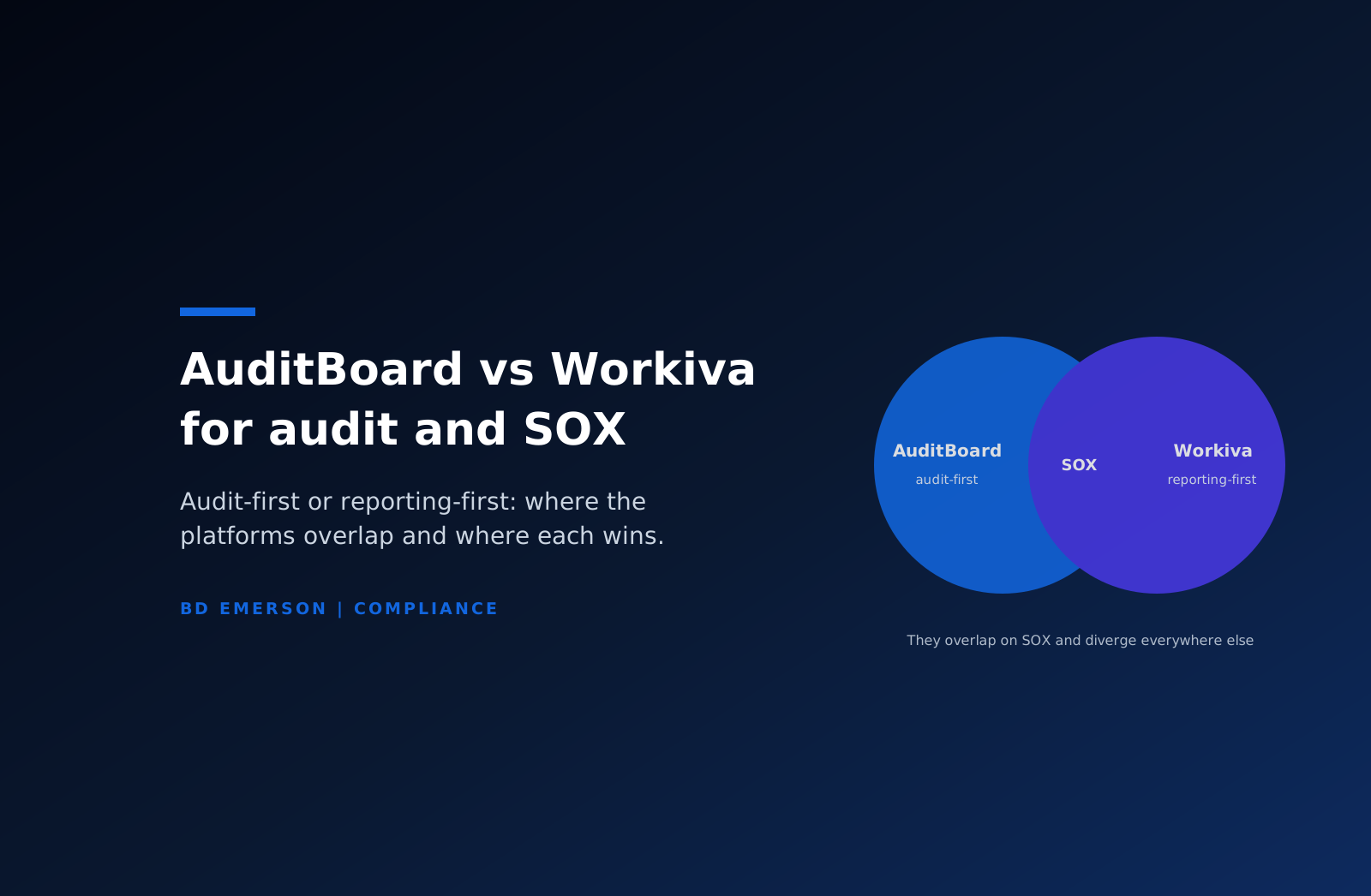
Choose AuditBoard when internal audit or SOX testing owns the platform: its core is workpapers, the risk-control matrix, fieldwork, and issue tracking, and it was built by auditors for that work. Choose Workiva when SEC reporting owns it: its core is the 10-K, XBRL tagging, and connected documents where a number changed once updates everywhere it appears. Both platforms run SOX programs, which is why the comparison comes up at all. The honest tiebreaker is organizational: the team that lives in the tool every day should pick it, because the losing team will keep its spreadsheets either way. One naming note before the detail: AuditBoard rebranded to Optro in March 2026, and the platform, modules, and contracts carried over unchanged. Most buyers still search and negotiate under the AuditBoard name, so this article uses it.
What each platform is for
AuditBoard started as SOXHUB in 2014, a SOX controls tool built by former Big Four auditors, and grew outward into a connected risk platform: internal audit management, SOX compliance, enterprise risk, IT and infosec compliance, third-party risk, and ESG. More than half of the Fortune 500 uses it. The center of gravity never moved, though. The product assumes your unit of work is an audit or a control test, and everything else (risk assessments, issues, reporting) hangs off that.
Workiva started in 2008 as WebFilings, a cloud tool for SEC filings, and grew into a connected reporting platform: 10-K and 10-Q preparation, XBRL, SOX documentation, ESG and sustainability disclosure, and management reporting. Its center of gravity is the document. The product assumes your unit of work is a filing or a report with numbers that must tie across hundreds of pages, and it solves that better than anything else on the market.
Where AuditBoard wins
Internal audit teams pick AuditBoard for the audit lifecycle: risk assessment feeding the audit plan, engagements with workpapers and review notes, time tracking, issue tracking with remediation owners, and audit committee reporting drawn from live fieldwork. The workpaper experience matters most in practice. Sign-offs, versioning, and reviewer workflows behave the way audit methodology expects, so a team migrating from TeamMate or from folders of Excel files recognizes the shape of its own work.
For SOX specifically, AuditBoard handles scoping, the risk-control matrix, test plans, sampling, evidence requests to control owners, deficiency evaluation, and certification workflows. Control owners interact with clean, bounded requests rather than the whole platform, which is most of why adoption sticks. If your SOX program is run by internal audit and your external auditor tests your work rather than your filings, this is the natural fit.
Where Workiva wins
Workiva wins wherever the output is a governed document. SEC reporting teams use it because the 10-K, the earnings release, and the board deck pull from the same linked data, and a late journal entry updates all of them at once. XBRL tagging is native rather than outsourced. For ESG and sustainability disclosure under frameworks like GRI, SASB, and the European CSRD, the same connected-document model applies, which is why reporting teams that already file in Workiva usually extend it to ESG rather than buying another tool.
Workiva's SOX offering is real, and for some buyers it is the right answer. Its strength is the connection between SOX documentation and the financial statements themselves: controls map to disclosure line items, and the SOX program lives one link away from the filing it protects. Companies where the controller or SEC reporting team owns SOX, especially those already paying for Workiva, often standardize there and avoid a second platform.
The SOX overlap
Both platforms will scope controls, manage test plans, collect evidence, track deficiencies, and produce certifications. Neither is a bad SOX tool. The differences show at the edges. AuditBoard is stronger at fieldwork mechanics: sampling, testing workflows, reviewer sign-off chains, and reusing the same RCM for internal audit and SOX work. Workiva is stronger at the reporting end: tying control documentation to disclosures and keeping SOX evidence adjacent to the filing process. Plenty of large companies run both, with Workiva for external reporting and AuditBoard for audit and SOX execution, and accept the integration seam between them.
One practical test cuts through vendor demos: ask each team to run one real engagement in the tool during evaluation. Have internal audit execute a small audit in AuditBoard, planning through issue closure, and have the reporting team build one quarterly document in Workiva. The friction each team reports predicts adoption far better than a feature matrix, because both platforms demo well and neither fails on paper.
Pricing model differences
Neither vendor publishes prices. Both sell custom annual subscriptions, and both price on modules and users, but the shapes differ.
AuditBoard prices by module (audit management, SOX, risk, compliance, third-party risk, ESG), tier, and named users. Independent purchasing data puts the median contract near $46,000 per year, with most contracts falling between roughly $21,000 and $150,000 depending on module count and scale. Implementation services typically add 10 to 25 percent to the first year, and renewal escalators of 3 to 7 percent are common. We break the full economics down in how much AuditBoard costs.
Workiva prices by solution (SEC reporting, SOX, ESG, and others), workspaces, and users, and its anchor buyer is a public company with a reporting calendar, which shows in the pricing. Entry points for a single solution commonly sit in the mid five figures, and multi-solution enterprise contracts reach into the mid six figures. For a private company that only needs audit and SOX workflows, Workiva usually quotes higher than AuditBoard for equivalent scope. For a public company already licensing Workiva for SEC reporting, adding SOX is incremental, which changes the math entirely.
Two budgeting notes apply to both vendors. First-year cost exceeds renewal in both cases, because implementation, migration, and training land up front. And both contracts carry annual escalators, commonly 3 to 7 percent, that should be capped in writing at signing rather than discovered at renewal.
Integration and adoption realities
AuditBoard deployments for core audit and SOX modules typically run 8 to 16 weeks, driven by how messy the workpaper and RCM migration is and how many integrations you wire: ERP, HRIS, identity provider, and ticketing. The recurring failure mode is treating it as an IT install. The platform is only as good as the control language and mappings loaded into it, and a rushed migration reproduces the old spreadsheet chaos inside newer software.
Workiva implementations center on document setup and data linking: chart-of-accounts mapping, tying the trial balance to the filing, and building the linked document set. Reporting teams adopt it readily because it removes their worst manual work. The adoption risk sits with people outside the reporting team, such as control owners and process auditors, who touch it rarely and find a document-first interface less natural for testing work.
Data residency and audit trail requirements deserve a look in either direction. Both platforms are SOC 2 audited, sell SSO and role-based access as standard at enterprise tiers, and hold up under vendor risk review. The differentiator is rarely security posture; it is whether the workflows match the team, which no security questionnaire will tell you.
A decision framework
Four questions settle most evaluations.
- Who owns the platform day to day? Internal audit or SOX PMO points to AuditBoard. Controller or SEC reporting points to Workiva.
- Are you public? Private companies rarely need Workiva's filing machinery. Public companies already using it for the 10-K should price adding SOX before buying anything else.
- What is the unit of work? Audits and control tests favor AuditBoard. Filings and connected reports favor Workiva.
- Where does the budget sit? The function paying for the platform will shape it in renewal negotiations. Buying against that gravity rarely ends well.
If the answers split, that is normal at large companies, and running both with a defined seam beats forcing either tool to do the other's job.
Where BD Emerson fits
Disclosure first: BD Emerson advises on and implements GRC platforms, including AuditBoard implementation, and we perform audit work of our own, including SOC examinations and ISO 27001 internal audits. We take no resale margin from either vendor, so the recommendation does not move our economics. In evaluations we run, audit-led buyers land on AuditBoard most of the time, reporting-led public companies extend Workiva, and the hard cases are SOX programs caught between a controller and a chief audit executive. If that is where you are, the platform decision is really an operating-model decision, and it is worth an hour with someone who has configured both sides. Our broader platform landscape is in the best GRC software guide.

About the author