TSA Exit Planning: Getting Off the Transition Services Agreement
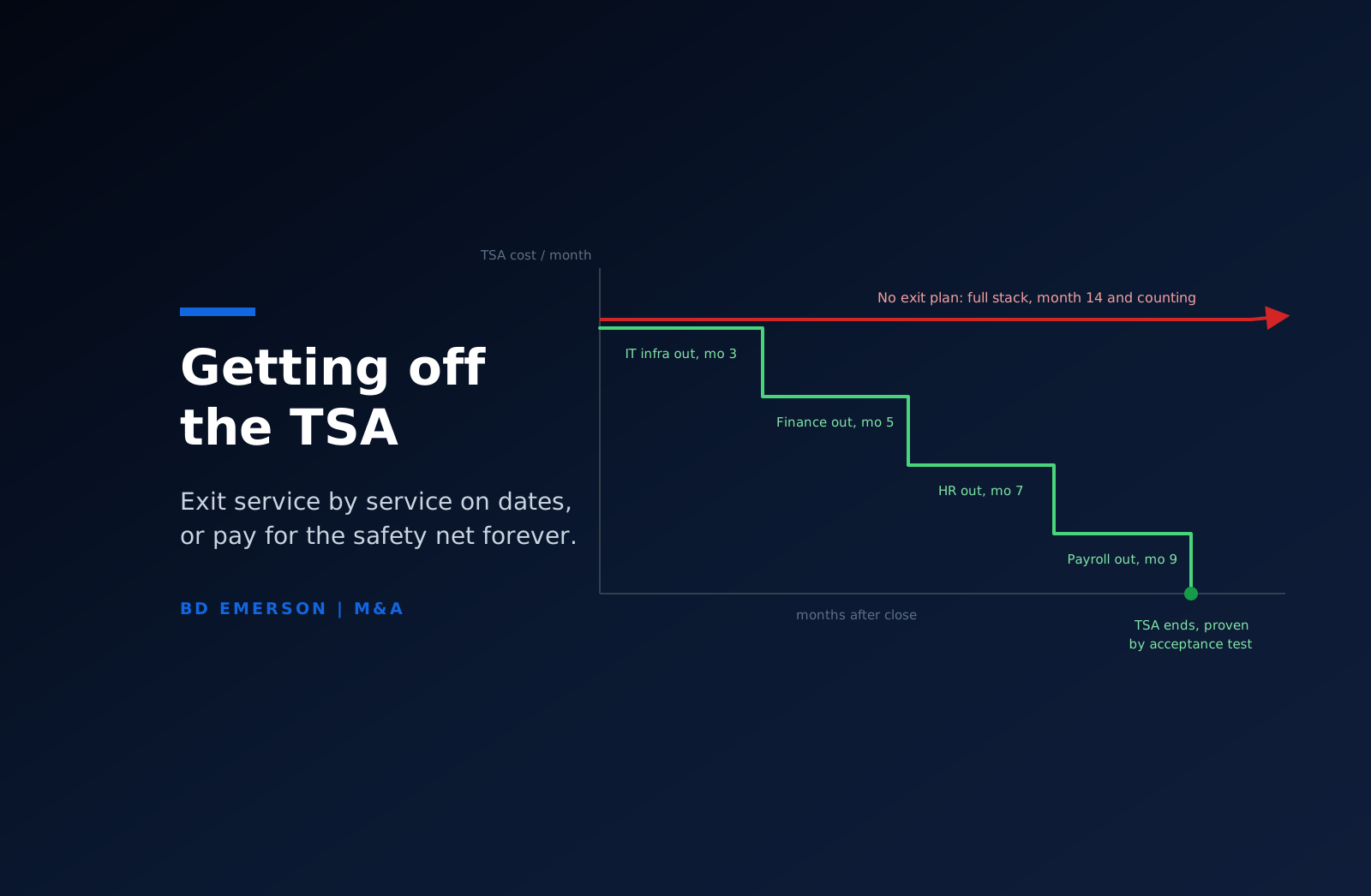
A TSA exit is the work of ending a transition services agreement service by service, so the buyer runs the business on its own systems and the seller stops delivering. It is the part of a carve-out that gets planned last and slips most. The pattern repeats across deals: the agreement is written as a safety net, and by month nine it has become a permanent cost. The seller is still running systems for a business it sold, the buyer never built the capability because the service kept arriving, and both sides are paying for a dependency neither one wants. Exits happen on schedule when the exit is designed before signing, with a date, a price step-down, and an acceptance test attached to every service.
Why TSA exits slip
The incentives at signing point away from a fast exit. The seller wants a clean break but does not want to be blamed for a failed cutover, so it accepts a long term with extension rights. The buyer wants continuity through close and treats the TSA as insurance, so it accepts the same. Neither side has staffed the replacement build yet, and both sign an agreement that assumes someone will.
After close, the pull gets stronger. The buyer's operating team is absorbing a business, and the systems they need to replace are working fine, delivered by someone else's staff, at a price already in the model. Building a payroll function, an ERP instance, or a service desk is disruptive work with no immediate revenue attached, and it competes for attention with integration items that do have revenue attached. On the seller's side, the people who know the systems are the ones being redeployed or losing their roles, so institutional knowledge drains on the same calendar the buyer needs it most.
Then there is the drafting problem. Many TSAs carry a single bundled monthly fee, no acceptance test, and no exit date per service. Under that structure nobody can prove a service is finished, exiting four services out of twelve does not lower the invoice, and there is no contractual moment that forces a decision. The agreement runs until someone renegotiates it, which is exactly the outcome the extension clause was written to avoid.
Design the exit before you sign
Three provisions do most of the work, and all three belong in the schedules rather than the master agreement.
Service-by-service exit dates. Every service gets its own target exit date, derived from the separation plan rather than the closing calendar. Chaining services to a single TSA end date means the fastest exits wait for the slowest one, and a US payroll cutover that could land in month 6 sits idle until a UK entity is ready in month 14. Dated lines create a schedule that a program manager can run.
Escalating pricing that makes staying expensive. Base rate for the initial term, then escalators of 10 to 25 percent at each extension period, applied per service. Pair that with a step-down: when a service terminates, the invoice drops by that service's price. Without the step-down, the buyer captures none of the savings from work its own team performed, and the business case for finishing early disappears. The two clauses together give the buyer's finance function a number that moves every month, which is the most reliable way to keep exit work funded after the deal excitement fades.
An acceptance test per service. Write, before signing, what finished looks like. For payroll that might be two consecutive pay cycles run entirely on the buyer's system with no seller involvement and no exceptions above a stated threshold. For a service desk it might be 30 days of ticket volume handled on the buyer's platform at or above the agreed service level. For an ERP module it might be a clean month-end close in the new instance with reconciliation to the prior period. A defined test makes exit provable. Without one, exit is a negotiation between a seller who wants to stop and a buyer who is not ready, and the extension always wins that argument.
Sequencing the buyer's replacement capability
A TSA exit is a build program with a contractual deadline. Sequencing it well is mostly about respecting dependencies and lead times.
Identity comes first, because almost every other system authenticates against it. A new directory, new accounts, device enrollment, and re-integration of every application that trusted the old tenant have to be in place before applications can move. Network circuits come next in priority order even though they take longest, since carrier lead times of 90 to 180 days sit on the critical path and cannot be compressed with money. Then the transactional systems in order of business risk: payroll, then the general ledger and financial close, then the customer-facing platforms, then the long tail.
Three practices separate programs that finish from programs that extend. Staff the build with dedicated people rather than volunteers from the day job, because a separation run as a side project moves at the speed of everyone's spare capacity. Run parallel operation for one full cycle before cutting over, and price that parallel period into the TSA at signing rather than requesting it later. And start license and contract repapering in month one, since new agreements for the buyer's own software, at the buyer's own volume, take longer to negotiate than most plans allow and are the quiet reason cutover dates move.
What stranded costs are, and who carries them
Stranded costs are the costs that stay with the seller after a divested business leaves, because the underlying commitment does not shrink when the revenue does. The division goes, its share of shared infrastructure and overhead stays, and the TSA revenue that partially covered it stops the day the last service exits. They typically run 20 to 40 percent of the cost that had been allocated to the divested business, and they hit the seller's operating income in full once the TSA ends.
Four categories carry most of the exposure.
- Headcount that does not scale down. Shared services teams in IT, finance, HR, and procurement were sized for both businesses. When one leaves, the work drops by less than the headcount would need to drop to match, and reductions carry severance, notice periods, and works council processes in some jurisdictions.
- Licenses bought at the old volume. Enterprise agreements were priced on a seat count or revenue tier that included the divested business. Most do not shrink mid-term, and the next renewal reprices the remaining company at a worse volume tier.
- Facilities on a lease. Space, data center capacity, and site services committed for years against a headcount that just fell. Subletting takes time and rarely recovers the full rate.
- Shared services overhead allocated to a business that has left. Corporate finance, legal, real estate, and executive costs that were charged out to the division on an allocation formula. The allocation disappears with the division. The cost does not.
Who carries them depends on drafting rather than fairness. The default is the seller, which is why sellers push for TSA rates that recover more than direct cost and for longer minimum terms. Buyers should read minimum-term commitments and termination fees as stranded cost recovery in another form and price them that way. The cleanest approach is to name it: agree what the seller may recover through the TSA rate, agree what it may not, and stop negotiating the same money twice under different labels.
Size the stranded cost before you sign, not after
Most sellers discover their stranded cost when the TSA revenue stops and the run rate does not. Sizing it early is a four-step exercise and takes weeks, not months.
Start from the allocation. Pull what the divested business was charged for shared services and overhead in the last full year, by function. That figure is the ceiling on what leaves. Then test each line for whether the cost is actually variable with the divested business gone. A per-seat license usually is at renewal. A data center lease is not. A shared services team is partly variable, and the honest number depends on how the work is distributed, not on the allocation percentage. Third, lay the reductions against a calendar: contract renewal dates, lease break dates, notice periods for headcount actions. That produces the elimination curve rather than a single number. Fourth, compare that curve to when TSA revenue stops. The gap between the two is the exposure, and it is the number that belongs in the board paper and in the deal model.
The same analysis has a buy-side use. A buyer looking at a carve-out should build the standalone cost model bottom-up, because the seller's allocation is almost always lower than what the business will actually spend to run itself. That gap comes out of the multiple, and it is one of the items our carve-out advisory team quantifies before price is set.
What a realistic elimination timeline looks like
Stranded cost comes out in three waves. The first, roughly months 0 to 6 after close, covers what can be stopped by decision: contractor spend, discretionary programs, open requisitions, and any service the seller can simply cease providing. This is usually 10 to 20 percent of the total and it is the only part that moves quickly.
The second wave, months 6 to 18, runs with the TSA exits themselves. As each service terminates, the capacity behind it becomes surplus and can be removed. This is where most of the reduction lives, and it is why the seller's cost takeout program has to be planned on the same calendar as the buyer's exit plan rather than started when the TSA ends. Headcount actions in this wave carry severance and notice periods, so the cash cost lands before the savings do.
The third wave, months 12 to 36, is governed by contract dates: enterprise agreement renewals, lease breaks, and data center commitments. Nothing accelerates these except paying to exit early, which usually costs more than waiting.
The practical implication is that a seller who starts cost takeout when the TSA ends is 12 to 24 months behind, carrying a full year or more of cost for a business it no longer owns. Sellers who avoid the write-down run three programs in parallel: the buyer's exit plan, their own separation of the retained estate, and the cost takeout tied to the same milestones. The same discipline applied to the technology estate is covered in our guide to the IT carve-out.
Where BD Emerson fits
We run TSA exit programs on both sides of the deal through our transition services agreement advisory practice: exit dates and acceptance tests built into the schedules before signing, replacement capability sequenced against real lead times, stranded cost sized and put on a calendar, and a monthly view of which services have exited and what the invoice should now be. If a TSA is already signed and drifting, the first step is an audit of the schedules against actual delivery, because the gap between the two is where the extension conversation is heading. The mechanics of the agreement itself are covered in our transition services agreement guide.

About the author