Top Digital Transformation Consulting Firms in 2026
The best digital transformation consulting firm for you depends on whether you are buying strategy, delivery, or both, and at what scale. The global integrators, Accenture and Deloitte Digital, win on breadth and staffing depth. The strategy houses, McKinsey and BCG X, win when the transformation question is really a business model question. The engineering-led firms, EPAM and Thoughtworks, win when the transformation is mostly software that has to ship. And focused firms, including ours, win when you want senior people on the actual work and an outcome measured in production systems rather than roadmaps. This guide ranks the field for 2026 on that basis. One disclosure up front: BD Emerson appears on this list, this is our site, and we have marked our entry accordingly.
How we ranked them
Four criteria, weighted toward evidence over brand. Delivery versus decks: does the firm's transformation work end in running systems, or in a strategy the client still has to build? Bench reality: who shows up after the partner sells the work, and how far is the drop from the pitch team to the delivery team? Technology depth: can the firm do the data, platform, and AI engineering that transformations now run on, or does it subcontract the hard parts? Incentive structure: does the firm profit from headcount and duration, or from finishing? Every firm below clears a competence bar. The differences are in shape, price, and what they optimize for.
1. Accenture
The largest transformation delivery machine in the world, with roughly 750,000 people and partnerships with every major platform vendor. Accenture's strength is industrialized delivery at a scale nobody else can match: if the program needs 400 people across four continents with SAP, Salesforce, and cloud migration workstreams running in parallel, this is the short answer. The watch-outs are cost, the distance between the deal team and the delivery bench, and a partnership model that earns on the platforms it recommends. Best for global enterprises running multi-year, multi-platform programs where scale risk outweighs cost.
2. Deloitte Digital
Deloitte pairs the transformation practice with the deepest tax, risk, and audit-adjacent capability in the field, which matters in regulated industries where the transformation has to survive examiners as well as users. Strong in healthcare, financial services, and government. The same caveats as any Big Four practice apply: variable delivery quality between offices, and pyramids staffed with juniors at senior prices. Best for regulated enterprises that need transformation and compliance credibility in one contract.
3. McKinsey & Company
McKinsey remains the default when the board needs conviction that the transformation is the right one before funding it. QuantumBlack gives it real data science muscle, and its operating model work is the strongest in the field. It remains a strategy firm at heart: implementation happens through ecosystem partners or client teams more often than through McKinsey's own builders. Best for CEOs who need the case for change made rigorously, with delivery sourced separately.
4. BCG X
BCG's build unit combines strategy consultants with about 3,000 engineers, designers, and data scientists, and it will co-build products and platforms rather than just specify them. Its AI transformation work is credible and its venture-build track record is real. Pricing sits at the top of the market, and engagements skew toward flagship initiatives rather than the unglamorous middle of a systems consolidation. Best for companies where the transformation centers on new digital products or AI capability the market has not seen yet.
5. EPAM
An engineering firm first, with over 55,000 technologists and roots in product development for software companies. EPAM wins when the transformation is, at bottom, a large amount of high-quality software and data engineering, and its rates undercut the strategy houses meaningfully. It expects the client to bring the strategy and the change management, or to buy them elsewhere. Best for organizations with clear direction that need serious engineering throughput.
6. Slalom
Slalom's model is local: roughly 13,000 people organized in city-based offices who work on site with mid-market and enterprise clients, with strong AWS, Salesforce, and Snowflake practices. Clients consistently cite the working relationship as the differentiator. Its ceiling shows on globally distributed programs, where the local model that is its strength becomes a coordination cost. Best for mid-market and regional enterprise transformations where proximity and cultural fit matter.
7. Thoughtworks
The firm that popularized much of modern software delivery practice, from CI/CD to evolutionary architecture. Thoughtworks transformations are engineering-culture transformations: platform modernization, developer experience, and data mesh work with strong opinions attached. It is smaller than the integrators and priced above the offshore-heavy alternatives. Best for organizations whose transformation blocker is engineering capability and culture rather than strategy.
8. Publicis Sapient
The digital business transformation arm of Publicis, strongest where customer experience and commerce drive the program. Deep retail, financial services, and travel credentials, and real engineering capacity behind the experience layer. Less suited to back-office and core-systems-heavy programs. Best for consumer-facing enterprises where revenue-side experience is the transformation.
9. West Monroe
A functional-and-industry matrix firm of about 2,000 people with a strong private equity practice, and a track record in the mid-market that the global firms price out of. Its operational technology and utilities work stands out. Bench depth on emerging AI engineering is thinner than the engineering-led firms above. Best for PE-backed and mid-market companies that want integrated operations and technology work.
10. BD Emerson (disclosure: this is us)
BD Emerson is a boutique consultancy whose transformation work runs from strategy through implementation: data platforms, enterprise AI deployment, legacy modernization, and the governance and security work that lets regulated businesses actually ship. Engagements are staffed with senior practitioners, the firm holds no reseller incentives on the platforms it recommends, and the deliverable is a running system with the client's team trained to own it. We are the right call for mid-market and enterprise clients who want the transformation done rather than perpetually planned, and the wrong call for a program that needs 400 consultants on the ground Monday. Our digital transformation practice page describes the model, and our work on why AI pilots stall shows how we think about the delivery gap this list keeps circling.
What the engagements cost in 2026
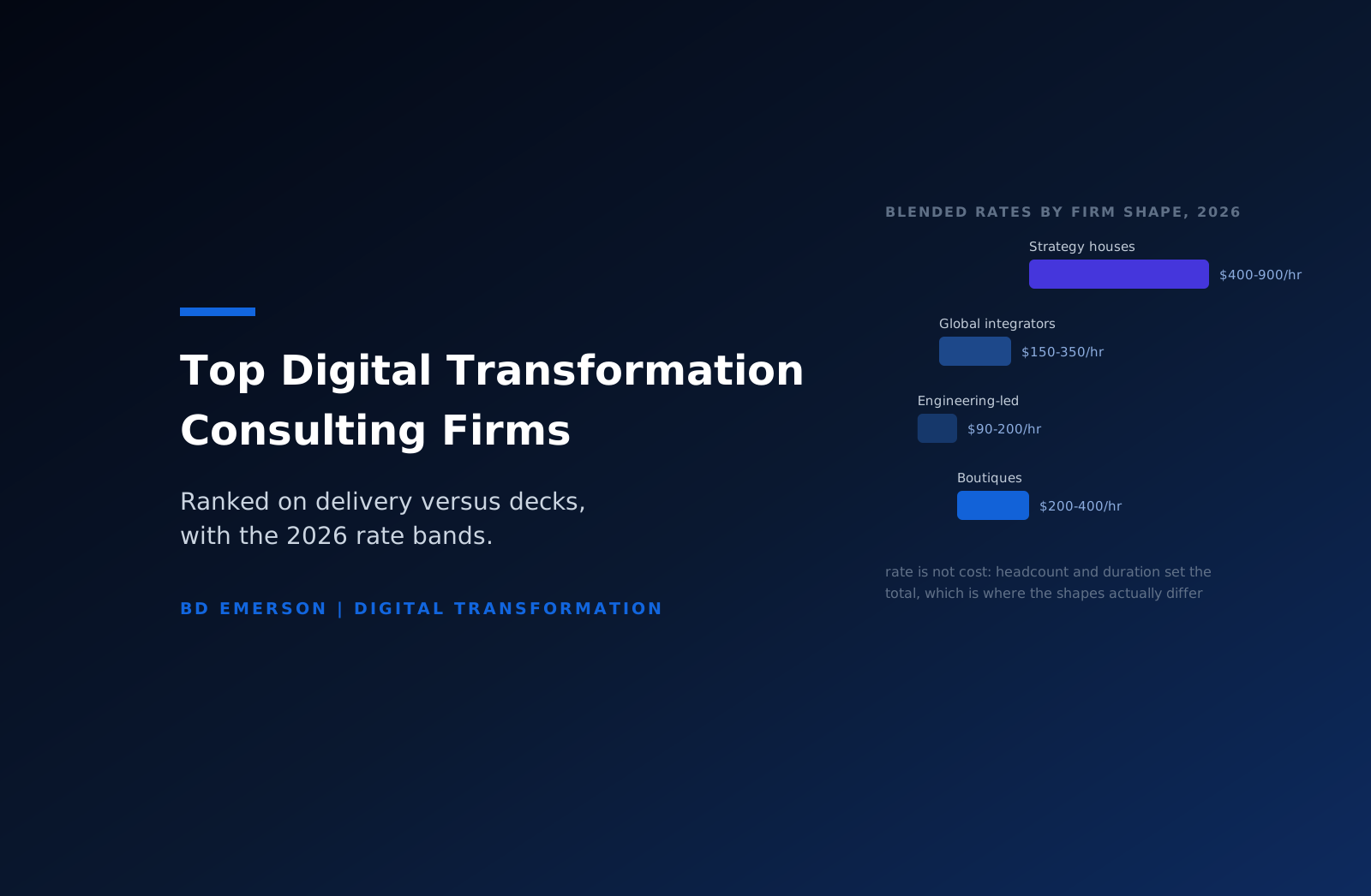
Rates vary more by firm shape than by geography. Strategy-house transformation work runs 400 to 900 dollars per hour blended, and a strategy phase alone commonly lands between 500,000 and 2 million dollars before anything is built. Global integrator delivery blends lower, 150 to 350 dollars per hour depending on the offshore mix, but programs run long and headcount-heavy, so nine-figure multi-year totals are normal at enterprise scale. Engineering-led firms typically blend 90 to 200 dollars per hour with nearshore and offshore delivery. Boutiques with senior-only staffing usually sit between 200 and 400 dollars per hour with a fraction of the headcount, which is why their program totals often come in below integrator estimates even at higher rates. Those are market ranges, and the spread inside each band is driven by industry, urgency, and how much of the work is fixed-fee. The more useful comparison than rate cards is cost to outcome: ask each finalist to price the first production milestone, not the first phase of discovery.
Watch the commercial structure as closely as the rate. Time-and-materials with no milestone gates pays a firm to be present rather than to finish. The healthier patterns are fixed-fee phases tied to running-system milestones, or T&M with a named senior team and a cap. And ask directly about platform incentives: a firm earning resale margin or partner rebates on the software it recommends is not giving you neutral advice, whatever the slide says.
How to choose from this list
Match the firm to the binding constraint, not the brand. If your constraint is conviction at the board level, start with the strategy houses. If it is delivery capacity at global scale, the integrators. If it is engineering quality, EPAM or Thoughtworks. If it is senior attention, honest platform advice, and a bill that matches the mid-market, talk to a boutique, ours or another. Two adjacent lists may help narrow the field: our guide to the top technology consulting firms covers the broader technology services market, and the best change management consulting firms covers the people side that decides whether any of this sticks. Whoever you shortlist, ask each firm the same question: show me the last transformation you finished, what it cost against the original estimate, and who on that team will be on mine. The answers separate this list faster than any ranking can.

About the author