What Is a Fractional CTO? A Close Look at the Role and Its Impact
There is a point in a company's life when the technology decisions outgrow the people making them. The architecture choice that will be expensive to reverse. The first senior engineering hire. The security questionnaire from a customer who will not sign without answers. The diligence request from an investor who wants the technical story behind the numbers. Not one of these, on its own, justifies a full-time chief technology officer. Every one of them goes better with someone in the room who has made that kind of call before.
That gap is what the fractional CTO market sells into, and the label has stretched to cover very different arrangements. The same two words get used for a part-time executive on a standing engagement, a temporary replacement covering a departure, a consultant delivering a fixed project, and a name on a marketplace listing. The differences are not academic. They decide who owns technical decisions, what you can hold the person to, and what is left behind when the engagement ends.
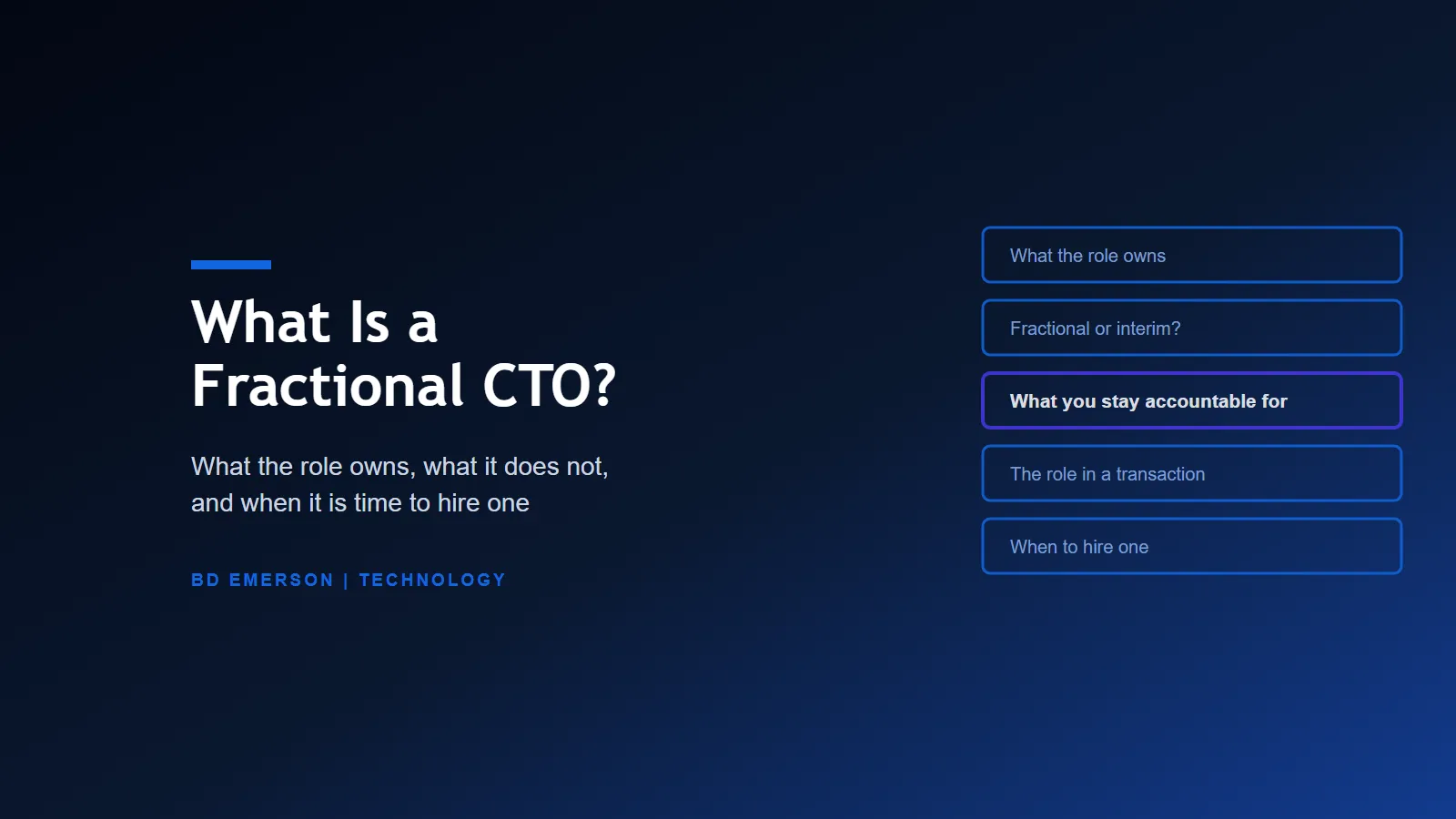
This guide sets out what a fractional CTO is, what the role owns and what it does not, how it differs from an interim or part-time CTO, where it changes the outcome, what it costs, and the signals that say it is time to hire one. It also covers the part vendor pages tend to leave out: the obligations that stay with you no matter who holds the title.
Key takeaways
- A fractional CTO is an ongoing arrangement, not a gap-filler. The role gives you senior technical leadership for a share of a week, held for as long as your stage justifies it, which is the opposite of an interim hire brought in to be replaced.
- The title carries no standard, so the scope is whatever the contract says. Nothing certifies the role and nothing defines it, and the cadences firms advertise disagree with each other, so read the engagement rather than the label.
- Decision authority matters more than day count. A fractional CTO who cannot say no to a shipping deadline will underperform at any number of days a month, and it is the check worth running before you price anything.
- Accountability does not transfer with the title. NIST CSF 2.0 puts responsibility and accountability for cybersecurity risk on organizational leadership, so a fractional CTO performs the work while your board still answers for it.
- Compare loaded cost against loaded cost, over three years. A full-time CTO carries recruiting, benefits, vacancy, and turnover on top of base pay, and a fractional engagement carries none of those, so a comparison built on base pay alone is missing line items rather than measuring them.
What a fractional CTO is
A fractional CTO is a chief technology officer retained for a share of a week rather than a full-time seat, holding the same decisions the role always holds: technical direction, architecture, engineering hiring, and what the board hears about technology. You will see the title written out as fractional chief technology officer, and shortened to fCTO.
The word carrying the weight there is retained. A fractional CTO is not filling a seat until you find someone permanent. The arrangement is meant to last, resized as the company changes and held for as long as the stage justifies it. That is where the confusion with interim leadership starts, and we separate the two below.
What the label does not settle
No body certifies the title and no framework defines the scope, so two offers using the same two words can describe very different arrangements. Three things vary with nothing to anchor them:
- How much time. Among the firms we reviewed, the advertised cadence runs from about one day a week to four.
- Whether there is a floor. Some attach a minimum term and some do not.
- What the role may decide. Nothing in the label separates an executive with a mandate from an advisor with an opinion, and that is the difference that decides whether the engagement produces outcomes.
Read what a specific offer commits to rather than assuming the label carries a fixed meaning.
In our own fractional CTO engagements the role covers strategy and execution together: hands-on management alongside technical guidance, with both held against what the business is actually trying to do. We fit the shape to the company rather than to a fixed cadence, whether that means part-time, full-time, or scoped to a project.
The companies that use the model are the ones that need executive technical judgment more often than they need an executive. It gives small and mid-sized companies access to senior technical leadership without hiring at that level, and it supports them through transitions where technical direction would otherwise be thin.
What a fractional CTO actually does
The work is executive work. A fractional CTO sets technical direction, makes the calls that are expensive to reverse, and reports on both to the people funding them. What that turns into week to week depends on the company, but the responsibilities cluster into a fairly consistent set.
What the role owns
These are the areas a fractional CTO should be accountable for, and the ones worth naming explicitly in the engagement:
- Technology strategy. What to build, what to buy, what to stop, and in what order. This is where the role earns its keep, because sequencing decisions compound.
- Architecture and the expensive decisions. Platform choices, data model, integration approach, and the calls whose cost shows up two years later rather than this quarter.
- The technology roadmap. A plan that ties technical work to business milestones, with the tradeoffs made visible rather than buried. We build this as a distinct deliverable, sequencing the work against the goals and measures set in the strategy.
- Engineering hiring and team shape. Who to hire, in what order, at what level, and how the team is structured as it grows. Hiring in the wrong order is expensive to correct, because the second hire has to work around the first.
- Delivery and engineering practice. Whether work ships predictably: process, testing, release discipline, and the operational hygiene that decides whether the team can move quickly without breaking things.
- Security and technical risk. Assessing exposure, deciding what to remediate and when, and making sure security is part of architecture rather than something bolted on afterward. Our CTOs take a holistic view here, running regular security assessments and compliance checks and helping teams build continuity plans.
- Vendors and spend. Selecting suppliers, negotiating contracts, holding them to service levels, and making sure the company gets value from what it buys.
- Reporting to the board and investors. Translating technical reality into the terms a board can act on, and answering the technical questions that arrive during fundraising.
What the role does not own
The limits matter as much as the scope, and only one of the seven guides we reviewed discusses them at all. A fractional CTO is not a team. Direction without execution capacity produces a roadmap nobody delivers, so if there is no engineering team, hiring one is the first item on the plan rather than an assumption behind it.
The role is also not a substitute for a hands-on engineer. Whether a given fractional CTO writes code is something to establish rather than assume, and expecting an executive engagement to also cover implementation is the fastest way to get neither. In the same way, a fractional CTO is not an IT support function. Where the need is really day-to-day systems administration and helpdesk, the honest answer is a different service, and we would point you toward virtual CIO services rather than sell the wrong seat.
Finally, the role does not carry your accountability. That deserves its own chapter, and it gets one below.
Fractional, interim, part-time, or outsourced: which one you are hiring
Three of the seven guides we reviewed draw the line between fractional and interim, and two more compare fractional against agencies and other options without mentioning interim at all. The distinction is worth drawing properly, because the labels imply different commitments.
- Fractional CTO. Ongoing and part-time. The engagement is designed to continue, scaling up or down as needs change, and it can run for years. Nobody is waiting for it to end.
- Interim CTO. Temporary and usually full-time. You bring one in when a CTO leaves abruptly and you need continuity while you recruit. The engagement exists in order to be replaced, and it ends when the permanent hire starts.
- Part-time CTO. Describes hours, not permanence. It is sometimes used as a plain synonym for fractional, which is fine, but on its own it tells you nothing about whether the arrangement is meant to last.
- Outsourced CTO, CTO as a service, or virtual CTO. These describe delivery rather than tenure, and they are used loosely enough that the label settles nothing. Treat them as a prompt to ask one question: is a firm standing behind the named person, or is the named person the whole arrangement? We offer the role under both fractional CTO and virtual CTO labels, so ask us the same question you would ask anyone else.
- Freelance CTO. An individual contracting directly, with no firm behind them. Often excellent, and worth understanding as a continuity question rather than a quality one, since there is no bench if that person becomes unavailable.
The mistake worth avoiding is hiring interim when you need fractional. A company that brings in a temporary full-time CTO while telling itself it will find a permanent one soon can spend months paying for a caretaker who holds the status quo, when what it actually needed was a smaller, standing commitment from someone building toward something.
The practical test cuts through the vocabulary. Ask whether the arrangement is designed to end. If the answer is yes and it ends when you hire someone, that is interim. If the answer is that it continues and resizes as you grow, that is fractional, whatever the page calls it.
Fractional CTO vs a full-time CTO
A full-time CTO is the right answer once the technology function is large enough and central enough to need someone in it every day. Before that point, a full-time hire buys capacity you are not using, at a price that includes everything a permanent executive costs rather than only what they are paid.
One thing worth naming before the table gets read the wrong way: a fractional engagement is not a junior version of the full-time role. Because you are buying a share of a week rather than a salary, the seniority you can reach is usually higher than the seniority you could afford to employ. That is the trade the model actually offers, and it is the opposite of what the word fractional suggests.
The two right-hand columns are there because the comparison does not always run CTO against CTO. An agency and a VP of engineering both fail as substitutes in the same way: they answer the question of who builds it, not the question of what gets built and what gets retired. Buying delivery capacity to fill a leadership gap is an expensive mistake, and it is worth being clear about which of the two you are actually short of before committing to either.
Where a fractional CTO changes the outcome
The benefit that gets sold is cost. The benefits that actually show up are about judgment arriving earlier than it otherwise would.
- Decisions get made on time. The cost of an absent technical executive is rarely a wrong decision. It is a decision deferred, then made under deadline pressure by whoever is available. A standing engagement puts a deadline on the deferral.
- Technology gets pointed at the business. The value of the role is high-level guidance on using technology to meet business objectives and keep scaling, which is a different exercise from picking tools. Our business-IT alignment guide sets out how that connection is made concrete.
- Things ship faster because someone is unblocking them. Rapid implementation of technology initiatives, hardened security infrastructure, and managed technical risk are what let a team respond to market changes rather than react to them.
- Spend gets managed by someone who knows what things cost. Vendor relationships, contract negotiation, and value from the tools you already pay for are ordinary parts of the role, and they are where an engagement often pays for itself first.
- Technical debt stops accumulating silently. Someone senior is looking at the tradeoffs being made and deciding which ones to accept deliberately. Our guide to managing technical debt covers the difference between debt taken on purpose and debt that just happened.
- An outside perspective arrives with the person. Patterns from other companies, including the failures, are worth more at a decision point than at a retrospective.
There is a limit worth stating plainly, because vendor pages tend not to. A fractional CTO changes outcomes only where the role has authority. Someone who reports three levels down, controls no budget, and learns about architecture decisions after they ship will be ineffective at any number of days a month. Before pricing the engagement, check whether the person you hire will be able to say no to a shipping deadline. If not, the money question is premature.
Who owns what, and what does not transfer
This is the part that vendor pages leave out and that boards, auditors, and acquirers do not. Hiring a fractional CTO changes who performs the work. It does not change who answers for it.
NIST's Cybersecurity Framework 2.0 is explicit about it, holding that "organizational leadership is responsible and accountable for cybersecurity risk" (GV.RR-01), and asks that "roles, responsibilities, and authorities related to cybersecurity risk management are established, communicated, understood, and enforced" (GV.RR-02). The second half of that is the practical instruction: write down who does what, and make it stick. Bringing in an outside executive satisfies the framework only if the split is documented and real.
The matrix below is the version worth filling in before an engagement starts, not after.
If a row in your own version has two owners, or none, the engagement is not scoped yet. Three rows are worth settling before any of the others: who may approve an architecture decision without escalating, who accepts a security risk that is not going to be fixed this quarter, and who speaks for technology to the board.
The fractional CTO in a transaction
Guides to this role tend to stop at operations, and only one of the seven we reviewed gives transactions a chapter of its own. The role shows up there too, and that is where an engagement often pays for itself in a single quarter.
The work takes a different shape at each stage of a deal.
- Selling, or raising. A company preparing for a raise or an exit gets examined by people looking for reasons to adjust the price. Technology due diligence looks at architecture and scalability, the engineering organization and its delivery velocity, technical debt, security posture, IP and open-source hygiene, and the IT cost structure. Someone who has sat on the other side of that review knows what a data room needs to contain, and what a buyer finds when it does not.
- Buying. The same review runs in the other direction, feeding valuation and the integration plan rather than the asking price.
- After close. Systems have to be combined against a transition services agreement clock, and the decisions get made in the first weeks whether or not anyone senior is available to make them. This is where a portfolio company most often needs experience in the seat without adding a permanent executive to a business that is about to change again.
Two of those stages have their own guides. The technology due diligence red flags that kill deals covers the findings that turn into price adjustments, and the first on that list is key-person concentration, which is its own argument for technical leadership that is documented rather than resident in one founder's head. For the work after signing, our post-merger IT integration playbook sets out the sequence. If you are choosing who should run the review itself, we assess providers, ourselves included, in our comparison of the best technical due diligence firms.
This is the one case where the arrangement is bounded by an event rather than by a stage. Everywhere else in this article a fractional engagement continues until the company outgrows it; a transaction gives it a horizon, and that horizon belongs in the contract rather than in an assumption.
Preparing for a transaction, or working through one? See what our technology due diligence engagements examine, buy-side and sell-side.
When to hire a fractional CTO
Company size is a poor proxy. Two companies with the same headcount can have completely different technical exposure. Judge by what is actually happening.
Signals that you need a fractional CTO
These are the patterns that say the decision is already overdue:
- Technical decisions are being made by whoever is nearest, or deferred until they are forced.
- You are about to spend serious money on a build, a platform, or a migration, and nobody senior has pressure-tested the plan.
- Engineering hiring is coming and the person writing the job description has never held the role being hired.
- A customer, an auditor, or an investor is asking technical questions your team cannot answer in the form they were asked.
- Delivery has slowed and nobody can say why with evidence rather than opinion.
- You are a non-technical founder of a technology company, and you cannot tell whether your developers are making sound decisions, padding estimates, or building something that will not scale.
- Your technical founder is now running the company and no longer has time to run the technology.
- Your lead engineer knows the product better than anyone but has never built a team, managed a budget, or sat in front of a board, and is not ready to be handed the title.
- You are moving from outsourced development to an in-house team, or the other way round, and the decision needs someone who has run both.
- A CTO has left and you are not yet sure whether the replacement should be full-time.
The fit at each company stage
The role fits differently depending on where a company sits, and the fit is worth naming because it changes what you should ask for.
- Pre-product and early startups. The need is to avoid decisions that will be expensive to unwind: the platform, the data model, the first hires, and whether to build at all. A small, standing engagement is usually enough, and the deliverable is a roadmap plus a hiring sequence.
- Post-revenue startups scaling a team. The need shifts to delivery and structure. Someone has to shape the team, install engineering practice, and keep the roadmap honest while the company sells against it.
- Established small and mid-sized companies. The technology is not the product, but it carries the business. Here the work is infrastructure, security, vendors, and cost, and it looks closer to running an IT function with an executive on top of it.
- Portfolio companies and businesses in a transaction. The need is speed and credibility with investors, on a horizon where a permanent hire may not survive the next structural change.
If you also need to decide between building software and buying it, that decision belongs to the same person and the same conversation. Our analysis of custom software versus off-the-shelf walks through where the real cost sits.
What a fractional CTO costs
We are not going to publish a single fractional rate, and it is worth saying why rather than pretending the number does not exist. Engagements price on scope and seniority, the published ranges disagree with each other, and an average assembled from marketplaces describes the marketplace rather than the engagement you would actually sign.
What is useful is the shape of the cost on each side, and how to read the figures that are published:
- Use a full-time benchmark to price dedicated ownership. It tells you what it costs to have the decisions available every day, which is the thing you are choosing not to buy.
- Use a fractional quote to price concentrated judgment. You are buying decisions and the risk they remove, not attendance, which is why an hourly frame tends to mislead both sides.
- Never compare a quoted fee with a salary. One number is nearly complete and the other is missing half its line items, which the rest of this chapter sets out.
The four ways a fractional engagement prices
Which meter you sign changes how the cost behaves as the work moves, so it is worth choosing deliberately rather than accepting the first structure offered.
- A monthly retainer for an agreed number of days. The easiest to plan against, and the one that makes the arrangement feel like a standing commitment rather than a series of purchases.
- A day rate. Suits work that genuinely varies month to month, at the cost of a budget line nobody can forecast.
- An hourly rate. Appears at the advisory end. It rewards the wrong behavior on both sides, because it prices attendance rather than decisions.
- A project fee. Works when the scope really is a project with an end. That is a different purchase from ongoing leadership, and it should not be confused with one.
What a full-time hire actually costs
Start with what the salary is. The US Bureau of Labor Statistics does not publish a separate figure for chief technology officers, but it does publish pay data for computer and information systems managers, the occupation that contains them alongside IT and MIS directors. Its handbook puts that group's median at $171,200 a year as of May 2024. The 2025 Occupational Employment and Wage Statistics behind it puts the median at $175,140 and adds the spread, which matters more than any midpoint: $138,060 at the 25th percentile and $297,510 at the 90th. The category covers a wide range of seniority, so read the range rather than the middle of it.
Whichever figure applies, the loaded number adds several more on top of it:
- Bonus and equity. A target bonus, plus equity in venture-backed companies, which is a real cost even when it never shows up in payroll.
- Employer taxes and benefits. Payable on the base, and easy to leave out of a spreadsheet built from salary alone.
- A retained search. Executive search runs a substantial share of first-year compensation, and it is charged whether or not the hire stays.
- The vacancy. The work does not pause while the search runs, so the months before a start date have a price even though payroll shows a saving.
- Turnover. Executive tenure makes the search a recurring cost rather than a one-time one, which is the line most comparisons omit entirely.
Compare either model on base salary alone and the comparison is already wrong.
How to run the comparison
The method matters more than any published range, and we have worked it through in public for the adjacent role. Our breakeven analysis for a fractional versus full-time CISO sets out the loaded cost on both sides, prices the fractional side by days per month, and identifies the crossover point, the level of spend at which you are paying full-time money for part-time presence. The arithmetic transfers even though the market rates do not: build both columns with the same line items, run them over three years rather than one, and see where the lines cross for your own scope.
One consideration sits outside the spreadsheet. The fractional number is predictable and the full-time number is not, because turnover is the variable. A company that hires three executives in six years pays three search fees and lives through three onboarding curves and two vacancies. Continuity has a value that neither model prices explicitly, and it is worth asking which side of the comparison is actually carrying it.
How the engagement works, and what to ask before you sign
A fractional engagement that works tends to follow the same arc. It starts with an assessment of the current technology and processes, identifying what is working and what is exposed, because a strategy written without that is a guess. From there comes a technology strategy with goals and measures attached and a budget it has to fit inside, then a roadmap that sequences the work, then delivery: leading projects, managing vendors, and holding the standard as things change. That is the sequence we run, and the last step is the one that separates a real engagement from a document, because the value shows up in decisions made over months rather than in the deck at the end of week four.
Before signing anything, get answers to these in the contract rather than in an email:
- How many days, and how are they scheduled? A day a week in one block behaves very differently from a day spread across five mornings. Agree which one you are buying.
- What decisions can this person make without escalating? Write the mandate down. This is the question that determines whether the engagement produces outcomes or advice.
- Who is the named person, and what happens if they are unavailable? Continuity is the main practical difference between an individual and a firm, and it only matters on the day it matters.
- What does success look like at 90 days, and how is it measured? Agree the measures at the start. Performance metrics that track progress and surface issues are part of the job, not a favor.
- Have you worked in our regulatory and market context? Someone who has scaled consumer platforms is not automatically the right person for a business carrying HIPAA obligations or a federal contract. Ask what the constraint was, not just what the stack was.
- How did your last three engagements end? The honest answer describes a company that no longer needed the arrangement at that size. An operator whose engagements only end when the client stops paying is building dependency, not capability.
- What do we own at the end? The roadmap, the architecture decisions and their rationale, vendor relationships, and the documentation that means the next person does not start over.
- What is the notice period? One of the real advantages of the model is that ending it is a notice period rather than a severance negotiation. Confirm that is true of the specific contract.
- Where does this stop? Get the boundary with implementation, support, and compliance work in writing, so the engagement is not quietly expected to absorb work that needs its own resource.
When the answer is no
The signals cut both ways, and a firm no is cheaper than a mismatched engagement. A fractional CTO is the wrong purchase in four situations we see often enough to name.
- You already have a capable technical leader who needs support rather than replacing. That is coaching or mentoring, and buying an executive engagement over the top of it undermines the person you are trying to develop.
- The team ships predictably and the gap is elsewhere. If delivery is fine and what is missing is help with budget, org design, or the board conversation, the problem is not technical leadership.
- What you actually need is hands on the keyboard. Hire engineers. An executive engagement priced for judgment is an expensive way to get implementation, and it will not deliver much of it.
- Nobody internally can set priorities or make a decision stick. Without a sponsor who can choose between competing urgent requests, the engagement produces advice and no outcomes, and no amount of seniority fixes a governance problem.
Conclusion
A fractional CTO is a straightforward idea wrapped in a confusing label. Strip the marketing away and it is senior technical leadership, bought by the share of a week, held for as long as your stage needs it. It works when technical decisions are frequent enough to need an executive and not frequent enough to need one full-time, and it works best when the person has real authority and a written mandate.
The decision is easier to get right if you take it in order. Establish which decisions are going unmade, write down what the role will own and what stays with you, check that the person will be able to say no when it counts, and only then compare loaded costs over three years. Run it in that order and the answer usually declares itself. Run it backwards, starting from a rate card, and you can end up with a title in the org chart and the same decisions still waiting.
Need Technology Leadership Without a Full-Time Hire?
BD Emerson offers professional fractional CTO services covering technology strategy, infrastructure, cybersecurity and risk, cloud, AI enablement, and the vendor relationships underneath them, shaped to what your business actually needs.
Contact us today to talk through the right scope for your stage!

About the author