What Is a Carve-Out? The M&A Meaning, Explained
In mergers and acquisitions, a carve-out is the separation of a business unit from its parent so it can be sold or run as a standalone company. The unit typically has no legal entity of its own, no separate financial statements, and no dedicated systems, so the transaction requires extracting it from shared infrastructure, shared contracts, and shared people before anyone can operate it independently. The term carries two other meanings worth clearing away first. In insurance, a carve-out is a benefit administered separately from the main plan. In contracting, a carve-out is an exception written into a clause, such as an indemnity that excludes fraud. This article covers the M&A meaning.
Carve-out, divestiture, and spin-off
A divestiture is any exit from a business the parent owns. A carve-out is a divestiture where the business has to be extracted rather than simply handed over, because it was never a separate company. Selling a subsidiary that already files its own financials and runs its own ERP is a divestiture with no carve-out attached, and those deals close months faster.
A spin-off distributes shares in the separated business to the parent's existing shareholders, with no buyer and no cash proceeds. A spin-off usually requires carve-out work as well, since the new public company needs its own systems and its own audited history, but the money moves differently: the parent receives nothing at separation and its shareholders end up owning two stocks instead of one.
One more usage appears in equity markets. A carve-out IPO, sometimes called an equity carve-out, is a structure where the parent sells a minority stake in the business to public investors and keeps control, often as the first step in a staged exit. The separation work underneath it is the same, and our divestiture consulting practice covers all three routes out.
The perimeter is the hard part
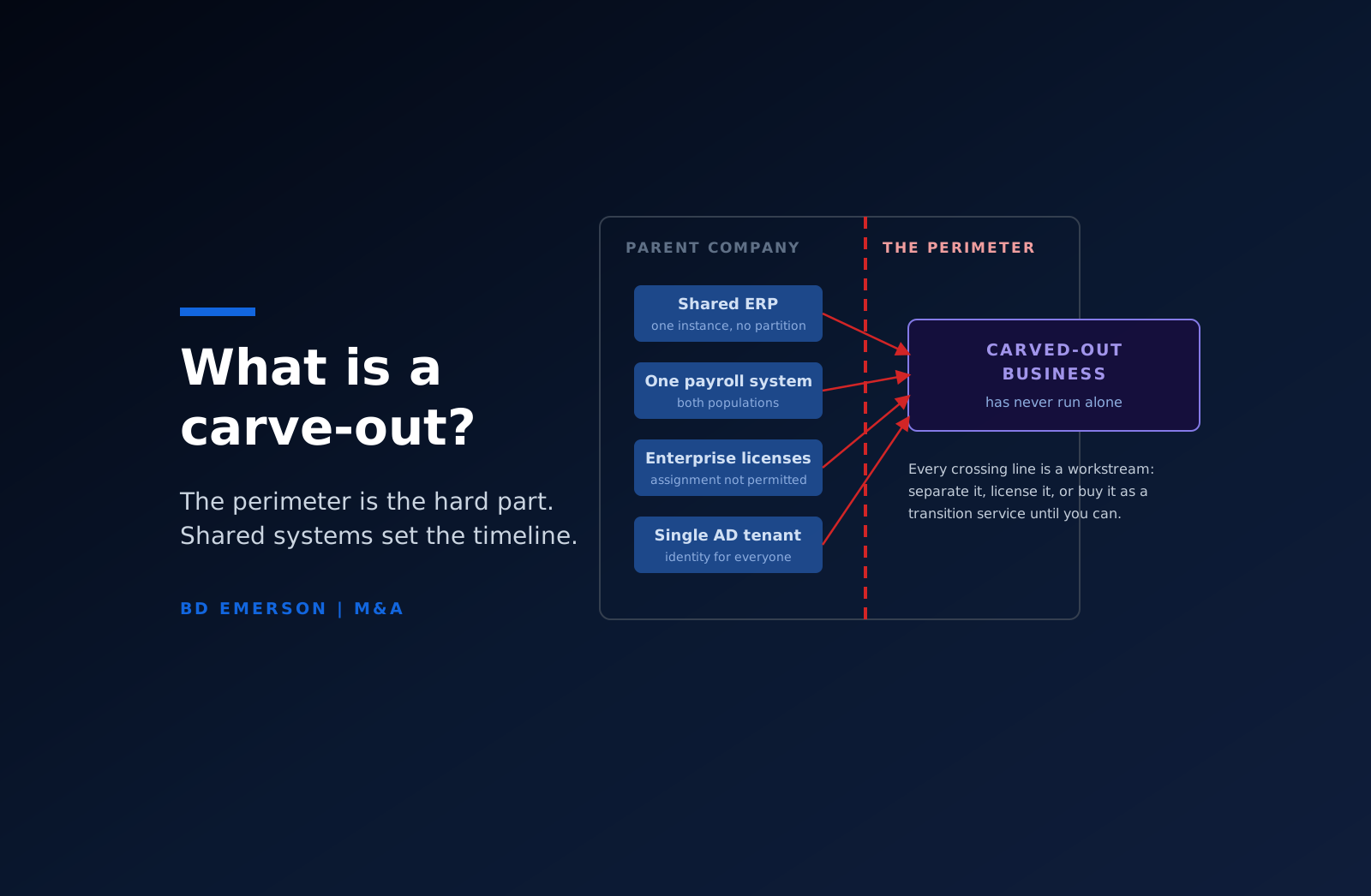
The perimeter is the line that defines what conveys to the buyer and what stays with the seller: legal entities, customer contracts, supplier agreements, intellectual property, employees, real estate, licenses, data, and liabilities. Drawing it is the first task in a carve-out and the one that determines the cost of everything after it.
Perimeter decisions are hard because the business was never built to have edges. A salesperson sells both the divested product and three retained ones. A master supply agreement covers volume across the whole company at a tier neither half will qualify for alone. A patent family protects products on both sides of the line. A factory makes goods for both businesses on the same lines. Each of these needs an answer, and the answers have prices: a shared contract that cannot be split becomes a supply agreement between the two companies after close, and a factory that cannot be divided becomes a manufacturing services arrangement with a term and a margin.
Sellers who defer perimeter decisions until a buyer is in confirmatory diligence pay twice. The financials get rebuilt, the standalone cost model gets rebuilt, and the buyer widens its risk assumptions in the meantime. The perimeter should be settled and documented before the information memorandum goes out.
Carve-out financial statements
A carved-out business has no financial history of its own, so someone has to construct one. Carve-out financial statements restate the business's revenue, costs, assets, and liabilities as though it had operated independently for the historical periods presented, using allocation methodologies a buyer and an auditor will accept.
Audited carve-out financials are required when the transaction is a carve-out IPO or a spin-off registered with the SEC, and when a public buyer has to file historical financials of a significant acquisition under Regulation S-X. Outside those cases they are not legally required, but every serious buyer will demand something equivalent before pricing the asset, because the alternative is underwriting a business from management estimates. The detail on how the statements get built and what buyers test in them is in our carve-out financial statements guide.
Standalone cost and dis-synergies
The number that moves carve-out valuations most is the gap between allocated cost and standalone cost. The parent's books charge the business an allocation for corporate services, calculated by a formula built for internal management reporting. That allocation reflects the parent's scale, the parent's contract pricing, and the parent's shared headcount, none of which the business will have after close.
Standalone cost is what the business actually has to spend to replace those services: its own finance and HR teams, its own audit and insurance, its own software licenses at single-company pricing, its own security operations. Across carve-outs, standalone cost commonly runs 15 to 30 percent above the allocation, and in service-heavy businesses more. Those dis-synergies are permanent EBITDA reductions, so the price effect is the gap multiplied by the multiple.
The only defense is a bottom-up model built from the actual scope of services the business consumes, priced against real quotes and real headcount plans, produced before buyers ask for it. A model built by discounting the allocation gets treated as advocacy and disregarded.
Transition services agreements
No carve-out is operationally separate at close. A transition services agreement obligates the seller to keep providing named services to the divested business after the deal is done: payroll processing, ERP access, help desk, hosting, security monitoring, accounts payable. Terms run 6 to 24 months, priced at cost or cost-plus for the base period with escalators of 10 to 25 percent per extension, because the pricing is designed to end.
The mistake to avoid is setting the term before the separation plan exists. A 12-month agreement signed against an 18-month IT separation hands the buyer two extension negotiations from a weak position and hands the seller an IT organization running two companies for longer than it budgeted. The term should come from the separation plan, which has to be written before the service schedules are drafted.
What actually breaks
Five entanglements cause most of the delay and most of the unbudgeted cost in a carve-out, and each of them is discoverable months before close.
A shared ERP with no clean data partition is the largest. When the business exists as company codes and cost centers inside one SAP or Oracle instance, and master data for customers, vendors, and materials is commingled, extraction means a new instance, a data migration, and a cutover weekend with a rollback plan. Enterprise software licenses are the second. Most enterprise agreements are signed by the parent and do not permit assignment to a third party, so the carved-out business needs its own agreements, negotiated on a deadline at single-company volume, which is the worst position from which to buy software.
Change-of-control clauses in customer and supplier contracts are the third. Each one gives the counterparty a consent right, and consent requests arriving during a sale process invite renegotiation. Counting them early tells the seller which revenue is actually transferable. One payroll system covering both employee populations is the fourth: the divested employees have to be established in a new payroll and benefits environment before the first post-close pay run, which is a hard date that does not move. A single identity directory is the fifth. When every employee authenticates against one Active Directory or Entra tenant, separation means a new tenant, new accounts, new device enrollment, and re-integration of every application that trusted the old directory. The technology side of this work is covered in depth in our article on IT carve-outs.
Why private equity buys carve-outs
Carve-outs are a favored source of deals for private equity funds, for reasons that follow directly from the difficulty. The auction is usually narrower, because most strategic buyers and many funds will not underwrite the separation risk, and a thinner field means a better entry multiple. The asset has typically been underinvested for years, since capital inside a diversified parent flows to whichever division has the better internal story, so the operating improvement available is real rather than theoretical.
The value creation plan also has a clear first chapter. Establishing a dedicated management team, replacing allocated corporate overhead with a right-sized cost structure, and giving the business its own capital budget produces measurable results in the first 18 months without needing a market thesis to be correct. The risk sits on the other side of the same coin. If the perimeter was drawn badly, the standalone cost model was optimistic, or the transition services agreement was too short, the fund spends its first two years fixing the separation instead of running the value creation plan, and the hold period extends past the model.
Where BD Emerson fits
We work carve-outs from both sides. For sellers, that means perimeter definition, carve-out financial statements, bottom-up standalone cost modeling, transition services scoping and pricing, Day 1 readiness, and the stranded cost takeout after the services end. For buyers, it means sizing the separation before the price is set, when the number still changes the outcome. Because the financial, tax, technology, and cyber workstreams run inside one firm, the findings reconcile to a single model rather than arriving as four vendors' reports that disagree with each other.
The first deliverable is always the same: a documented perimeter and an inventory of what the business actually shares with its parent. Every credible timeline, every transition services term, and every standalone cost number starts from that list. Our carve-out advisory practice builds it.

About the author