Palantir Apollo, Explained
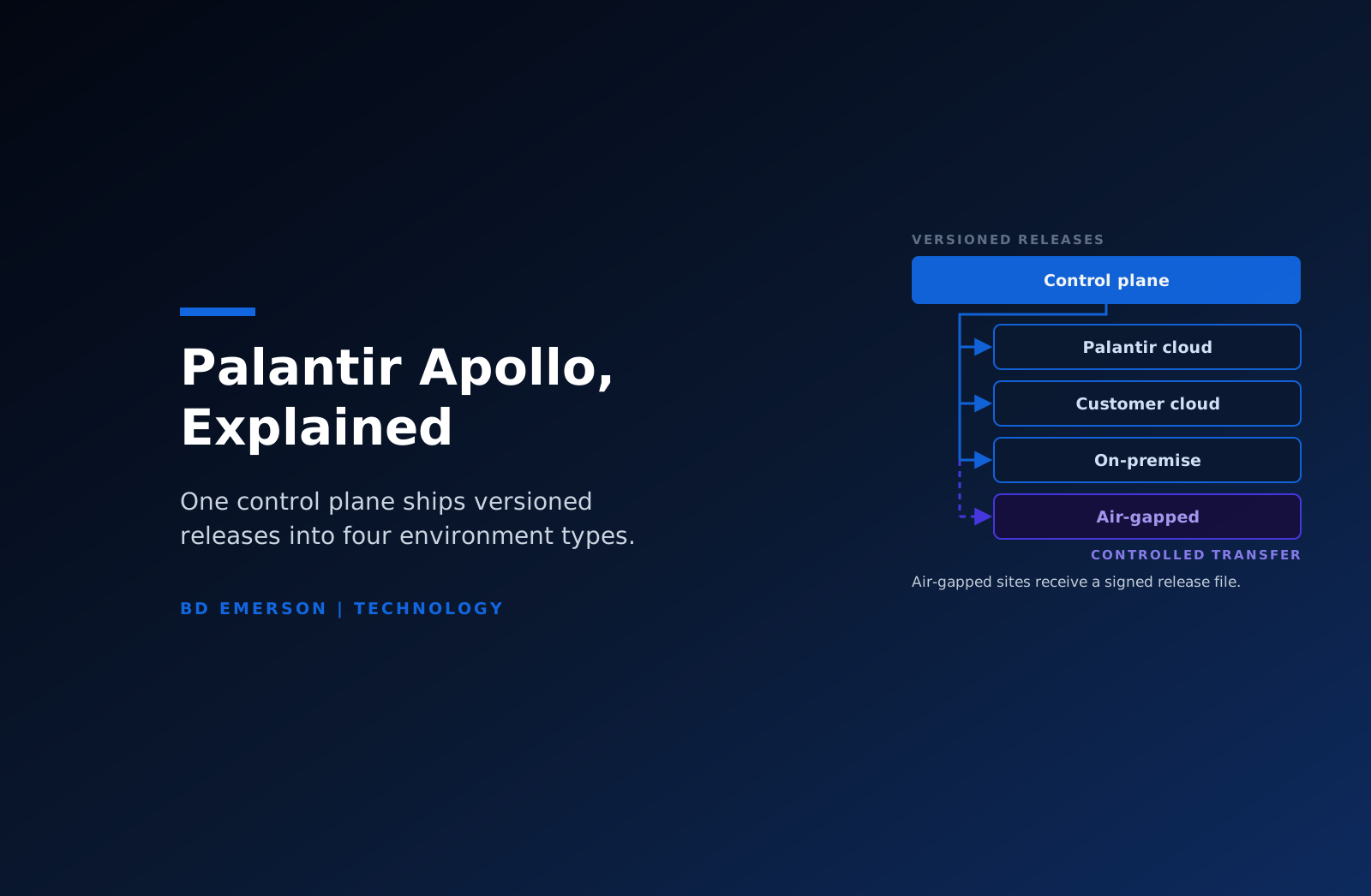
Apollo is Palantir's deployment and orchestration layer. It continuously ships software updates into environments the vendor cannot log into: customer clouds, on-premise data centers, air-gapped networks, classified enclaves, ships, and edge devices. Rather than engineers connecting to each environment, Apollo publishes declarative instructions that agents running inside those environments pull, verify, and apply according to policy. That is the mechanism behind Palantir shipping the same product to a commercial cloud tenant and to a disconnected network at sea, and it is the machinery under FedStart, where third-party software gets deployed into accredited government environments.
The problem Apollo solves
Most software companies deploy to infrastructure they control. Continuous delivery in that world means a pipeline that pushes to your own Kubernetes cluster, and if something breaks an engineer opens a terminal.
Palantir's deployments broke that assumption early. Foundry and Gotham run in customer-controlled environments, including networks with no inbound connectivity and no vendor access by design. Shipping a weekly release by hand to hundreds of such environments does not scale at all, and the traditional answer was to freeze versions per customer and support a long tail of divergent installations. That is how enterprise software historically ended up with customers three years behind.
Apollo inverts the control flow. Nothing pushes into the environment from outside. An agent inside each environment reads its intended state, fetches artifacts, verifies them, and converges toward that state on its own schedule. The vendor never needs a connection in, which is what makes the model acceptable to a security team that operates a classified enclave.
How it works
Three ideas do the work.
The first is declarative state. You describe what should be running: which product versions, in which environments, with which configuration and dependencies. Apollo reconciles reality against that description rather than executing a sequence of deployment steps that assume a starting condition.
The second is constraints. Environments carry their own rules: maintenance windows, dependency requirements between services, approval gates, and the order in which components may upgrade. Apollo treats these as constraints on the reconciliation, so a release rolls out where it is allowed to and waits where it is not, without a human tracking the matrix.
The third is progressive delivery with automated evaluation. Releases move through environment tiers, from internal to canary to broad production, with health signals gating each promotion. A regression that surfaces in a canary environment stops the rollout before it reaches the rest, and rollback is a state change rather than a manual recovery.
Everything is logged, which matters more than it sounds in a regulated deployment. The record of which version ran in which environment, when it changed, and who approved it is exactly the change control evidence an auditor asks for. That is a governance artifact you get from the deployment layer rather than assemble by hand.
How it differs from a normal CI/CD tool
Comparisons to Argo CD, Spinnaker, and Flux come up quickly, and they are reasonable on the reconciliation idea. The differences are about who owns the target. Those tools assume the operator of the pipeline also operates the cluster, and assume network reachability between them. Apollo assumes neither, and adds the fleet dimension: hundreds of environments with different constraints, different owners, and different connectivity, managed as one release process rather than one pipeline per environment.
The other difference is scope. Apollo manages product versions and their dependencies across a fleet rather than container rollouts alone, which is why it shows up in industrial and defense settings where the thing being updated is not always a web service.
How Apollo relates to Foundry and Gotham
Foundry and Gotham are the products. Apollo is how they reach you and stay current. A Foundry customer running in their own cloud or on-premise is being served by Apollo whether or not anyone on the team thinks about it, and the visible symptom is that the platform keeps moving without a project to upgrade it.
The architectural relationship matters when you are scoping a deployment. Environment topology is an Apollo question: how many environments, what connectivity each has, what the maintenance windows are, and which components must upgrade together. Those answers shape the delivery plan and the cost. The platform architecture itself is covered in what is Palantir Foundry.
Apollo is also sold on its own, to companies with the same distribution problem and no Palantir platform. The buyers are software vendors and operators with fleets of environments they do not control: industrial equipment, defense systems, regulated on-premise installations, and multi-cloud products with per-customer isolation.
Why air-gapped and multi-environment delivery is the point
Three properties matter to organizations in this position.
No inbound access is the first. Security teams that run isolated networks will not accept a vendor tunnel, and Apollo's pull model means they do not have to. The agent inside the boundary initiates everything, and artifacts are verified before they are applied.
Version convergence is the second. The cost of divergent installations compounds, because security patches have to be backported, support has to reproduce customer-specific versions, and features cannot assume a baseline. Continuous delivery to disconnected environments keeps the fleet close to current, which turns a support economics problem into a routine operation.
Verifiable provenance is the third. In defense and regulated contexts the question is not only what version is running but where the artifact came from and whether it was altered in transit. Signed artifacts, verification inside the boundary, and an immutable deployment record answer it.
Apollo and the government accreditation path
This is where Apollo becomes commercially interesting to companies with no interest in Palantir's data platforms. FedStart lets a software vendor deploy its own product inside Palantir's accredited FedRAMP and Impact Level environments and sell to federal customers on that basis. Apollo is the orchestration that makes it work at more than one customer.
The practical consequence is that a vendor with an ordinary cloud product can be running in a government-accredited environment without building the environment or the deployment tooling for it. The obligations that remain, and the difference between hosted accreditation and holding your own authorization, are in FedStart and the FedRAMP path.
What to plan for
Apollo removes deployment labor and adds design work at the front. Three things need decisions early. Your environment model, meaning how environments are defined, tiered, and grouped, because that structure determines how releases flow and is awkward to change later. Your constraint set, meaning the maintenance windows, approvals, and dependency rules that reflect how your operators actually accept change. And your health signals, because progressive delivery is only as good as the evaluation gating each promotion. Teams that skip the third get automated rollouts of regressions.
Security configuration belongs in the same conversation. Deployment identity, artifact signing and verification, separation of approval duties, and log routing to your SIEM are all decisions here, and they sit in the same control set we cover in securing Palantir deployments.
Where BD Emerson fits
Most of our Apollo work sits inside Foundry and AIP deployments, where environment topology and change control decide whether the platform stays current and whether the change management evidence holds up in an audit. Our Palantir consulting practice handles that alongside the ontology and security work.
BD Emerson is a Palantir implementation partner and consultancy. If you are evaluating Apollo on its own, the question that decides the business case is how many environments you cannot log into, and what it currently costs you to keep them current.

About the author