ServiceNow IRM vs GRC: What Changed and What It Includes
ServiceNow IRM and ServiceNow GRC are the same product line. Integrated Risk Management is the name ServiceNow has used since it repositioned the suite in the late 2010s, and GRC is the older name that still dominates search results, job postings, and the way practitioners talk. If you are evaluating ServiceNow GRC in 2026, the product you will buy is called IRM. The rename tracked a real architectural shift: the suite moved from a system of record for policies and audit checklists to a set of applications wired into the platform's CMDB and workflow engine, where controls attach to real systems, indicators pull live data, and one control library serves every framework you carry. This article maps the modules, the implementation work, and the cases where IRM is the wrong size.
Why the name changed
The label followed the analyst category. Gartner began replacing GRC with integrated risk management as its term of art around 2017, and ServiceNow moved its applications under the IRM banner in the years that followed. The lineage is still visible in the product: application scopes and tables carry the sn_grc prefix, and ServiceNow's own community forum for the suite is still titled GRC. Nobody will correct you for using the old name, and search behavior suggests most buyers still do.
The substance behind the rename matters more than the label. Classic GRC tools were document stores with workflow attached: policies in one module, a risk register in another, an audit plan in a third, each updated by hand on a review cycle. ServiceNow's bet was that risk software should sit on the platform that already knows what the company runs. The CMDB holds the applications, services, and infrastructure. ITSM holds the changes and incidents. IRM attaches risks and controls to those same records, which it calls entities, and uses indicators to pull evidence from live data rather than asking a control owner to attest each quarter that everything is fine. That integration is the product, and whether it pays off depends almost entirely on the condition of the data underneath it, which is where implementations succeed or stall.
The module map
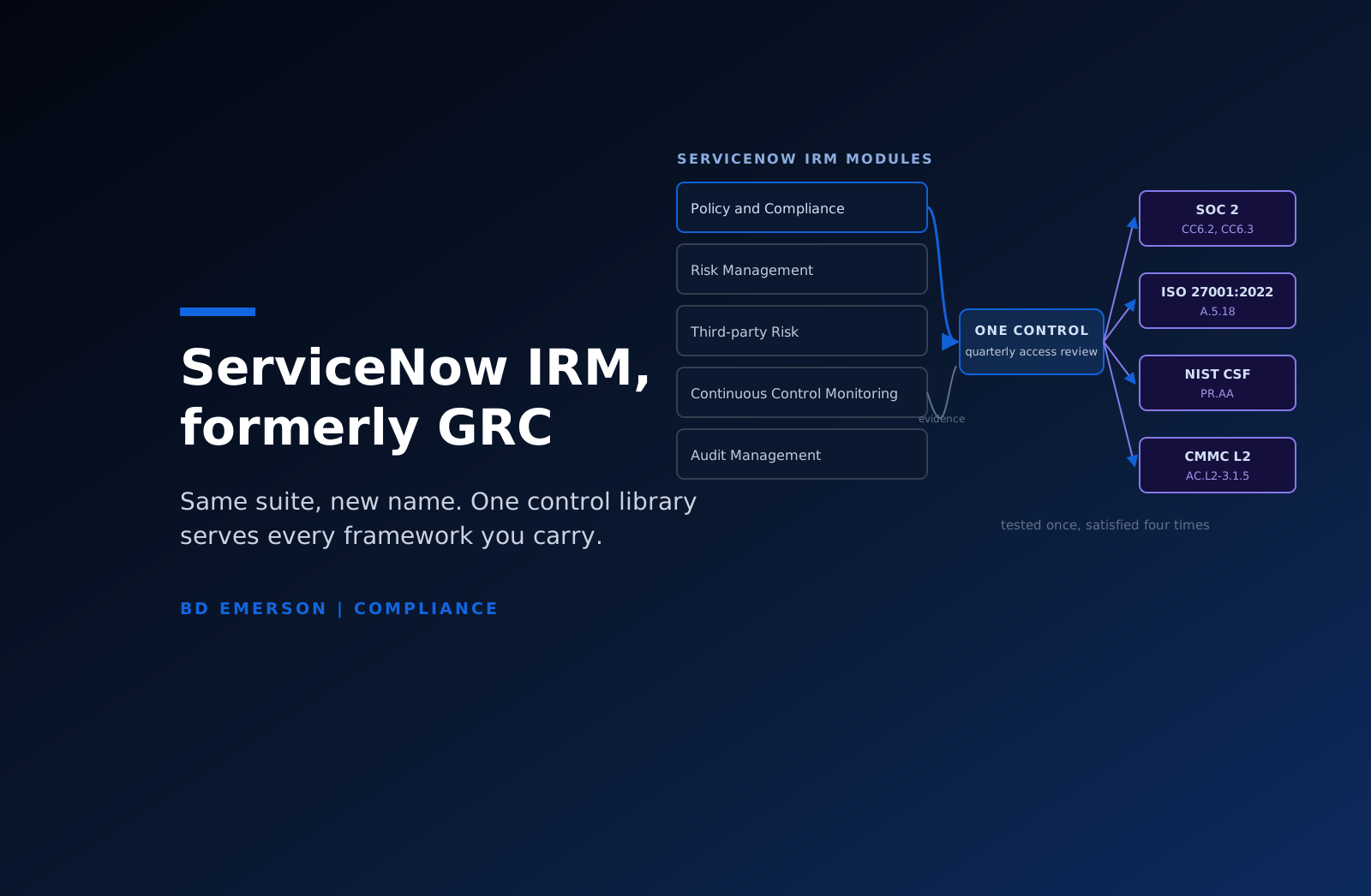
Five applications do the core work.
Policy and Compliance Management
This is the control backbone and the module most implementations start with. It manages the policy lifecycle from draft through approval, publication, and staff attestation, and it holds the compliance object model: authority documents such as SOC 2 or ISO 27001, the citations inside them, and the control objectives and controls your organization operates against them. Day to day, a compliance analyst lives here, publishing a revised policy and collecting acknowledgments, watching control test results arrive, and processing exception requests with owners and expiry dates instead of letting them live in email.
Risk Management
This is the risk register, attached to the same entities the controls sit on. Risk statements come from a library or your own taxonomy, get assessed for inherent and residual exposure, and roll up from individual systems to the enterprise level. Key risk indicators watch thresholds against platform data, so a score moves when the count of overdue critical vulnerabilities moves rather than when someone remembers to update a spreadsheet. Risk analysts use it to run assessment campaigns, track remediation, and produce the quarterly heat map for the risk committee with drill-down that survives questioning.
Third-party Risk Management
TPRM replaced Vendor Risk Management in ServiceNow's Vancouver release in 2023, and the new name widened the scope from IT vendors to any third party: suppliers, service providers, contractors, and partners. It covers tiering, due diligence questionnaires served through a portal the third party logs into, assessment scoring, issue tracking, and continuous monitoring feeds from security ratings services. If your vendor reviews currently live in a shared mailbox and a 400-row spreadsheet, this is the module that replaces them. Note that ServiceNow licenses TPRM separately from the core IRM packages, which surprises buyers who assumed it came along. We design third-party programs on and off ServiceNow through our third-party risk management practice.
Continuous Control Monitoring
CCM is the machinery that makes the word integrated mean something. Indicators run on a schedule against platform data and connected sources: pull the list of accounts with admin roles, check last night's backup jobs, count the changes that skipped approval. A passing indicator files evidence against its control. A failing one opens an issue with an owner and a due date. The practical effect is that control testing stops being an annual archaeology project and runs as a background process, so audit preparation becomes a review of evidence already collected.
Audit Management
Internal audit plans and executes engagements from the same data the other modules maintain. The audit universe comes from entities, scoping draws on current risk scores, fieldwork reuses control test results and indicator evidence, and findings route into the same issue workflow everything else uses. External auditors do not work inside your instance, but the evidence packages they request come out of it in hours rather than weeks.
One control, many frameworks
The design decision that pays for the platform is running a common control framework: one internal control set mapped to every framework you carry, rather than a separate control set per framework. In ServiceNow terms, each framework is an authority document made of citations, and each of your controls maps to citations across every document it satisfies. Test the control once and the evidence flows to every mapped requirement.
A quarterly user access review is the standard example. The review is one control with one owner producing one piece of evidence each quarter, and it can satisfy SOC 2 criteria CC6.2 and CC6.3, ISO 27001:2022 control A.5.18, the NIST CSF access management outcomes under PR.AA, and CMMC practice AC.L2-3.1.5 at the same time. An organization carrying those four frameworks without a common control set runs four access review workstreams and answers the same auditor question four times. With one, adding a framework becomes a mapping exercise: import the authority document, map its citations to existing controls, and scope the remainder that is new. Across the engagements we have run, the overlap between a new framework and a mature control library lands between 60 and 80 percent, driven by how far the new framework sits from the ones already mapped.
What implementation involves, and where it stalls
A first release scoped to one framework and one business unit typically lands in 10 to 16 weeks. The two variables that move that range are the condition of your CMDB and how much of your control library exists in writing before the project starts. Three stalls account for most of the schedule risk.
CMDB hygiene is the first. IRM generates entities from CMDB records, so if the CMDB carries applications with no owner, duplicate records, and services decommissioned two years ago, the control universe inherits all of it. Teams discover mid-project that the risk platform is exactly as accurate as the asset data underneath it, and remediation becomes an unplanned phase. The fix is scoping discipline: identify the entity classes your frameworks actually require, clean those, and decline to repair the entire CMDB inside a compliance project.
Indicator design is the second. Automating a control test requires a data source, a threshold, and a defined failure path, and each of those is a decision somebody must own. Projects fail in both directions here. Leave everything as manual attestation and you have rebuilt the spreadsheet program inside a more expensive tool. Switch on indicators wholesale and you drown control owners in failures nobody triages. The working pattern is to automate the ten controls with the cleanest data first and expand as each one proves stable.
Evidence automation is the third, and it is mostly an integration and ownership problem. The systems that hold the truth, meaning the identity provider, the cloud accounts, the vulnerability scanner, and the HR system, each need a connector or a scheduled import, and access to each one crosses a team boundary. Getting a security engineer, a platform owner, and a compliance analyst to agree on what counts as evidence for one control routinely takes longer than configuring the pull. Budget for that coordination and assign a decision owner before the workshops begin.
Licensing, in general terms
As of mid-2026, ServiceNow sells IRM as a subscription on the Now Platform, packaged in tiers, with Standard, Professional, and Enterprise packaging in the market and the higher tiers carrying capabilities such as advanced risk assessment and risk event management. Third-party Risk Management is a separate purchase from the core packages. Pricing is quote-based, there is no public price list, and the subscription scales primarily with the number of people who work inside the applications, while people who only attest to a policy or approve a request are licensed on lighter terms. Treat any specific dollar figure you find in a blog post as stale, and verify current module names and bundles against ServiceNow's own materials during procurement, because both have changed before. One budgeting reality does hold: this is an enterprise platform line item with a real implementation project beside it, and the implementation cost is commonly of the same order as the first-year subscription, moved by scope and CMDB condition.
When IRM is the wrong size
IRM earns its cost when most of these conditions hold: you already run ITSM on ServiceNow with a maintained CMDB, you carry three or more frameworks, internal audit needs to work from the same data as compliance, risk rolls up across business units, and your third-party count runs to the hundreds. In that situation the platform consolidates work currently spread across spreadsheets, a point GRC tool, and a ticketing system that talks to neither.
A 150-person SaaS company pursuing its first SOC 2 and ISO 27001 sits outside every one of those conditions. A compliance automation platform in the Vanta and Drata class deploys in weeks, costs a small fraction of an IRM program, and automates evidence collection against named frameworks well. We compared that class of tooling in our practical evaluation of GRC software. The distinction to price is operating scope. Those platforms exist to carry a company through specific framework audits with the least effort, while IRM exists to run risk and compliance as an operating function across a large organization. Paying platform money for a checklist outcome is the most common sizing mistake we see, and it usually starts with a procurement team that already had a ServiceNow relationship.
Where BD Emerson fits
We implement ServiceNow IRM end to end, covering entity scoping, the common control library, indicator and evidence design, and TPRM rollout, through our ServiceNow GRC implementation practice. BD Emerson is an independent consultancy. We do not work for ServiceNow and we do not resell its licenses, so when a lighter tool fits your size, we say so before you sign anything. Our partnership with VComply exists for those cases: policy and obligation tracking for regulated teams without the platform overhead. If you are weighing IRM against the alternatives, the deciding facts are your existing ServiceNow footprint, your framework count, and the state of your CMDB. Start the conversation with those three and the sizing decision mostly makes itself.

About the author