How Much Does SOC 2 Cost?
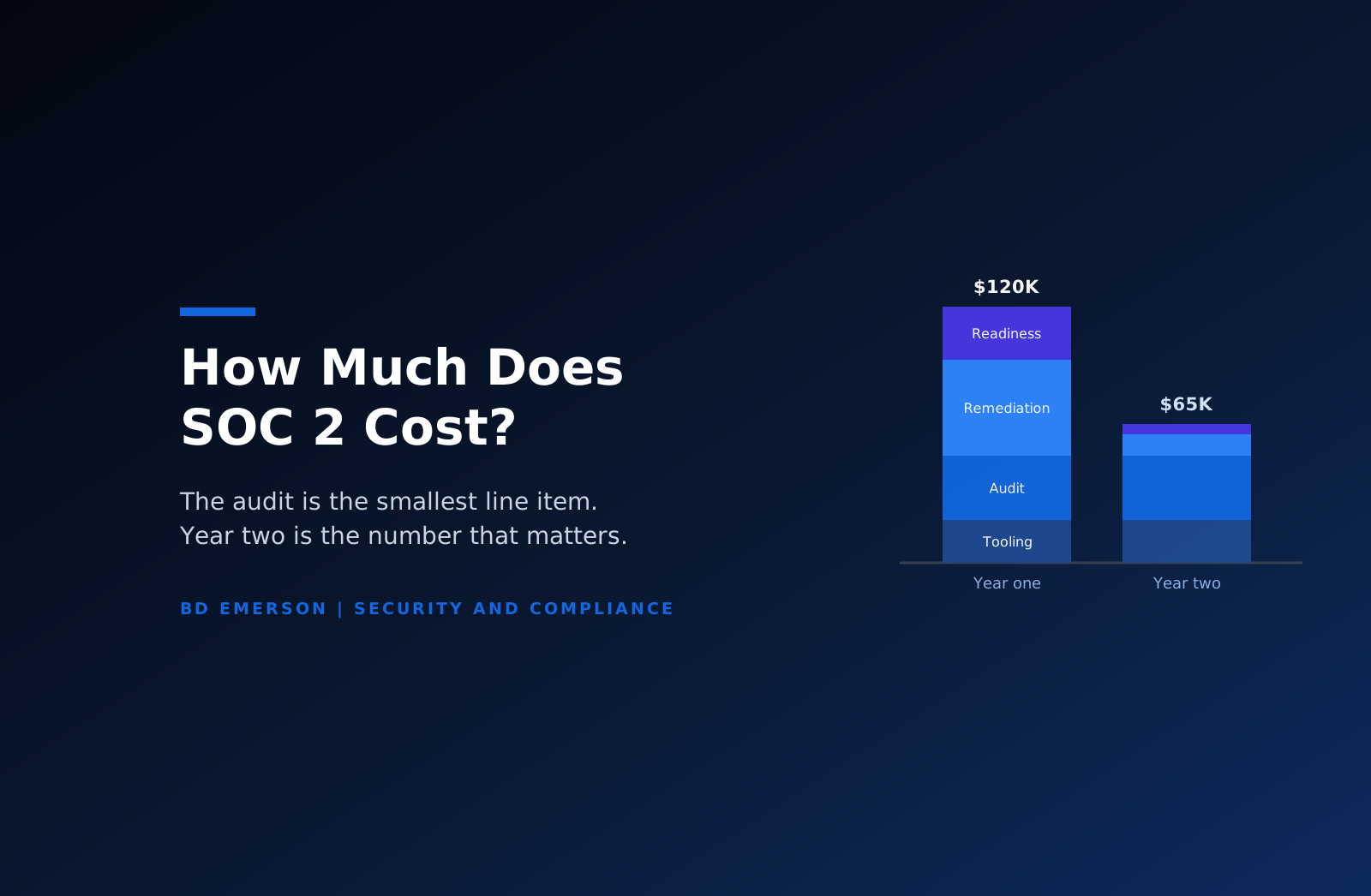
For most companies going through it for the first time, SOC 2 costs $30,000 to $90,000 in year one, all in. The audit itself runs $7,000 to $25,000 for a Type 1 and $12,000 to $45,000 for a Type 2 at typical startup and mid-market scope. The rest is everything around the audit: readiness and gap work at $5,000 to $40,000 depending on how much you outsource, compliance automation tooling at $8,000 to $30,000 per year, a penetration test at $8,000 to $25,000 if your customers expect one, and 100 to 300 hours of internal staff time that never appears on an invoice. Scope drives all of it, so start with the drivers.
What actually drives the audit fee
Auditors price SOC 2 on effort, and effort follows scope. Five inputs matter more than anything else.
Trust services criteria. Security is mandatory and is the whole audit for most first-timers. Adding Availability or Confidentiality typically raises the fee 10 to 25 percent each, because the incremental controls overlap heavily with Security. Processing Integrity and Privacy are different animals: both add controls that need bespoke testing, and Privacy in particular can add 30 to 50 percent. Most SaaS buyers ask for Security plus Availability, sometimes Confidentiality. Do not add criteria your customers have not asked for.
Size and complexity. Headcount, number of production applications, number of cloud environments, and how much of the stack sits in scope. A 40-person company with one product on AWS is the cheap end. Multiple products, hybrid infrastructure, or acquired entities with separate stacks push the fee up quickly.
The audit window. A Type 2 covering three months costs less than one covering twelve, though not proportionally, since much of the auditor's work is fixed regardless of period length.
Auditor tier. A boutique CPA firm, a mid-tier attest firm, and a Big Four practice can quote the same company $15,000, $35,000, and $90,000 for materially the same report. Big Four pricing buys a logo, not a different opinion, and few customers require it.
Your own readiness. Disorganized evidence turns into billable follow-up rounds. Companies running a compliance automation platform consistently land at the lower end of quoted ranges because fieldwork moves faster.
Type 1 versus Type 2 fees
A Type 1 audit tests whether your controls are designed properly at a single point in time. Expect $7,000 to $25,000 depending on the drivers above. It is faster and cheaper because there is no operating-effectiveness testing and no sampling across a period.
A Type 2 audit tests whether the controls operated over a window, usually three to twelve months. Expect $12,000 to $45,000 at startup and mid-market scope, and $50,000 to $100,000 or more for enterprises with multiple criteria and complex environments. Type 2 is what enterprise procurement actually wants; a Type 1 mostly buys you time in sales conversations while the Type 2 window runs. If a customer asks for a SOC 1 Type 2 instead, our SOC 1 vs SOC 2 comparison covers how the two reports differ in subject matter, timeline, and audit fee.
Plenty of first-year companies now skip Type 1 entirely and run a three-month Type 2. That saves the Type 1 fee but leaves you with nothing to show customers until the window closes. Which sequence makes sense depends on how hard your pipeline is pushing, which we cover in SOC 2 Type 1 vs Type 2.
Readiness and gap work
Almost nobody passes a first audit from a standing start. Before the auditor shows up, someone has to map your controls to the criteria, find the gaps, write or fix policies, and stand up the evidence trail. There are three ways to pay for this.
Do it yourself with internal staff and a platform, and the cash cost is near zero, but expect it to consume a meaningful fraction of a senior engineer's or security lead's quarter. A standalone gap assessment from a consultancy runs $5,000 to $15,000 and tells you what is broken without fixing it. Full readiness support, where consultants drive remediation, write policies with you, and prepare your team for auditor interviews, runs $15,000 to $40,000 depending on starting maturity and headcount.
The right amount to spend depends on whether anyone inside the company has done this before. A firm with an experienced security lead needs a gap assessment at most. A 30-person startup where compliance is landing on a staff engineer for the first time usually saves money by paying for readiness, because auditor follow-up rounds and a blown timeline cost more than the consulting would have.
Compliance automation tooling
Vanta, Drata, and their competitors connect to your cloud, identity provider, HR system, and repositories, then collect evidence continuously and flag failing controls. Pricing is driven by employee count and how many frameworks you run on the platform. Budget $8,000 to $20,000 per year for a company under 100 people on a single framework, and $20,000 to $30,000 or more as headcount and frameworks stack up.
The tooling earns its cost in audit mechanics: screenshot collection, access reviews, policy acceptance tracking, and vendor inventories stop being manual projects. Auditors also quote lower against a well-run platform. If you buy one, have someone configure it properly; a platform full of failing tests and unscoped connections is worse in an audit than no platform at all. That configuration work is its own discipline, which is why Vanta implementation exists as a service.
The internal time nobody budgets
Plan for 100 to 300 hours of internal effort in year one, concentrated in whoever owns security, IT, and people operations. It goes to policy review and adoption, access reviews, onboarding and offboarding cleanup, evidence collection, auditor interviews, and remediation of whatever the gap assessment found. At loaded cost, that is $10,000 to $40,000 of payroll pointed at compliance instead of product. Automation compresses it, readiness consultants compress it further, and neither takes it to zero. Companies that pretend this line item does not exist are the ones whose audits stall in month four.
The penetration test add-on
SOC 2 does not strictly require a penetration test, but the monitoring criteria expect you to identify vulnerabilities somehow, and enterprise security questionnaires ask for a recent pentest report in the same breath as the SOC 2. Most companies bundle one into the program. A credible web application and external network test runs $8,000 to $25,000 depending on the size of the attack surface. A scan dressed up as a pentest costs less and is usually recognized for what it is by the first sophisticated customer who reads it.
Year two looks different
The readiness spend largely disappears, the platform is configured, and your team knows the drill. A steady-state year looks like this:
- Type 2 audit over a twelve-month window: $12,000 to $40,000
- Automation platform renewal: $8,000 to $30,000
- Annual penetration test: $8,000 to $25,000
- Internal time: 50 to 150 hours
Call it $25,000 to $75,000 per year as an ongoing program. The mistake is treating year one as the cost of SOC 2. SOC 2 is a subscription, and the pricing conversation with any auditor or consultant should cover year two from the start.
How to keep the total down
Four moves reliably cut the first-year number without weakening the report. Scope tightly: one legal entity, one product, the criteria your customers actually request, nothing speculative. Book the auditor early: audit calendars compress in the fourth quarter, rush scheduling carries a premium, and a firm booked three months out will often hold better pricing. Align the penetration test and the audit window so one test serves both the report and your customers' questionnaires instead of paying for two. And ask about multi-year audit pricing; a two or three year commitment commonly takes 5 to 15 percent off the annual fee, and switching auditors every year resets a learning curve you already paid for once. None of these require negotiating skill so much as starting the process before the deadline is real.
The independence rule, and why it protects you
One structural point matters when firms quote you a bundle. Under AICPA independence rules, the CPA firm that signs your SOC 2 opinion cannot also design and build the controls it will audit. An auditor who audits their own work has an opinion worth little, and the rules exist because the people reading your report rely on that separation.
BD Emerson performs SOC 2 examinations through its attest arm, BD Emerson CPA, and keeps implementation and attest on opposite sides of that line. When a single firm offers to get you ready and then audit the result as one engagement, ask directly how they satisfy independence. Vague answers there tend to predict how the rest of the engagement will run, and a report your customers cannot rely on is the most expensive item on this page regardless of what it cost.
Where BD Emerson fits
We run SOC 2 programs from both sides of the line, never for the same client at the same time. Our attest arm performs Type 1 and Type 2 examinations at fixed fees quoted against real scope, staffed by auditors with security backgrounds who work natively in Vanta and Drata. For companies being audited elsewhere, our consulting side handles readiness, remediation, and platform configuration. Either way, the first conversation is a scope conversation, because every number in this article narrows considerably once someone has looked at your actual environment.

About the author