Top AI Consulting Firms for Financial Services in 2026
The right AI consulting firm for financial services depends on what you need built and what a regulator will ask about it afterward. Seven firms stand out in 2026: Accenture and IBM Consulting at global scale, McKinsey QuantumBlack and BCG X where strategy houses build software, Publicis Sapient for engineering-led modernization, Fractal among the AI-native specialists, and BD Emerson, which is our own firm, included here with that disclosure made plainly. The right choice turns on who actually builds versus who advises, whether the firm can pass model risk review under supervisory guidance like SR 11-7, how it handles customer data, whether it profits from the software it recommends, and who owns the model after it ships.
Every firm on this list runs a financial services AI practice we verified against the firm's own published pages. We describe only what that public positioning supports, and we make no pricing claims about any firm other than our own.
How to evaluate an AI consulting firm for financial services
The criteria come before the names because the ranking changes with the problem. A fraud-model rebuild at a regional bank rewards a different firm than a firmwide generative AI program at a global one. Six things separate the firms that put models into production at regulated institutions from the firms that produce decks about doing so.
- Who builds and who decks. Ask for the production record rather than the pilot record. A firm can run fifty pilots without once clearing model validation, security review, and change management at a regulated institution. Ask how many models the team has shipped into production at institutions your size, and what those models do today.
- Model risk management fit. US supervisors examine models under guidance like the Federal Reserve's SR 11-7: documented development, independent validation, and explainability a regulator can examine. A consulting firm that cannot produce validation-ready documentation leaves you with a model your second line cannot approve.
- Data governance and PII handling. AI development moves customer data into new places: training pipelines, vector stores, third-party model APIs. Ask where regulated data goes during development, who can see it, and how the design honors GLBA safeguards and your privacy commitments before the first prompt is written.
- Software resale incentives. Several firms on this list sell or resell the software their advice recommends. A firm can do honest work under that incentive, and the honest handling is disclosure: ask what each firm earns if you adopt its recommended stack, and ask for a reference architecture built on tools it does not sell.
- Post-deployment ownership. A model starts degrading the day it ships. Someone must own monitoring, drift thresholds, retraining, and the audit evidence that all of it happened. If the engagement ends at go-live, the audit finding arrives on your desk.
- Team seniority inside your window. Budget cycles and exam calendars give most financial services AI programs a hard window. Ask who specifically staffs yours, because at many firms the people who scope the work and the people who deliver it are different people.
Accenture
Accenture treats AI in banking as an operations problem at scale. Its banking operations practice positions data and AI as the fix for high-cost legacy processing, and its published claims are operational: cost savings of 20 to 25 percent, efficiency gains of up to 50 percent, automated controls, and generative AI in customer interactions across account opening and lending. Delivery runs through a managed service model and a partner ecosystem that includes Pega, ServiceNow, Salesforce, Finastra, and Celonis.
Accenture fits global and super-regional banks that want AI embedded inside a broader operations transformation, with one provider able to staff every country the program touches. The watch-for is the operating model: the firm that redesigns your processes also sells the managed service that then runs them, so ask how model documentation, monitoring, and audit evidence transfer back to you if you ever bring the work in house.
McKinsey QuantumBlack
QuantumBlack is McKinsey's AI arm, grown from a 45-person acquisition in 2015 into the firm's global AI and engineering group. The financial services proof McKinsey publishes is concrete: a joint team with ING shipped a customer-facing generative AI chatbot in seven weeks, with ING's risk stakeholders involved from the start and guardrails that kept the system from giving mortgage or investment advice. That risk-first build sequence is worth copying whichever firm you hire.
QuantumBlack fits institutions where AI is a board-level operating model question and the buyer wants the strategy case and the first production build from one team. The watch-for is composition: the published work features flagship programs at large institutions, so ask how many people on your named team write code, and what code, documentation, and tooling stay with you when the engagement ends.
BCG X
BCG X is BCG's build unit, and in banking it sells a named product: Smart Banking AI, analytics software that consolidates customer data for personalization, churn prediction, and credit risk work. BCG publishes results from client deployments, including a 20 to 30 percent profit lift and a 14 percent churn reduction, and offers two paths: an in-house build supported by BCG, or a subscription running on BCG's own cloud platform.
BCG X fits banks that want a strategy firm's commercial thesis turned into working software quickly and will accept a productized starting point. The watch-for is the product itself: a firm that sells software has an incentive to see your problem through it, and the subscription path moves your customer data pipeline onto BCG's platform, which your data governance and third-party risk teams should examine as they would any other vendor's.
IBM Consulting
IBM Consulting pairs a banking and financial markets practice with the deepest governance tooling story on this list. Its published positioning covers core banking and payments modernization, assistants and agents built on watsonx Orchestrate, and explainability and transparency through watsonx.governance, with named client work that includes an AI governance framework at Banco do Brasil and customer-service improvements at NatWest.
IBM fits institutions modernizing core systems, and institutions that want AI governance tooling plus the consulting to implement it from one provider, particularly where IBM already runs in the estate. The watch-for is the obvious one: the consulting arm sits beside a software business, so recommendations tend toward watsonx. Ask for the reference architecture without IBM software in it and compare the two.
Publicis Sapient
Publicis Sapient comes at financial services AI through engineering. Its practice ships three named platforms: Sapient Bodhi, which orchestrates AI agents and includes prebuilt banking agents for KYC onboarding, investment mandate interpretation, and transaction monitoring; Sapient Slingshot, which automates the software lifecycle and which the firm credits with converting three million lines of COBOL into clear specifications in eight weeks; and Sapient Sustain for IT operations. Named client types include global banks, pension investment managers, and post-trade firms.
Publicis Sapient fits institutions whose real AI blocker is the legacy estate, where modernization and AI adoption have to move as one program. The watch-for is the distance between build speed and supervisory evidence: ask which of the prebuilt agents run in production at a regulated institution today, and who produced the model validation documentation when they did.
Fractal
Fractal is the AI-native specialist on this list. Its financial services practice spans retail banking, asset and wealth management, and payments, with published work in generative AI process transformation, including underwriting, conversational AI, and extraction from unstructured documents, and a product line that includes CRUX Intelligence. Forrester named Fractal a leader in customer analytics services in its Q2 2025 Wave.
Fractal fits institutions buying deep data science capacity for specific decisions: fraud, churn, underwriting analytics, customer intelligence. Those problems reward a specialist more than a transformation machine. The watch-for is that the public financial services positioning is broad on capability and light on quantified deployments, so ask for production references in your segment and for the monitoring arrangement that follows each model after go-live.
BD Emerson
BD Emerson is our firm, so read this entry knowing who wrote it. We are a boutique built deliberately senior: the people who scope an engagement are the people who design the architecture, build the deployment, and sit with your model risk and compliance teams. Our enterprise AI consulting practice runs from use-case selection through production, and we implement Palantir Foundry and AIP for institutions that run on them; our comparison of Palantir implementation partners covers that landscape, including where we sit in it. We are not Palantir, we resell no software, and we hold no partner tier that pays us when you buy a platform.
We build security and compliance into the deployment itself: access controls, data lineage, and the monitoring and audit evidence an examiner will ask for. Our licensed CPA attest arm performs SOC 2 examinations, so the controls we design produce evidence in the form examiners request. Two anonymized examples show the shape of the work: a fintech platform modernization delivered through our fintech software development practice, and an insurance underwriting modernization that rebuilt submission workflows with governance and audit trails built in.
We are the wrong fit for a global transformation program that needs a thousand seats across dozens of countries; that work belongs with the giants at the top of this list. We fit institutions that want the senior team in the room for the whole build and a deployment that stands up to model risk review.
Running the selection
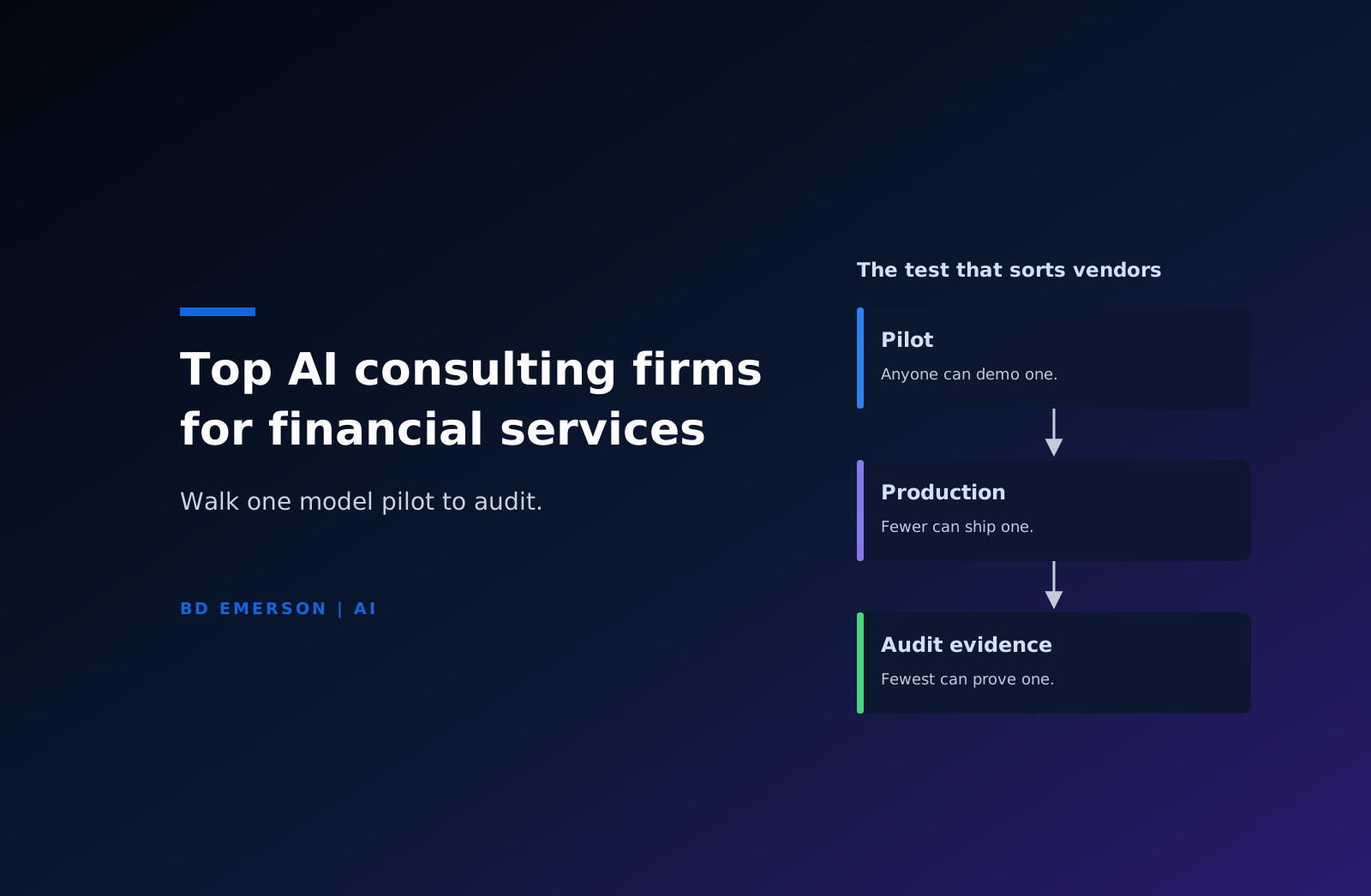
Shortlist two or three firms whose model fits the problem, then make the comparison concrete. Ask who specifically will design and build, and get names rather than titles. Request a sanitized past report or model documentation package and judge whether your model risk team could validate from it. Ask each firm to walk one model from pilot through production to its audit trail: who monitored it, what drifted, and what evidence shows that someone acted. The firm that answers with specifics has done this before, and the firm that answers with framework slides has not.
If the program in front of you needs a senior team and a build your examiners can follow, start with our enterprise AI consulting practice.

About the author