Top Palantir Implementation Partners in 2026
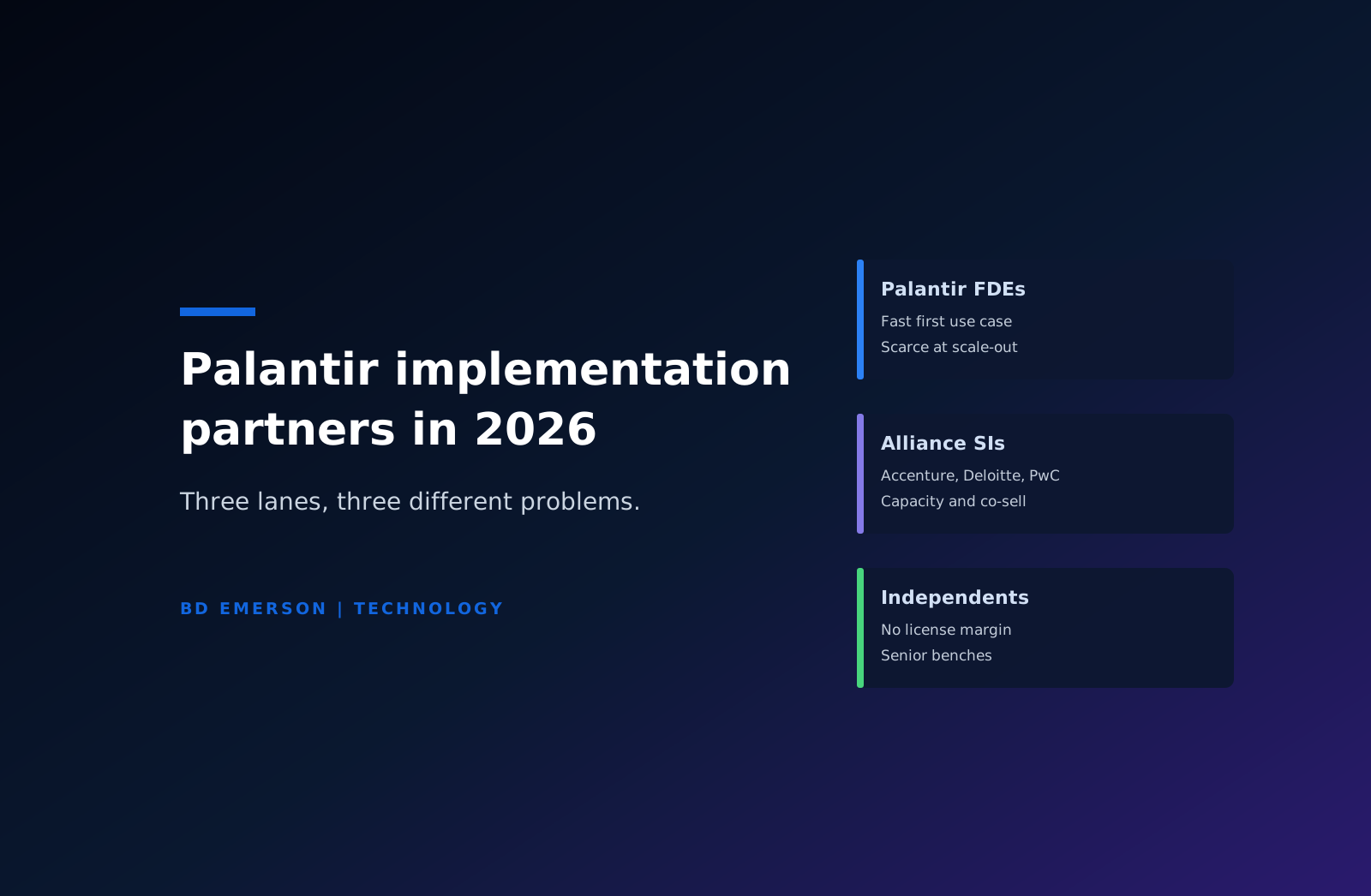
Palantir implementation help comes from three places, and they are not interchangeable: Palantir's own forward deployed engineers, the global system integrators with announced Palantir alliances, and independent specialists who implement the platform without reselling it. In 2026 the announced alliance list is short: Accenture expanded a global strategic partnership with Palantir in 2025 and runs a dedicated federal practice with Accenture Federal Services, Deloitte launched a strategic alliance aimed at enterprise functions, and PwC offers Palantir implementation and engineering services. BD Emerson, our own firm and the publisher of this page, sits in the independent category: we implement Foundry and AIP, we hold no reseller badge, and we take no margin on licenses. Which lane fits you depends on where the license came from and what has to be true in production twelve months later.
What to ask before picking a partner
Five questions do most of the sorting:
- Who has actually shipped an ontology? Foundry work lives or dies on ontology design, the object model that maps your business into the platform. Ask any candidate team how many ontologies its named engineers have built and what broke on the first one.
- Forward deployed experience. Palantir's delivery culture is engineers embedded in the operation, not analysts in a war room. Teams with former forward deployed engineers, or people who have worked alongside them, move at a different speed. We wrote about the role in what a forward deployed engineer is.
- Independence from the license. A partner whose economics improve when your Palantir footprint grows will scope accordingly. An independent implementer has no margin on the license and can tell you when a workflow does not belong in Foundry at all.
- Security posture. Palantir deployments concentrate an organization's most sensitive data by design. The implementation team needs to treat access controls, data governance, and audit evidence as part of the build, not a compliance afterthought.
- Exit artifacts. Ontology documentation, pipeline runbooks, and trained internal owners. Foundry skills are scarce, which makes a knowledge-transfer plan worth more here than on any commodity platform.
Palantir itself: the forward deployed model
For the first deployment, Palantir's own engineers are often part of the package, and they are very good at proving value fast against a hard operational problem. The limits show at scale-out: FDE time is scarce, priced accordingly, and pointed at the use cases Palantir selects. Most enterprises eventually need a bench that belongs to them, either internal or contracted, to carry the ontology and pipelines the FDEs stood up.
Accenture
The deepest announced alliance, expanded globally in 2025, with a federal joint effort through Accenture Federal Services aimed at government operations. Accenture brings what it always brings: certified capacity at volume, program management for deployments that span regions and business units, and co-sell alignment with the vendor. Best for very large enterprises and federal agencies standardizing on Palantir. The tradeoffs are the familiar ones: pyramid staffing and program minimums that price out the mid-market.
Deloitte
Deloitte's alliance points Palantir at enterprise functions, finance, supply chain, and operations, where Deloitte already holds the process relationships. Best when Foundry lands inside a broader transformation Deloitte is already running, or when regulatory and audit adjacency matters to the board. The same handoff caution applies as with any multi-arm firm: know which Deloitte you are buying.
PwC
PwC publishes a Palantir implementation and engineering services offering built around AI deployment on Foundry and AIP. Best for organizations that want a Big Four wrapper on the work, with the usual strengths in risk and controls and the usual premium.
BD Emerson
Disclosed again: this is our page. BD Emerson is an independent implementation consultancy for Palantir Foundry and AIP. We are not Palantir, we do not resell licenses, and we take no resale margin, which means our advice on scope has nothing riding on your license bill. The team is deliberately senior, builds ontologies and production pipelines rather than steering committees, and pairs the platform work with the security, governance, and compliance controls the deployment will be audited against. Two recent deployments, anonymized under our confidentiality terms, show the pattern: Foundry in daily operations for a major hospital system and underwriting rebuilt for a major insurance provider. Best for mid-market and enterprise teams that already chose Palantir and need it working in production, and for buyers who want an honest read on which workflows belong in Foundry before spending more. Watch for scale: a thousand-seat global rollout with co-sell requirements belongs with the alliance firms above. Our Palantir consulting practice page lists the engagement models by name.
Alliance partner or independent: an honest comparison
The announced alliances buy you co-sell coordination, vendor-aligned roadmaps, and capacity. Independence buys you advice with no license economics behind it and senior people at boutique rates. Federal work with clearance requirements narrows the field to the firms that hold them. A reasonable pattern for mid-market buyers: let Palantir's FDEs or an alliance firm prove the first use case, then move build-out and run to a bench sized to your actual budget. What the full deployment costs, license and implementation together, is a separate question we priced from real figures in what Palantir actually costs.
The bottom line
There is no certified-partner directory that makes this choice for you, so the criteria above have to. Ask who has shipped an ontology, who profits from your license line, and who will still be answerable for the deployment in year two. Get those three answers in writing and the partner conversation gets short.

About the author