Best AI Consulting Firms in 2026
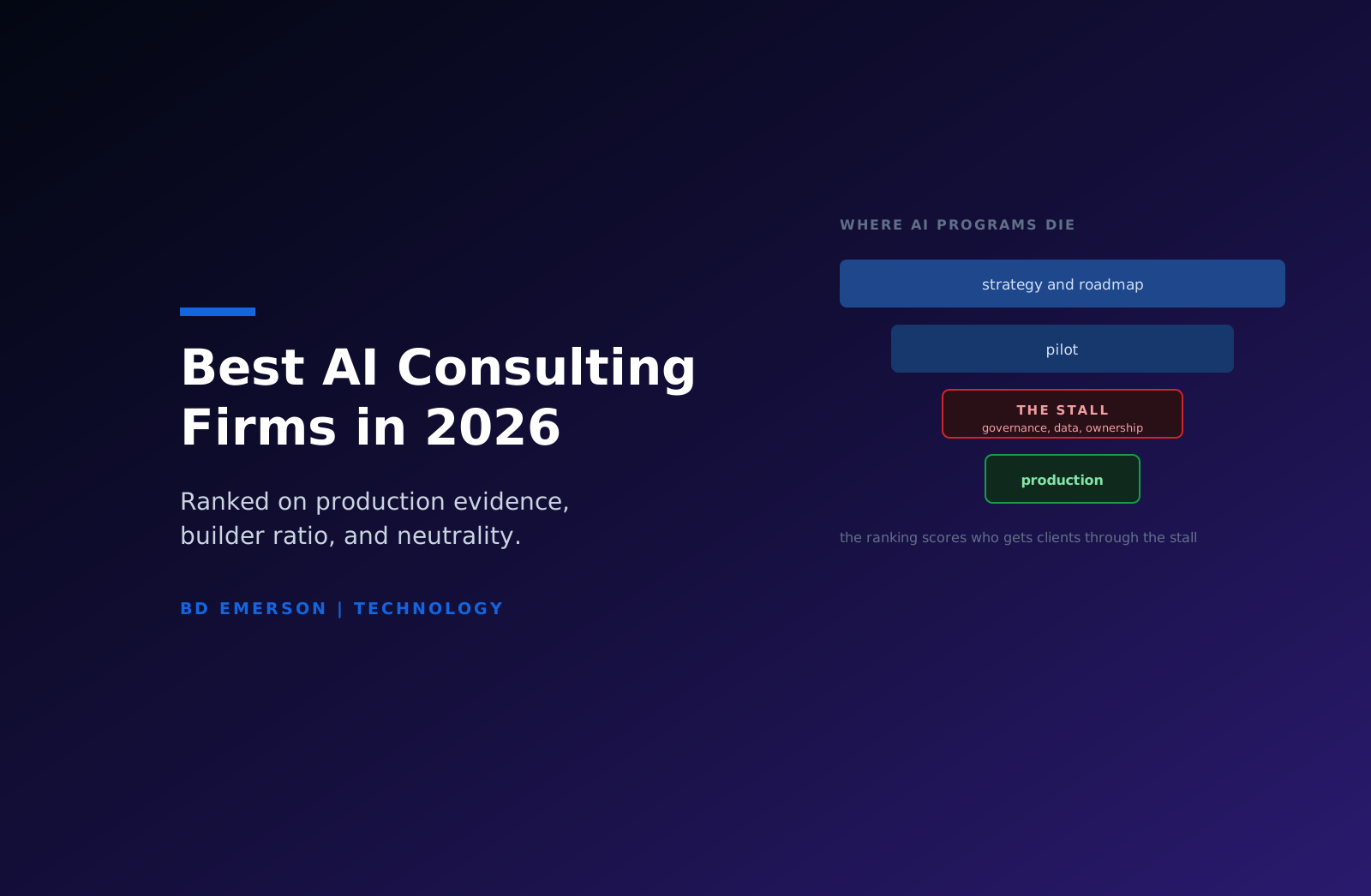
The best AI consulting firm for you depends on which failure you are trying to avoid. If the risk is betting the company on the wrong AI strategy, the strategy houses, McKinsey and BCG X, earn their fees. If the risk is that nothing ships, the engineering-led firms, EPAM and Fractal, are built to ship. If the risk is a program that dies between the pilot and production, look for firms whose references are running systems with usage data, at whatever size. The market splits cleanly in 2026: a small number of firms that build AI systems that survive contact with real operations, and a much larger number that produce roadmaps, workshops, and pilots that stall. This guide ranks the field on that line. Disclosure up front: BD Emerson appears on this list, this is our site, and our entry is marked.
How we ranked them
Five tests, applied from public evidence and from what we see across engagements where these firms preceded or followed us. Production evidence: can the firm point to AI systems in production with measured outcomes, not pilot counts? Builder ratio: how much of the bench writes code and evaluates models versus builds slides? Model neutrality: does the firm profit when you pick a particular vendor's stack, through resale margins or partnership economics? Governance depth: can it make the system defensible to your regulators, auditors, and security team, which is where enterprise AI actually dies? And post-deployment ownership: who monitors, evaluates, and improves the system after go-live, and is that in the contract or in the appendix?
1. McKinsey & Company (QuantumBlack)
QuantumBlack is the strongest strategy-plus-data-science combination in the market, and McKinsey's own aggressive internal AI deployment gives it operating credibility the other strategy houses lack. Where it wins: AI strategy tied to operating model redesign, at board altitude, with real data scientists in the room. Where to be careful: engagements price at the top of the market, and long-run engineering ownership typically transfers to the client or a delivery partner. Best for large enterprises deciding what AI should do to the business, not just in it.
2. BCG X
BCG X co-builds: its bench of several thousand engineers, data scientists, and designers takes products from concept to launch alongside client teams. Its agentic AI work in 2025 and 2026 has been ambitious, and it will put its own name on shipped software, which most strategy firms will not. The premium is steep, and flagship innovation work gets the best staffing. Best for companies building new AI products or businesses where design and engineering have to arrive together.
3. Accenture
Accenture has trained hundreds of thousands of people on AI delivery and holds top-tier partnerships across Microsoft, Google, AWS, and NVIDIA. For a global rollout, Copilot deployment at 80,000 seats, or an AI program with twelve integrated workstreams, its scale is the product. The trade-offs are the partnership economics, which reward recommending the platforms it resells and implements, and delivery quality that varies with the team you draw. Best for global enterprises where scale and vendor ecosystem management dominate the problem.
4. IBM Consulting
IBM pairs a large consulting arm with its own model and governance stack, watsonx, and decades of regulated-industry delivery. Its governance tooling is among the most mature, which matters in banking, insurance, and healthcare. The obvious caution is that IBM sells software: the consulting recommendation and the product catalog are not independent. Best for regulated enterprises that want one accountable vendor across advisory, build, and governance tooling, and are comfortable with the coupling.
5. Deloitte
Deloitte's AI practice is enormous and its differentiation is trust: risk, controls, audit-adjacent capability, and regulatory fluency wrapped around AI delivery. For AI programs that must survive examiner scrutiny, model risk review, and internal audit, that wrapper has real value. As with any Big Four practice, staffing pyramids and office-to-office variance are the watch-outs. Best for enterprises whose binding constraint is making AI defensible to regulators and boards.
6. EPAM
EPAM is what engineering-first AI consulting looks like at scale: over 55,000 technologists, deep platform work, and AI-native delivery tooling of its own. It builds the data foundations and production systems that strategy decks assume into existence, at rates below the strategy houses. It expects direction from the client, and change management is not the product. Best for organizations that know what they want built and need it built well.
7. Slalom
Slalom brings AI delivery to the mid-market and regional enterprise through local teams and strong AWS, Microsoft, and Snowflake practices. Clients get senior attention and a firm that works in their offices rather than from a hub. Globally distributed programs and frontier research work sit outside the sweet spot. Best for mid-market companies that want a capable partner nearby and a bill that matches their size.
8. Fractal
Fractal is an AI-native firm of roughly 5,000 people focused on applied AI for Fortune 500 operations: pricing, supply chain, customer analytics, and decision systems, with productized accelerators that shorten delivery. It is a builder with domain depth in consumer, retail, and financial services. Brand recognition outside those verticals lags the capability. Best for enterprises that want applied AI outcomes in operations without strategy-house pricing.
9. BD Emerson (disclosure: this is us)
BD Emerson is a boutique consultancy that takes enterprise AI from strategy through production: multi-model architecture and platform selection, data engineering, deployment on Palantir, Databricks, and cloud-native stacks, and the governance, security, and compliance work that regulated buyers require before anything touches real data. The firm holds no reseller margins on the platforms it recommends, staffs engagements with senior practitioners, and writes post-deployment evaluation and monitoring into the engagement rather than the appendix. Our analysis of why AI pilots stall describes the delivery gap this ranking keeps returning to, and it doubles as a preview of how we scope. We are the right call when you want AI in production with the audit trail to defend it, and the wrong call when the program needs a thousand consultants across forty countries. The model is described on our enterprise AI consulting page.
What AI consulting costs in 2026
Blended rates cluster by firm shape. Strategy-house AI work runs 400 to 900 dollars per hour, and an AI strategy engagement alone commonly lands between 300,000 and 1.5 million dollars. Global integrators blend 150 to 350 dollars per hour depending on offshore mix, with enterprise AI programs regularly reaching eight figures once data foundations and change management are counted. Engineering-led firms blend 90 to 200 dollars per hour. Senior-staffed boutiques typically sit between 200 and 400 dollars per hour with small teams, which often produces lower program totals than integrator bids despite the higher rate, because the headcount is a fraction. Production deployments of a single meaningful use case, from data readiness through monitored go-live, most often land between 250,000 and 1.5 million dollars in the mid-market, with the spread driven by data condition and integration surface rather than by the model. Any proposal priced before someone has looked at your data should be read as a placeholder.
The proposal red flags repeat across the market: a pilot priced attractively with production scoped as "phase 2, TBD," success criteria described in adoption language rather than business metrics, no named evaluation methodology, and a staffing plan the firm will not commit to by name. Each one predicts the stall pattern the ranking above tries to select against. The inverse signals are worth naming too: a firm that asks to see your data before quoting, prices the production milestone rather than the workshop, and volunteers what it will not be good at is telling you how the engagement will actually run.
How to run the selection
Shortlist two firms of different shapes, a large one and a focused one, and give both the same test: a specific business problem, your real data constraints, and a request for the team roster that would actually staff the work. Then ask each for two references where the system has been in production for a year, and call them. Ask the references what broke, who fixed it, and what the firm's evaluation numbers looked like against the sales claims. Vertical depth matters more as the work gets closer to regulated decisions, which is why we also maintain a vertical companion to this list, the top AI consulting firms for financial services. However you weight the criteria, hold every firm on this list, ours included, to the same standard: production systems, measured outcomes, and an incentive structure that pays them to finish.

About the author