Vanta vs Drata: An Implementer's Comparison
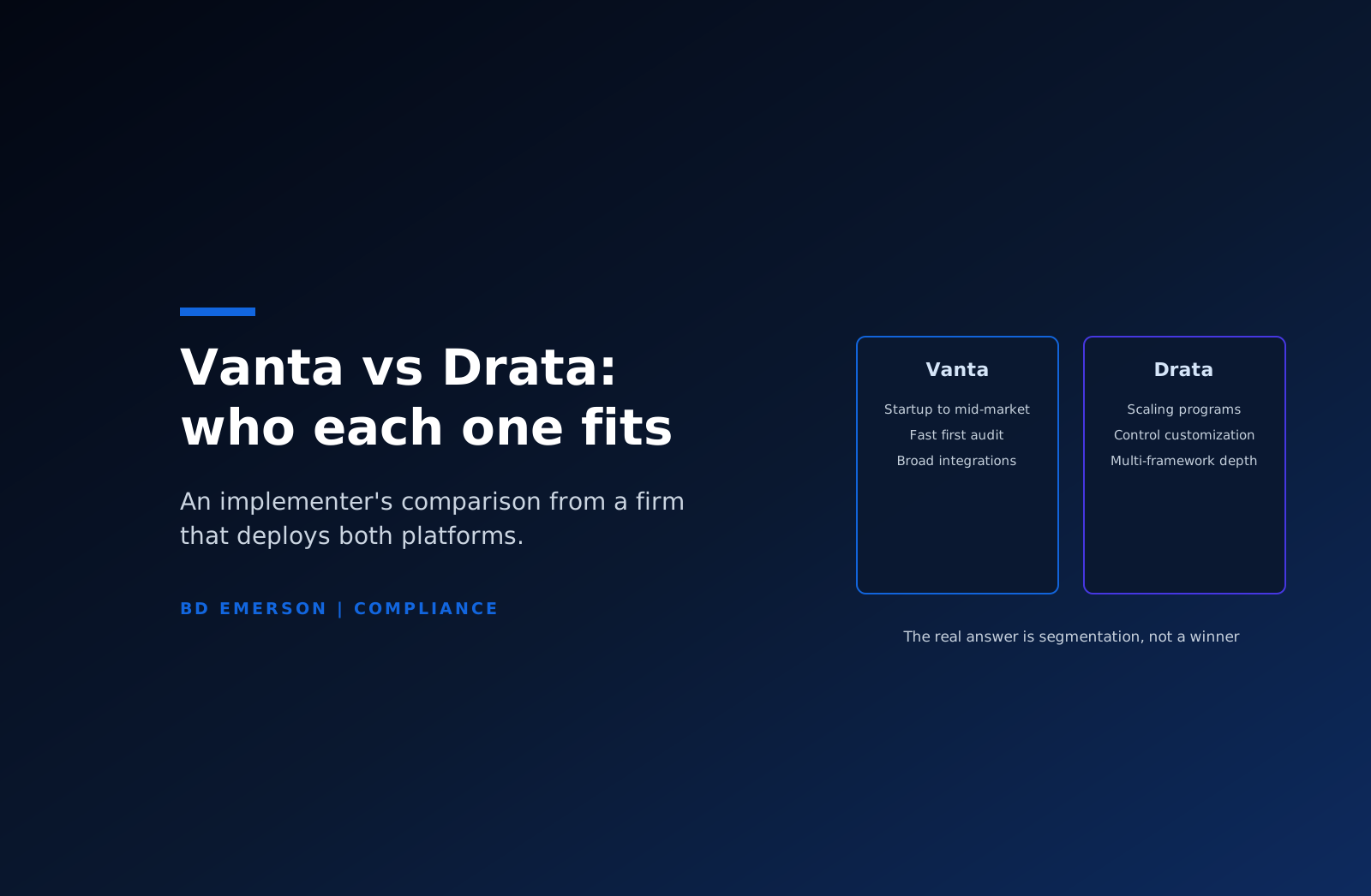
Vanta and Drata solve the same problem, and for most buyers either one will work. The difference shows at the edges. Vanta fits companies buying their first compliance platform for a first SOC 2 or ISO 27001: it has the largest integration library in the category, more auditors work in it than in anything else, and the defaults are good enough that a small team can get moving without heavy configuration. Drata fits companies running several frameworks at once that want deeper control customization and cross-framework mapping, which is why it shows up more often in the mid-market. BD Emerson implements both platforms and takes no referral position on either. This comparison comes from configuring and operating both across client programs.
Two platforms built on the same idea
Both products automate compliance evidence the same way. You connect your cloud infrastructure, identity provider, HR system, code repositories, and device management tooling. The platform runs continuous tests against those connections: is MFA enforced, are access reviews current, is encryption on, did the offboarded employee lose access. Passing tests become evidence, failing tests become a to-do list, and the auditor gets a portal instead of a shared drive full of screenshots.
Vanta created the category in 2018 and grew up around the SOC 2 use case for startups. Drata launched in 2020 and built for multi-framework programs from the start, with control customization as a first-class feature rather than an enterprise add-on. Both have since converged toward the middle: Vanta added customization and upmarket features, Drata broadened its startup motion. The origins still show in the defaults, and defaults matter more than feature lists, because most teams run whatever the platform ships.
Around that shared core, both have expanded into the same adjacencies: public trust centers for sharing reports with customers, security questionnaire automation, vendor and third-party risk management, and risk registers. Drata has pushed harder into enterprise GRC territory, with custom frameworks and agent-style AI features for evidence and questionnaire work. Vanta has invested in the breadth of its connector library and its auditor and MSP partner network. Treat the adjacent modules as separate purchases in both cases, because each is priced as an add-on and each has standalone competitors.
Framework coverage
Coverage is close to identical for the frameworks that drive most purchases. Both platforms support SOC 2, ISO 27001, HIPAA, PCI DSS, GDPR, and a long tail that runs past twenty frameworks each, including newer additions like ISO 42001 and NIST AI RMF. Both support custom frameworks on higher tiers.
The practical difference is in how controls map across frameworks. Drata's control library treats a control as one object mapped to many frameworks, so the access review you run for SOC 2 counts toward ISO 27001 and HIPAA without duplicate work. Vanta does cross-mapping too, but teams running three or more frameworks tend to report less friction in Drata's model. If you will only ever run one framework, this difference is worth little. If your roadmap says SOC 2 this year, ISO 27001 next year, and HIPAA when the healthcare deal closes, it is worth weight.
Integrations and evidence automation
Vanta maintains the larger integration catalog, and for unusual stacks that is the first thing to check. Both platforms cover the common core: AWS, Azure, Google Cloud, Okta, Entra ID, Google Workspace, GitHub, GitLab, the major HR systems, and the usual MDM and ticketing tools. Outside that core, check your specific systems against each vendor's published list before you buy, because every unsupported system falls back to manual evidence with an owner and a calendar reminder.
On automation depth, the honest report is that both platforms automate the same 60 to 70 percent of evidence and leave the same hard remainder: admin-console screenshots for systems without APIs, evidence from custom internal applications, and anything requiring human judgment, like access review signoffs. Vendor marketing on both sides implies otherwise. Plan for the manual remainder regardless of which platform you pick, and staff it.
The auditor experience
More audit firms work natively in Vanta than in any other platform, which is a real advantage: an auditor who knows the platform samples faster, asks fewer clarifying questions, and finishes fieldwork sooner. Drata's Audit Hub is well built and auditors who use it tend to like it, but the ecosystem is younger and you are somewhat more likely to draw an auditor seeing it for the first time.
The way to neutralize this variable is to pick the auditor and the platform together. Ask any audit firm you are evaluating which platform their team works in daily. BD Emerson's CPA arm performs SOC 2 examinations directly and works natively in both, which is part of why we see the fieldwork difference firsthand: a platform the auditor knows shaves real days off the engagement either way.
What neither platform does
Three gaps are shared, and knowing them up front prevents the most common post-purchase disappointment. Neither platform designs your controls: they ship sensible defaults, and someone still has to decide whether those defaults describe your company, which is judgment work the software cannot do. Neither platform closes the manual evidence gap for systems without integrations, so the screenshot work shrinks rather than disappears. And neither platform operates itself. A tenant with no owner accumulates failing tests, stale policies, and unonboarded hires within a quarter or two, and an auditor reads a neglected dashboard as a finding, whichever logo is on it.
Both vendors sell professional services to address the first gap, and a partner ecosystem exists on both sides for the same reason. Whoever does the work, budget for configuration as a separate line from the subscription, because the license price assumes it happens.
How the pricing models differ
Less than the sales teams suggest. Both sell annual subscriptions quoted per company rather than published prices. Both scale on the same three drivers: employee count, number of frameworks, and add-on modules such as trust centers, third-party risk management, and questionnaire automation. For a company under 100 employees on a single framework, both typically quote in the low five figures per year. Multi-framework mid-market programs run into the mid five figures, and large enterprise scopes climb from there.
Two behaviors are shared and worth planning for. First-year discounts are common and renewal increases are also common, so negotiate the renewal cap at signing, when you still have leverage. And each platform prices additional frameworks as paid add-ons, so activating frameworks speculatively is the most common way bills grow. We cover the full cost picture, including the audit and implementation spend around the license, in how much SOC 2 costs.
Who each platform fits
A segmentation that has held up across our implementations:
- Under 50 employees, first SOC 2, standard SaaS stack: Vanta, for the integration coverage, the auditor familiarity, and defaults that need the least configuration.
- Growing company with two or more frameworks live or planned: Drata, for the control model and cross-framework mapping.
- Nonstandard stack or niche tooling: whichever platform covers more of your actual systems, checked integration by integration. This outweighs every other factor.
- Enterprise GRC requirements, custom frameworks, or risk workflows beyond audit prep: Drata leans further upmarket; evaluate both against the specific requirement.
- Either way, the platform is a fraction of the outcome. Configuration quality decides whether the dashboard reflects reality, and that is true of both products.
If you are also weighing platforms beyond these two, our GRC software evaluation covers the wider field, including the heavyweight enterprise suites these tools increasingly replace.
Migrating between them
Switching platforms mid-program is routine and slightly tedious rather than risky, provided you respect the audit window. Controls and policies map over cleanly since both platforms organize around the same frameworks. Evidence history is the constraint: your auditor needs continuous evidence across the observation period, so either time the cutover between audit periods or run both platforms in parallel until the old period closes. Budget two to four weeks of overlap. The most common migration mistake is canceling the outgoing subscription before the auditor has sampled from it.
Directionally, we see more Vanta-to-Drata moves at the point a company's framework count grows, and Drata-to-Vanta moves where a team wants simpler operation or their new auditor works natively in Vanta. Neither direction is a referendum on either product. Most switches trace to a mismatch between the platform and the program it was bought for, which is an argument for scoping the choice properly the first time.
How to decide
Write down your framework roadmap for three years, your actual system list, and who will operate the platform after week one. Check integration coverage against the system list, weight Drata if the roadmap has three or more frameworks, weight Vanta if this is a first program on a standard stack, and ask your auditor which platform they work in. Run both demos against your own environment rather than the vendor's sandbox. Then treat implementation as its own decision, because a well-configured second-choice platform beats a badly configured first choice every time. BD Emerson runs fixed-scope implementations for both: Vanta implementation and Drata implementation, including migrations in either direction.

About the author