Palantir FedStart and the FedRAMP Path
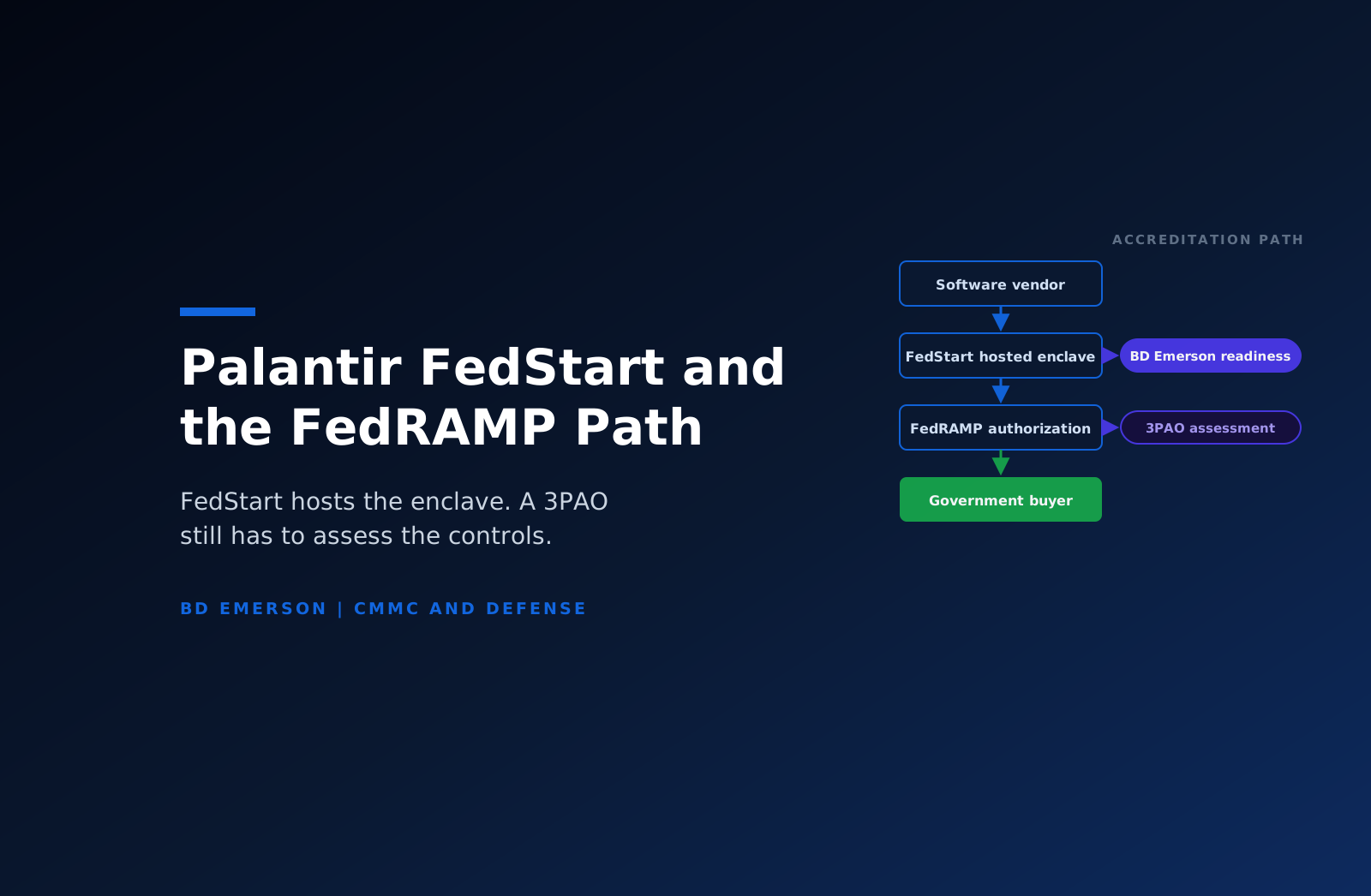
Palantir FedStart is a hosting and accreditation service. A software vendor deploys its product inside Palantir's already-accredited environments, and it can then sell to federal customers under Palantir's FedRAMP and, for defense workloads, Impact Level authorizations instead of pursuing its own from scratch. The practical effect is time. An independent FedRAMP authorization typically takes 12 to 24 months and costs high six figures to low seven figures. FedStart compresses the accreditation path for the hosting layer to weeks or a few months. It does not remove your security obligations, and it does not make your company FedRAMP authorized in its own right.
What FedStart actually provides
FedStart runs a customer's software in Palantir-operated environments that already hold the authorizations government buyers require. Palantir has offered FedStart environments spanning FedRAMP Moderate and High, and Department of Defense Impact Levels up to IL5 and, for some workloads, IL6, which covers the range from controlled unclassified information up to classified. The vendor's application is deployed into that accredited boundary, and Palantir operates the platform, the continuous monitoring, and the relationship with the sponsoring authorization.
Orchestration comes from Apollo, Palantir's deployment layer, which is what makes it practical to ship a vendor's software into environments ranging from commercial cloud to air-gapped and classified without a dedicated team per environment. We wrote about that machinery in Palantir Apollo.
Publicly named FedStart customers have included companies across AI, cybersecurity, and data infrastructure, and the pattern is consistent: a commercially successful product with federal demand and no appetite for a two-year accreditation program before the first federal dollar arrives.
How this relates to FedRAMP authorization
FedRAMP is the US government's standardized program for authorizing cloud services. A cloud service offering is assessed against a NIST SP 800-53 control baseline at Low, Moderate, or High, tested by an accredited third-party assessment organization, and authorized either by an agency or through the program office. Once authorized it is listed in the FedRAMP Marketplace and subject to continuous monitoring. The mechanics are in our explainer on FedRAMP requirements.
Inheritance is the concept that makes FedStart work. A service running on an authorized platform inherits the controls the platform operates and only has to demonstrate the controls it operates itself. This is the same principle that lets a SaaS vendor inherit physical and environmental controls from AWS GovCloud or Azure Government, applied one layer higher up the stack.
What matters commercially is what you can tell a contracting officer. Running inside FedStart lets you say your offering is deployed in a FedRAMP High or IL5 accredited environment. Depending on the agency and the acquisition, that is either sufficient or a strong bridge while you pursue your own authorization. It is a different statement from holding your own FedRAMP authorization with your own package listed in the Marketplace, and the difference will come up in procurement. Decide early which statement your pipeline requires.
What FedStart does not do
The accredited boundary covers the platform. Your application's own security posture is still yours. Secure development, vulnerability management, access control inside your product, incident response, and the personnel requirements that come with government work remain your obligations, and they get assessed.
Three more constraints are worth pricing before you commit. Your software has to be deployable in the model FedStart supports, which is a real engineering constraint for products with unusual architecture or heavy third-party dependencies. Your data stays inside the accredited boundary, which changes how support, telemetry, and debugging work. And you take on a platform dependency, with the commercial and architectural consequences that carries over a five-year horizon.
There is also the exit question. If your federal business grows to the point where you want your own authorization, the control work you did to run inside FedStart transfers partially and the inherited control documentation does not. Plan that sequencing rather than discovering it.
What it costs and how long it takes
Palantir does not publish FedStart pricing, and it varies with environment level and footprint. The comparison that matters is against the alternative. An independent FedRAMP Moderate authorization commonly runs $400,000 to $1 million in assessment, tooling, and advisory costs before internal labor, takes 12 to 24 months, and carries continuous monitoring costs every year after. High and IL5 cost more.
Hosted accreditation trades a recurring platform fee for most of that elapsed time. Whether the trade is good depends on one number: what a year of federal revenue is worth to you. For a vendor with real federal pipeline, twelve months of market access usually settles the argument. For a vendor with one interested agency and no signed intent, the cheaper move is to qualify the demand first.
The CMMC question sits next to this one
FedRAMP and CMMC solve different problems and are routinely conflated. FedRAMP authorizes a cloud service for government use. CMMC certifies a defense contractor's own environment for handling federal contract information and controlled unclassified information, assessed against NIST SP 800-171. If you sell software to the government, FedRAMP is your path. If you are in the defense supply chain and CUI flows through your business, CMMC applies to you regardless of what your product runs on.
Many companies in the FedStart conversation carry both obligations, because the product needs an accredited hosting path and the company handles CUI in engineering, support, and program management. Those are separate scopes, separate evidence, and separate timelines, and treating them as one program is how both slip. Our CMMC gap assessment establishes which of the two actually binds first.
How to sequence the decision
Start with the requirement in your pipeline. Read the actual solicitations and security requirements from the agencies you are chasing, because the difference between a FedRAMP Moderate requirement and a requirement to be listed in the Marketplace changes the answer completely. Then size the delta: what your product already does against the applicable 800-53 baseline, and what it does not.
If the requirement is speed to a first federal award and the baseline gap is manageable, FedStart or an equivalent accredited hosting path is usually the right call. If federal is going to be a substantial share of revenue and you expect to be assessed on your own package, start the independent authorization in parallel and use hosted accreditation as the bridge. Either way the control work is the same work, and only the boundary changes.
Where BD Emerson fits
We do the readiness and implementation side of this. Our FedRAMP compliance consulting practice runs gap assessments against the applicable baseline, builds the System Security Plan and supporting policies, implements the controls your product is missing, and prepares the evidence an assessor will ask for. On the defense side we do the equivalent against NIST SP 800-171, including scoping the CUI boundary, which is where most of the cost in a CMMC program gets decided.
To be precise about what we are and are not: BD Emerson performs implementation and readiness work. We are not a 3PAO and we are not a C3PAO, so we do not perform the assessment that results in your authorization or certification. That separation is deliberate, and it means we can prepare you for an assessment without holding a stake in the outcome.
We are also a Palantir implementation partner, which is why this sits in our practice at all. Companies evaluating FedStart usually need someone who understands both the Palantir side of the deployment and the federal control baseline they are being measured against.

About the author