Palantir Competitors and Alternatives
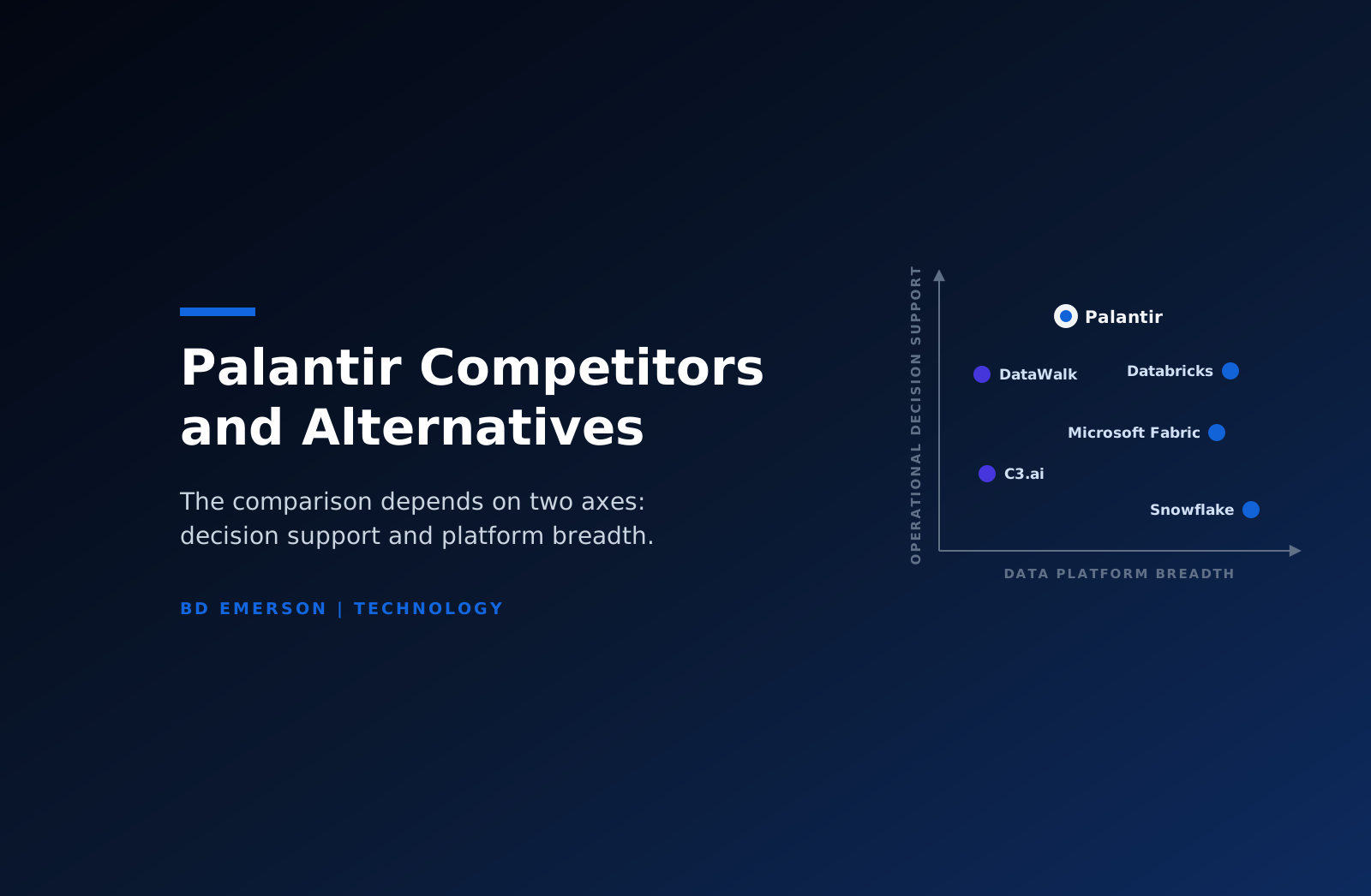
Palantir's real competitors depend on which problem you are solving. If you need a governed data and machine learning estate, the alternatives are Databricks, Snowflake, and Microsoft Fabric. If you need an operational layer where people and agents act on data across many systems, there is far less on the shelf, and the credible alternatives are C3.ai for industrial AI, DataWalk for investigative and link analysis work, and building it yourself on a cloud stack. Palantir wins evaluations where the requirement is operational execution across many source systems under tight governance. It loses them when the requirement is analytics, reporting, or a single well-defined data product.
The comparison that gets set up wrong
Most Palantir evaluations start as a platform bake-off and end in confusion, because the shortlist mixes categories. A lakehouse and an operations platform answer different questions, and scoring them on one matrix produces a spreadsheet where both look mediocre. We wrote the long version in Palantir vs Databricks, and the short version is that Databricks answers how you engineer and govern data while Foundry answers how people and agents act on it.
Before comparing vendors, write down which of three problems you have. The first is a data estate problem: pipelines are fragile, definitions conflict, nobody trusts the numbers. The second is an analytics problem: the data is fine and the reporting is slow or fragmented. The third is an operational problem: the data exists, the reports exist, and decisions still get made in spreadsheets and email because no system spans the workflow. Palantir is priced and built for the third. Buying it for the first two is how organizations end up with an expensive platform and a disappointed sponsor.
The second framing error is comparing Palantir to a product when a large part of what you are buying is a delivery model. Palantir engagements come with forward deployed engineers who build in your environment, and a meaningful share of the outcome depends on that. When you compare against Databricks or Fabric, you are comparing a licensed platform plus whatever implementation capacity you can field. Price and scope the delivery side of both options, or the comparison is not real.
Databricks
Databricks is the strongest alternative when the problem is the data estate. It covers ingestion, transformation, streaming, lakehouse storage in open table formats, and the full model lifecycle, with Unity Catalog as a single governance plane over tables, models, and AI assets. Its users are data engineers and data scientists.
Where it differs from Foundry is the layer above the data. Databricks gives you governed datasets, notebooks, dashboards, and model endpoints. It does not ship a business object model with permissioned write-back actions and application scaffolding. Teams that need those build them, and the build is usually underestimated by a year. Where Databricks is stronger: open table formats, cost transparency, a much larger talent pool, and no dependency on one vendor's delivery model.
Snowflake
Snowflake competes for the same budget and the same executive attention, and it wins when the center of gravity is SQL analytics, data sharing, and a governed warehouse that a broad population of analysts can use without specialist skills. Its separation of storage and compute makes cost attribution straightforward, which matters to finance teams that have been surprised by platform bills before.
Snowflake has moved toward applications and AI with Snowpark, Native Apps, and Cortex, and the gap with Foundry is narrower than it was three years ago. It remains a data platform with applications on top rather than an operations platform with data underneath. For a company whose main problem is that forty analysts cannot get consistent answers, Snowflake is a better fit and a smaller change program. Our comparison of the two data platforms is in Databricks vs Snowflake.
Microsoft Fabric
Fabric is the default alternative in Microsoft-heavy enterprises, and the argument for it is usually commercial rather than technical: the licensing is already negotiated, the identity model is already in place, Power BI is already deployed, and the internal skills already exist. That combination beats a better platform more often than vendors like to admit.
The trade is maturity and depth on the operational side. Fabric consolidates a lot of previously separate Microsoft services, and the integration is still settling. If your use case is operational workflows spanning a dozen non-Microsoft systems under a strict governance regime, Fabric will require substantially more construction than Foundry. If your use case is analytics and reporting inside a Microsoft estate, Foundry is more platform than the problem needs.
C3.ai
C3.ai is the closest thing to a direct competitor in the industrial and energy segment, and it competes on prebuilt applications. Where Palantir sells a platform plus a delivery model, C3.ai sells applications for predictive maintenance, reliability, supply network risk, and energy management, with a model-driven architecture underneath.
The evaluation comes down to whether a prebuilt application fits your operation closely enough. When it does, time to value is faster and the price is lower. When it does not, you are configuring around an opinionated application rather than modeling your own operation, and the ceiling arrives early. Reference checks in your specific industry matter more here than in any other comparison on this list.
DataWalk
DataWalk shows up in the investigative use cases Palantir Gotham built its reputation on: fraud, financial crime, law enforcement, and insurance investigation. It handles entity resolution, link analysis, and analyst workflows, and it competes on price and time to deploy against a much larger vendor.
For an agency or a fraud unit whose requirement is analyst-driven investigation across linked data, DataWalk is a credible shortlist entry and frequently a cheaper one. It is a narrower product, so it weakens as a choice when the requirement broadens into enterprise-wide operations, data engineering, and application delivery.
Building it yourself
The build option is real, and it is the one most large enterprises actually compare against. A competent platform team can assemble a lakehouse, a semantic layer, an orchestration tool, a permissions model, and a set of internal applications on cloud services. Several have done it well.
What the business case usually misses is the second half. The parts that take time are field-level permissions that hold up in an audit, write-back to systems of record with validation and rollback, lineage that survives schema changes, and an application layer that operators will use instead of exporting to Excel. Budget two to four years and a permanent team, and be honest about what happens when the two engineers who understood the permissions model leave. Our data engineering practice builds these stacks, and we still tell clients the build is the right answer only when the operational model is unusual enough that no platform fits, and the organization has the engineering bench to maintain it for a decade.
Where Palantir is the wrong answer
Four situations come up repeatedly. You have one well-defined analytics problem and a working warehouse, in which case a data mart and a dashboard will finish the job for a fraction of the cost. Your organization cannot commit an operational sponsor and a decision-making forum, in which case the ontology never gets settled and the platform becomes a very expensive data lake. Your total data estate is small enough that a mid-market tool covers it. Or your procurement process cannot accommodate a vendor that prices per deal and expects a services relationship, which is a real constraint in parts of the public sector and in cost-sensitive private equity portfolios.
The fifth case is more common than the other four combined. The organization wants the outcome Palantir markets and is not prepared to change how decisions get made. No platform on this list solves that, and the ones that promise to are selling you the same disappointment at a lower price.
How to run the selection
Score against the workflow rather than the feature list. Pick one operational decision that costs you money today, and ask each vendor to show that decision being made in their platform, on your data, with your permission model. Two weeks of that is worth more than a hundred-line requirements matrix.
Then price the whole program, including implementation, internal capacity, and the second year, which is where the real difference between these options appears. Ask each vendor for the shape of year two specifically. Platform cost in year one is usually the smallest number in the program. What matters is whether the platform keeps needing specialist labor to extend, and whether that labor has to come from the vendor.
BD Emerson implements Palantir and Databricks and takes no resale margin from either, so we have no reason to steer the answer. Our Palantir consulting practice runs these evaluations alongside the teams who will own the result.

About the author