Why AI Pilots Stall Before Production
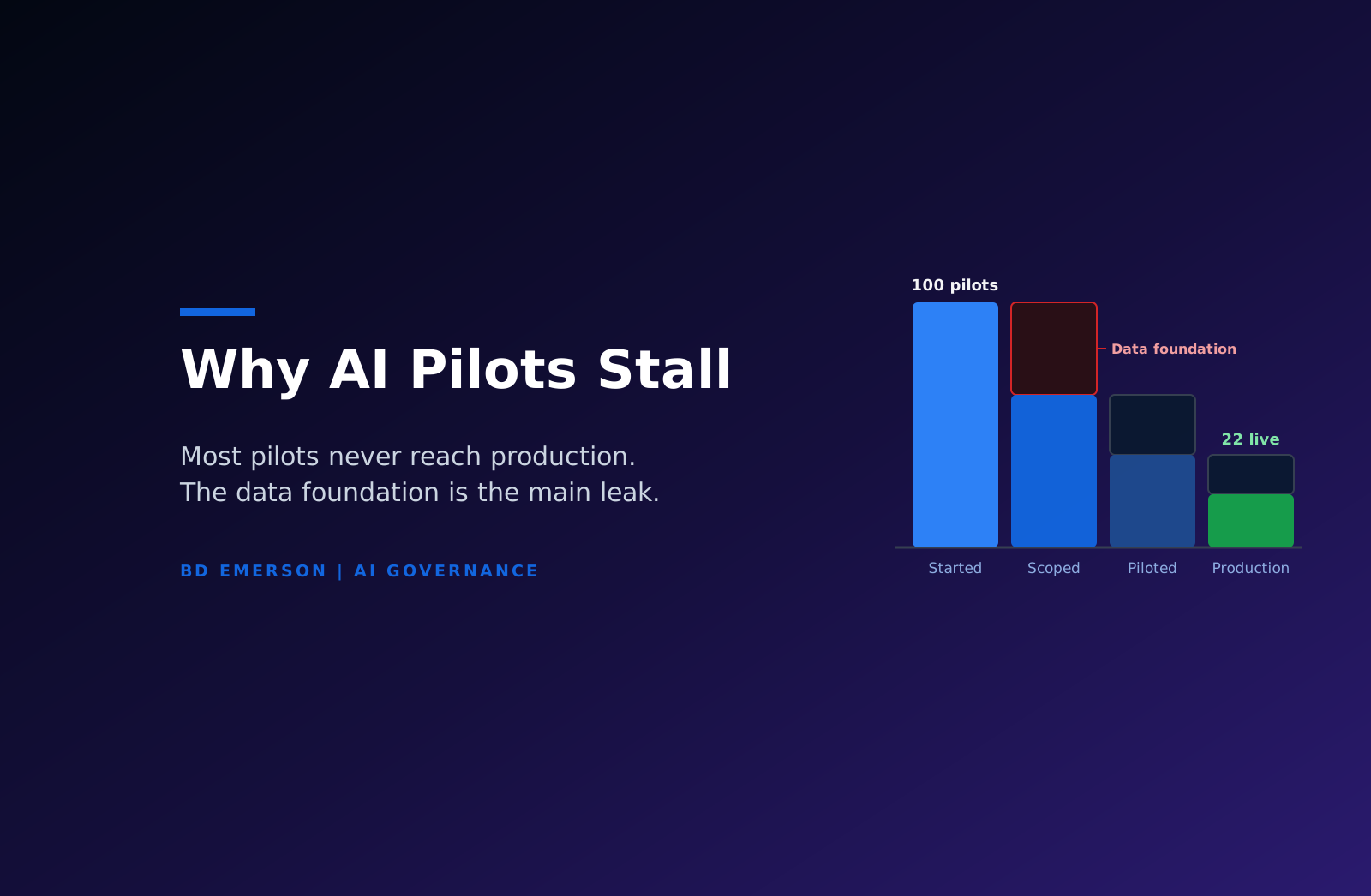
The pattern repeats across industries: a team ships an impressive demo in six weeks, leadership funds a pilot, the pilot runs a quarter, and production never arrives. The numbers say this is the norm rather than the exception. MIT's Project NANDA reported in 2025 that about 95 percent of enterprise generative AI pilots showed no measurable P&L impact. S&P Global found that 42 percent of companies abandoned most of their AI initiatives in 2025, up from 17 percent a year earlier. The causes rank consistently: ungoverned data foundations, no owner for model risk, no ROI baseline, security review arriving last, and integration debt. Every one of them is addressable before the pilot starts, which is exactly when almost nobody addresses them.
Why demos flatter and production punishes
A demo runs on curated data, a forgiving user, and a happy path. Production runs on the real corpus with its permissions and its rot, users who type the wrong thing, edge cases at volume, and an error budget somebody has to own. The gap between those two environments is not a polish problem; it is the actual work, and it is routinely 5 to 10 times the effort of the demo. Teams that present the demo as 80 percent done have set their own trap, because every stakeholder now anchors on a finish line that was never real. The five causes below, in rough order of how often they kill the project, are what fills that gap.
Cause 1: ungoverned data foundations
Most stalled pilots trace back to data nobody governed. The pilot ran against a hand-picked folder; production needs the real estate: duplicated records, stale documents, conflicting versions, and permissions that have been wrong for years without consequence. Retrieval-based systems make old sins visible. An assistant that indexes the shared drive will surface the spreadsheet nobody remembered was open to all staff, and suddenly the AI project is a data governance incident with a comms plan.
Quality does the quieter damage. Models grounded on contradictory or outdated content produce confidently wrong answers; users catch a few, trust collapses, and adoption flatlines within a month. The remediation is unglamorous, ownership, lineage, access rights, retention, deduplication, which is why realistic AI roadmaps put data work in the first phase rather than the appendix, and why unrealistic ones stall in month four.
Cause 2: nobody owns model risk
A model in production makes mistakes at some rate, forever. Someone has to decide what error rate is acceptable for this use case, what happens when the model is wrong, who reviews drift, and under what conditions the system gets pulled. In most stalled pilots, no one holds that authority. Legal will not sign off because there is nothing specific to sign off on. A review committee convenes without criteria and defaults to no. The pilot idles in approval purgatory until the budget cycle ends it quietly.
The fix is structural and boring: name a model risk owner with authority to accept risk in writing, define evaluation criteria and escalation paths per use case, and give the review board a rubric so approval becomes a checklist rather than a debate. Companies with model risk management traditions, banks operating under the Federal Reserve's SR 11-7 guidance, for instance, stall here far less often. Their models are not better; the decision has a desk it sits on.
Cause 3: no ROI baseline
The pilot went well is not a business case. If nobody measured the process before the pilot, minutes per ticket, cost per document processed, cycle time per contract review, then nobody can prove the pilot changed anything, and a CFO asked to fund production scaling on enthusiasm will decline. This is how technically successful pilots die: the model performed, and the value claim was unfalsifiable.
The discipline costs about two weeks up front. Pick the metric, measure the current state, set the delta that would justify production economics including inference, integration, and support costs, and instrument the pilot to report against it from day one. Pilots designed this way also get killed, but they get killed fast and for defensible reasons, which frees budget and attention for the candidates that clear the bar. A portfolio that kills three of five pilots on evidence outperforms one that lets five drift.
Cause 4: security review as an afterthought
The pilot gets built in a sandbox with API keys in a notebook, then arrives at security review two weeks before the planned production date. The review finds what reviews find: prompt injection paths nobody considered, sensitive data flowing to a third-party API without a data processing agreement, no audit logging, vendor terms nobody read, and access scopes wide enough to be findings in themselves. Remediation takes 6 to 12 weeks, the launch window closes, and sponsors drift to the next initiative.
None of that is security being difficult; it is sequencing. AI systems carry attack surfaces that traditional review checklists do not cover, so the fix is to involve security at design time, threat model the data flows before anything is built, and run AI-specific testing before the formal review rather than in response to it. Teams that do this treat the security requirements as part of the definition of done, and their reviews take days instead of quarters.
Cause 5: integration debt
The demo bypassed everything production requires: single sign-on, role mapping, audit logging, rate limits, error handling, data contracts, change management, and an on-call rotation. Wiring an AI system into a 15-year-old ERP without a usable API is a systems integration project the pilot budget never contained, and the last 20 percent of integration reliably consumes 80 percent of the timeline. This is also where per-seat pilot pricing meets production inference costs at real volume, and where latency that was tolerable in a demo becomes a workflow blocker at scale. Teams that scope integration honestly at the start either budget for it or pick a use case with a shorter path into the workflow. Both choices beat discovering the debt in month five.
What the fix looks like
The fix is selection pressure before spend. A structured AI readiness assessment scores the organization and each candidate use case across the dimensions that decide outcomes: data quality and governance, risk ownership, measurable value, security posture, and integration surface. Use cases that score poorly get fixed or cut before they consume a quarter of engineering time. The output worth paying for is a ranked portfolio with the gaps named, owned, and priced, not a maturity heat map for a steering committee slide.
From there, a governance-first roadmap sequences the work: foundations first, meaning data ownership, access remediation, model risk structure, and security requirements; then pilots that inherit those foundations instead of improvising around them; then scale for the pilots that clear their pre-agreed ROI bar. That sequencing discipline is the core of serious AI strategy consulting, and it shows up in portfolio statistics as fewer pilots started and a far higher fraction shipped.
The uncomfortable summary
Pilots do not stall because the models underperform; the model is usually the most reliable component in the stack. They stall because the organization around the model, its data, its risk decisions, its measurement, its security process, its integration surface, was never made ready, and a pilot is precisely the instrument that discovers this. Companies that internalize the lesson stop asking which model and start asking which use case we can govern, measure, secure, and integrate, which is the question enterprise AI consulting engagements exist to answer. The 5 percent that show P&L impact are not luckier. They did the unglamorous half first.

About the author