What Is Palantir AIP? The Artificial Intelligence Platform Explained
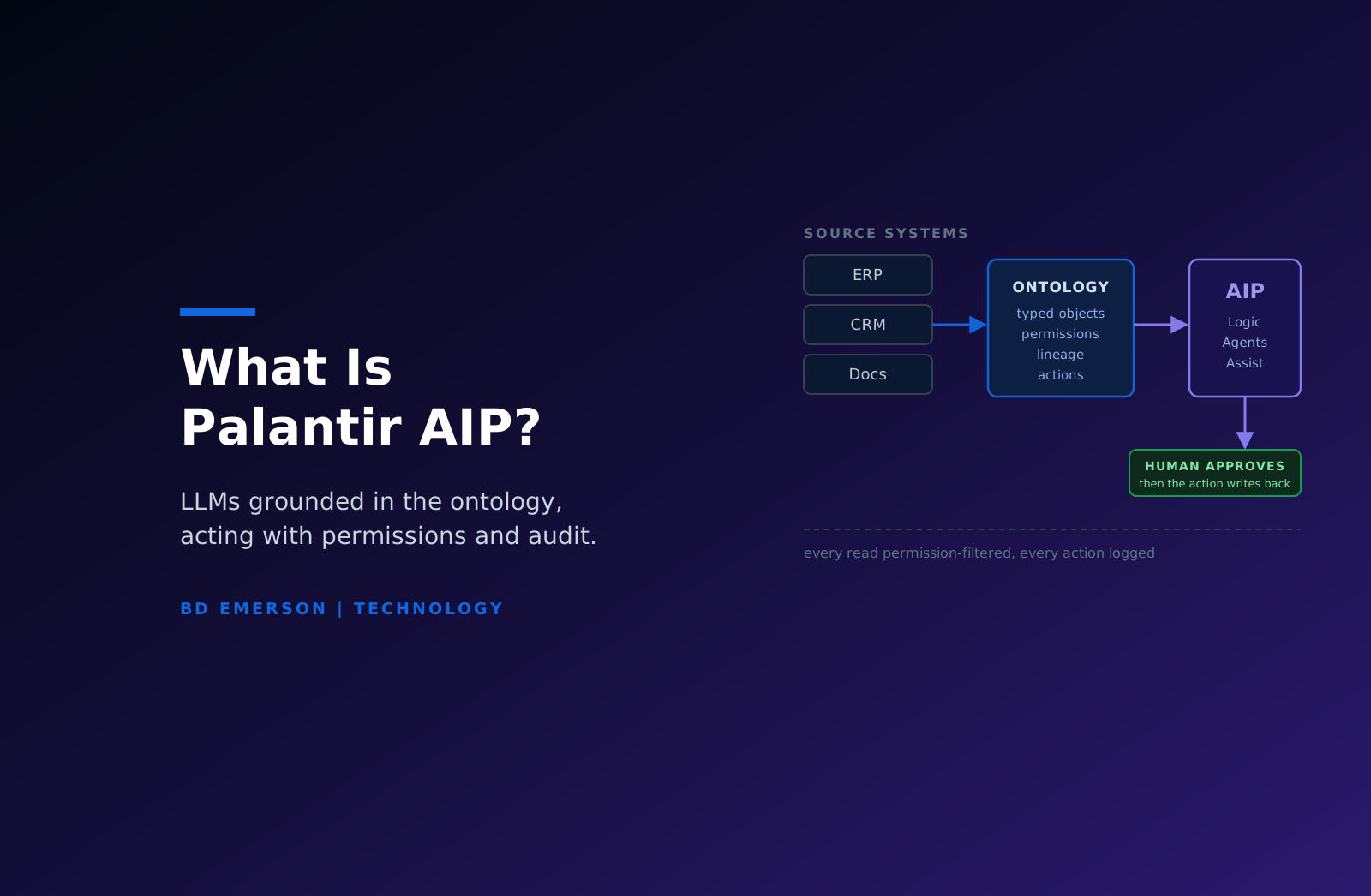
Palantir AIP is the Artificial Intelligence Platform, the layer of Palantir's stack that connects large language models to an organization's operational data and lets them take governed action inside it. Announced in April 2023, AIP is not a separate product you license on its own: commercial buyers get it as part of a Foundry deployment, where it uses the ontology, Foundry's semantic model of your business, as the grounding layer that tells a model what a customer, a shipment, or a claim actually is. The practical difference from a generic LLM deployment is that AIP models operate on live, permissioned business objects and can trigger real workflows, with every action logged. That is also why AIP succeeds or fails on the quality of the Foundry implementation underneath it.
What AIP actually is
Strip away the branding and AIP is three things bolted onto Foundry. First, a model layer that brokers access to LLMs, including OpenAI and Anthropic models through cloud providers, open-weight models, and models a customer hosts itself. Second, an orchestration layer, AIP Logic, where teams compose LLM functions with tools, retrieval, and branching without writing application code. Third, an agent layer, Agent Studio, where those functions become persistent agents that watch queues, draft decisions, and hand off to humans at defined checkpoints.
All three depend on the ontology. When an AIP agent reads "order 4471 is late," it is not parsing a PDF or guessing from column names. It is reading a typed object with defined properties, linked to a customer object, a carrier object, and an action set that says what a user, or an agent, is allowed to do about lateness. The model's context window gets structured, permission-filtered objects rather than raw tables, and its outputs land as proposed edits to those objects rather than free text. That design is the entire argument for AIP over a homegrown stack: the hard part was never calling a model API, it was giving the model a safe, current, and complete picture of operations.
How AIP differs from building your own LLM stack
Most enterprises that started with a DIY retrieval pipeline in 2023 or 2024 learned the same lesson: the demo took three weeks and production took a year, because production meant permissions, lineage, evaluation, and write-back. AIP's pitch is that those four problems are already solved by Foundry primitives. Permissions come from the ontology's granular access controls, so a model can only see what the requesting user can see. Lineage is inherited from Foundry's pipeline layer, so you can trace a generated answer back to source systems. Evaluation harnesses live inside AIP Logic, so prompt and model changes get regression-tested like code. Write-back happens through action types with validation rules, so an agent cannot push a change the schema forbids.
The honest counterweight: you are buying those guarantees at platform prices, and they are only as good as your ontology. A thin ontology produces a thin AIP, and teams that skipped the data modeling work find their agents hallucinating for the same reasons their dashboards were already wrong. If your data foundation is weak, the money is better spent there first, whether or not Palantir is the vehicle.
What AIP costs
Palantir does not publish AIP pricing. In commercial deals AIP capability ships inside the Foundry subscription, with usage-based compute on top, and model inference billed through whichever provider serves the tokens. The realistic planning numbers are the Foundry numbers: commercial platform subscriptions that typically start in the mid six figures per year and scale with usage and seats. We break the components down in what Palantir actually costs, including where compute consumption surprises first-year buyers. Budget separately for implementation: the ontology and pipeline work that makes AIP useful is services effort, whether Palantir's own engineers, a partner, or your team does it.
AIP Logic, Agent Studio, and AIP Assist in practice
AIP Logic is where most real deployments start. A logic function takes inputs, typically ontology objects, applies one or more model calls with tools such as search, calculators, or API calls, and returns a typed output. Because functions are versioned and testable, teams treat them like code artifacts, which is what makes them deployable in regulated environments. Common first builds are document extraction into ontology objects, triage functions that classify and route incoming work, and drafting functions that prepare a response a human approves.
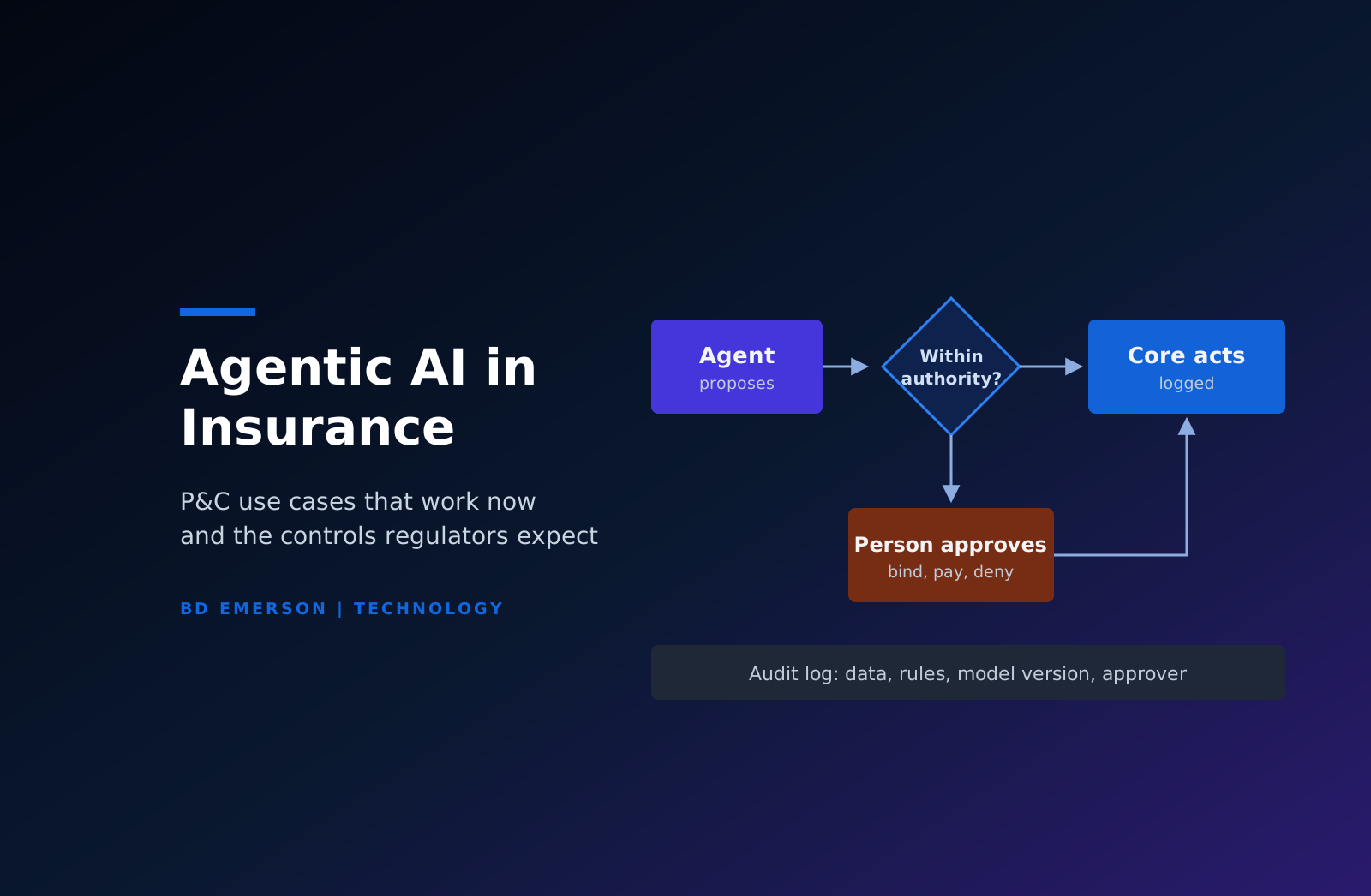
Agent Studio turns functions into standing agents with scoped permissions and human checkpoints. The checkpoint design matters more than the model choice: the deployments that survive audit are the ones where the agent proposes and a named human approves anything with financial or customer impact. AIP Assist, the conversational interface across the platform, is the piece users meet first, but it is the least differentiated part of the stack, and buying Foundry for a chat interface alone is a mistake.
AIP and the rest of the Palantir stack
AIP capabilities run across Palantir's platforms, including its government products, but commercial buyers encounter AIP as a set of capabilities inside Foundry. If you are evaluating the platform, evaluate it as one decision: Foundry as the data and ontology foundation, AIP as the intelligence layer on top. Palantir's five-day bootcamps are the standard on-ramp, and they are effective at producing a working prototype against your own data quickly. Treat the bootcamp output as a prototype, though. The distance between a bootcamp win and a production deployment is measured in data engineering, ontology design, security review, and change management, and that distance is where timelines and budgets actually live.
What teams build first, and how to measure it
The pattern across successful first deployments is boring on purpose: pick a decision that happens hundreds of times a week, has a measurable error cost, and already lives in Foundry data. Claims triage in insurance, exception handling in supply chain, contract intake in procurement, and maintenance prioritization in industrial operations all fit the shape. Each has a clear baseline, which is the point. An AIP deployment without a baseline produces testimonials; one with a baseline produces a number, and the number is what earns the second and third use case their budget.
Set the measurement contract before the build: what the human process gets right today, what rate the agent must hit before it graduates from draft-only to auto-approve on low-risk cases, and who reviews the disagreement log weekly. Teams that skip this end up in the demo loop, where the system impresses everyone quarterly and changes nothing operationally. The evaluation tooling inside AIP Logic makes the discipline cheap to run. It cannot make anyone run it.
The failure modes to plan around
Three patterns account for most stalled AIP programs. The first is ontology debt: the bootcamp prototype ran on a handful of hand-curated objects, and production needs hundreds of object types with owners, definitions, and pipelines, which is months of unglamorous work nobody scoped. The second is workflow bypass: the agent produces good outputs into a queue nobody's process actually reads, because the operating procedure was never changed to include it. The third is governance arriving late: security and compliance review starts after the build, discovers the agent can see data its users cannot, and the program loses two quarters to rework that a week of upfront design would have prevented. All three are avoidable, and all three are implementation problems rather than platform problems, which is exactly why the implementation partner matters as much as the license.
What to have in place before AIP pays off
Three preconditions separate AIP deployments that compound from ones that stall. Source systems need reliable pipelines into Foundry, because agents amplify stale data into confident wrong answers. The ontology needs to model the decisions you want automated, not just the tables you happen to have, which is a design exercise with operators in the room. And there needs to be an owner for evaluation: someone accountable for measuring whether the agent's outputs are correct, at what rate, against what baseline. Palantir gives you the tooling for all three. It does not do the work for you, and neither does any other platform.
Where BD Emerson fits
BD Emerson is an implementation consultancy for Palantir environments. We are not Palantir, we do not resell licenses, and we take no margin on the software, which means our only incentive is that the deployment works. Our teams build the pipelines and ontology that AIP depends on, design agent workflows with defensible human checkpoints, and put the security and governance controls around the platform that regulated buyers need. If you are weighing an AIP bootcamp, planning the jump from prototype to production, or deciding whether Foundry is the right foundation at all, our Palantir consulting practice can give you a straight answer on scope, cost, and sequencing before you commit.

About the author