CMMC Compliance Software: What It Actually Does and How to Choose
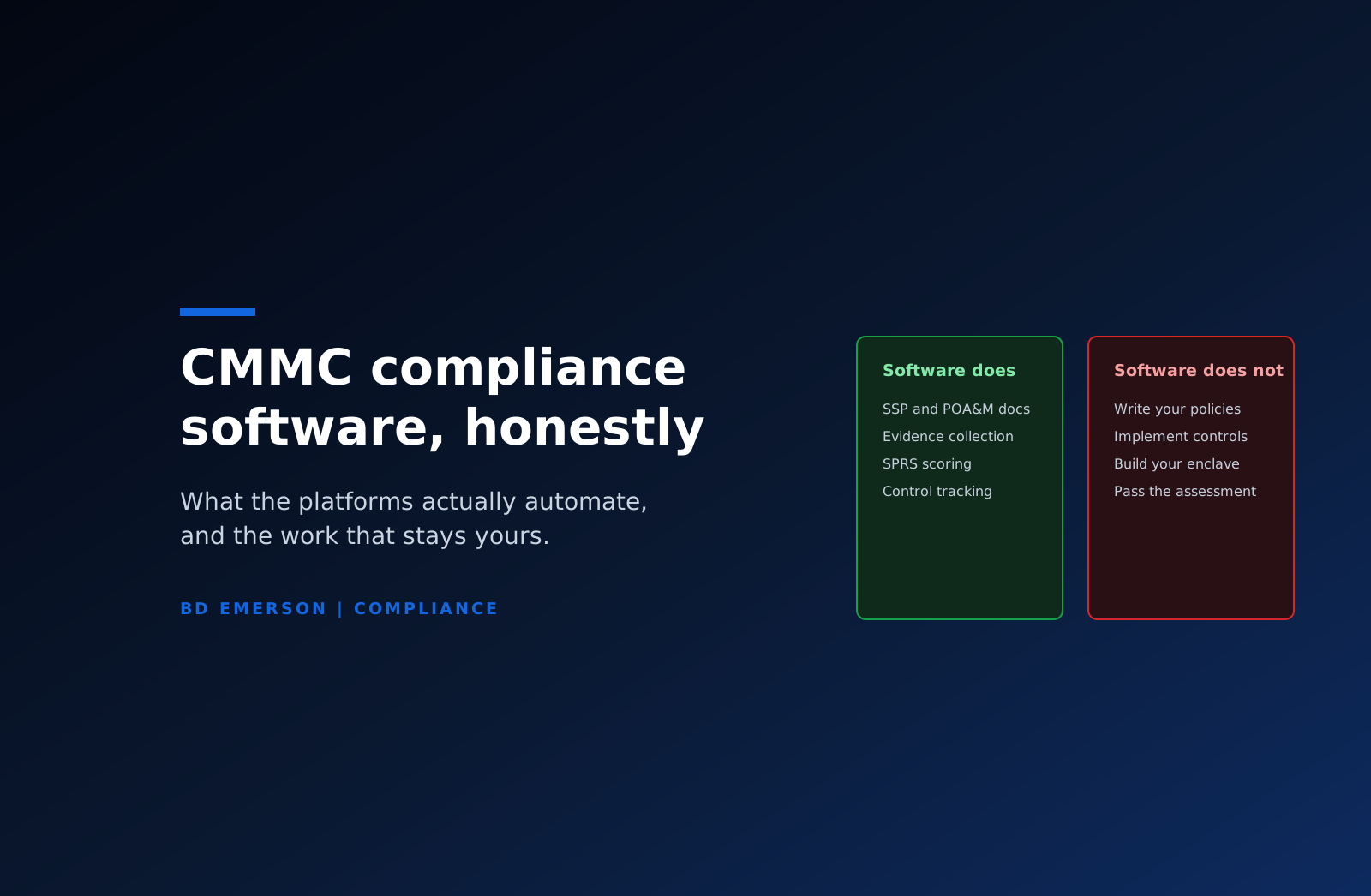
CMMC compliance software helps with the paper and proof side of the program: building and maintaining the System Security Plan, tracking the POA&M, collecting and refreshing evidence against the assessment objectives, computing the SPRS score, and keeping 110 requirements assigned to owners who know what they owe. It does not implement controls. No platform will deploy your multifactor authentication, validate your cryptography, segment your network, or stand up your enclave, and an assessor scores the environment, never the dashboard. One disclosure before the category guide: BD Emerson implements several of the platforms discussed below for clients, so we make money when some of these tools get bought. We have tried to let the limitations speak as loudly as the strengths.
What the software actually does well
Four jobs justify the spend. The SSP as a living document: 110 requirements, each with an implementation statement, responsible owner, and covered systems, is a maintenance problem that a structured tool handles better than a 200-page word processor file that three people edit and nobody versions. The POA&M with mechanics attached: owners, milestones, dates, and the 180 day closeout clock, tracked instead of remembered. Evidence collection on a schedule: the difference between an assessment that goes smoothly and one that stalls is whether producing proof for a given requirement takes five minutes or a day, and tooling that files artifacts by requirement and refreshes them quarterly builds that capability. And SPRS scoring: computing the minus 203 to 110 number against the 5, 3, and 1 point weights, and recomputing it as items close, without spreadsheet drift. What good SSP structure looks like is covered in our SSP guide; the evidence habits worth automating are in the CMMC compliance checklist.
One mechanical note that surprises buyers: none of these platforms submits anything to the government for you. SPRS entries still go in by hand through the PIEE portal, affirmations are still signed by your senior official, and a C3PAO still collects evidence through its own process. The software's output is readiness, meaning a current SSP, a defensible score, and artifacts that surface in minutes, and that output is real. The submission and the assessment stay manual and human.
GRC platforms: Vanta, Drata, Secureframe, Hyperproof
These platforms grew up automating SOC 2 and ISO 27001, and their core trick is API integration: connect the identity provider, cloud infrastructure, MDM, and ticketing system, and the platform continuously tests controls and gathers evidence without a human screenshotting anything. All four now ship NIST SP 800-171 and CMMC frameworks, and Hyperproof in particular positions for multi-framework programs with heavier customization.
The honest fit assessment: they are strongest for contractors who already run one of them for SOC 2 or ISO 27001 and can extend to 800-171, and for cloud-native companies whose in-scope stack is exactly what the integrations cover. The limits show up in defense-specific terrain. Integration coverage inside GCC High and GovCloud environments lags the commercial equivalents, sometimes badly, which is a real problem given that the enclave is often where all the evidence lives. Automated checks map to controls, while a C3PAO assesses roughly 320 objectives from NIST SP 800-171A, so objective-level evidence still takes human assembly. And the platforms have no opinion about your scoping, which is the decision that determines whether the rest of the program is even priced correctly. A green dashboard is a monitoring result. MET is an assessment result. They correlate; they are not the same thing.
BD Emerson implements Vanta for clients, including 800-171 programs on it, through our Vanta implementation services. That experience is where this section's opinions come from, in both directions.
Purpose-built CMMC tools
A second category, FutureFeed being the best known, was built for CMMC rather than adapted to it. These tools speak the program's native language: assessment objectives rather than just requirements, SPRS math built in, POA&M rules encoded, scoping worksheets that follow the CMMC asset categories, and workspaces designed for eventual C3PAO collaboration. What they mostly lack is the API-driven evidence automation that the GRC platforms sell; evidence lands in them because a person put it there. For a defense-focused contractor with no SOC 2 obligations and a program run by one or two people, that trade often makes sense: the hard part of their year is the paperwork discipline, and the automation would have covered a commercial stack they do not run anyway.
Documentation kits
The third category is not software at all: policy and procedure template libraries mapped to NIST SP 800-171, with ComplianceForge the established name. For a few hundred to a few thousand dollars, one-time, you get the document skeleton of a compliance program, which beats writing forty policies from a blank page. The caveat that matters: a template describes a generic company, and assessors read policies against practice. A policy that names systems you do not run and review cadences nobody follows is worse than a shorter one that tells the truth, because the mismatch becomes a finding and an invitation to probe. Budget real tailoring effort, measured in weeks, or the kit is shelf decoration with a license.
What software cannot do
It cannot write policies that describe your company; it can generate text, and the gap between generated and true is exactly what an interview exposes. It cannot implement technical controls, and the expensive requirements, multifactor authentication everywhere, FIPS validated cryptography, logging with review, are engineering projects with their own budgets. It cannot be your enclave: a compliance platform is a place to manage the program, and if CUI itself would land in the tool, in evidence screenshots or uploaded artifacts, the tool becomes a cloud service that needs FedRAMP Moderate authorization or documented equivalency, so most programs deliberately keep CUI out of it. It cannot generate operating history, since assessors sample real tickets, reviews, and training records across months. And it cannot make the scoping decision that determines most of your cost. Every one of these lives on the implementation side of the line, which is people and engineering.
How to choose, by level and size
At Level 1, with 15 requirements and an annual self-assessment, a spreadsheet and a disciplined evidence folder are defensible, and any spend beyond that should buy time savings you can name. At Level 2 under about 75 people and defense-only, the purpose-built tools or a documentation kit plus consulting hours usually beat a GRC subscription, because the automation would idle against a small or enclave-bound stack. At Level 2 with an existing Vanta, Drata, or Secureframe deployment for commercial frameworks, extend it, and accept that enclave evidence will be partly manual. Multi-framework companies at any size should weigh consolidation on one platform against best-of-breed per program, and usually consolidation wins on the strength of a single evidence library. On price, expect GRC platforms in the low five figures annually for most small and mid-sized contractors, purpose-built CMMC tools generally under that, and kits as one-time purchases. Whatever you pick, the selection criteria are stable: objective-level granularity, evidence export an assessor will accept, integration coverage in the environment where your CUI actually lives, and a price that does not consume the remediation budget.
Budget the labor beside the license. A GRC platform configured properly takes four to eight weeks of setup: connecting integrations, mapping controls to the 800-171 framework, tuning tests that fire false positives, and assigning owners who will actually clear their queues. Skipping that setup is the most common way these purchases fail, and it is why implementation services exist as a category. A purpose-built tool or a documentation kit trades less setup for more ongoing manual effort, which is a fine trade at small scale and a poor one past a few hundred employees.
Where software fits the program
The sequence of a CMMC program does not change because a platform entered it: scope the boundary, assess the gap, remediate, operate long enough to have history, then assess. Software makes a real program cheaper to run and a weak one better documented, and only one of those is worth paying for. Our CMMC consulting practice does the implementation side, scoping, gap assessment, remediation, SSP development, and mock assessment, with or without a platform underneath, and we will say plainly when a tool is the wrong spend for your size. The standing boundary applies here too: BD Emerson is not a C3PAO, and a separate certified assessor performs the certification assessment. Independence from the assessment is what lets a readiness firm, or a software recommendation, be honest with you about what will fail.

About the author