What Is a Divestiture? Structures, Process, and Timeline
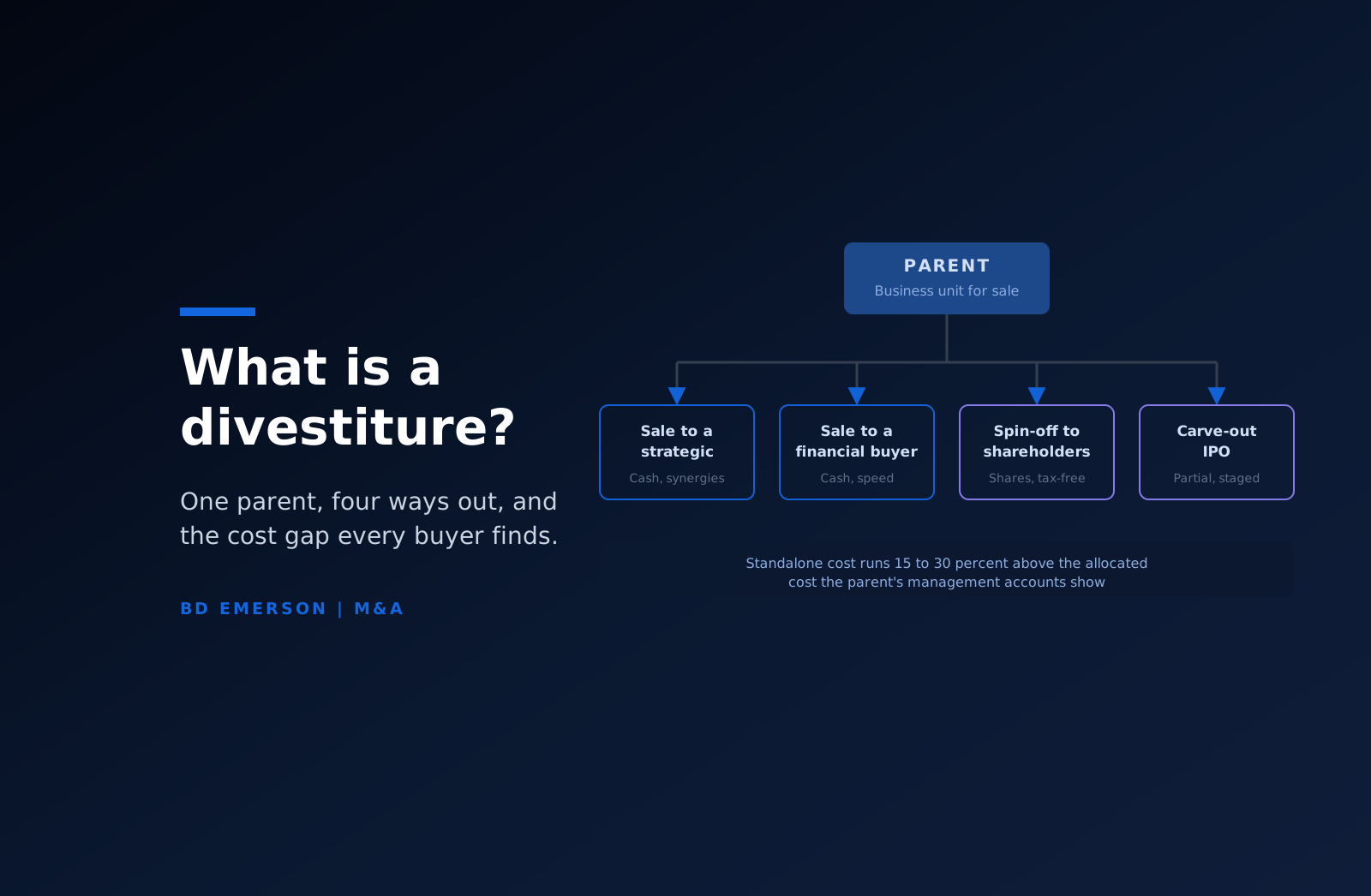
A divestiture is the sale or separation of a business unit, product line, subsidiary, or asset by the company that owns it. The parent gives up control, the business ends up owned by a buyer or by the parent's own shareholders, and the proceeds go to the seller's balance sheet. Companies divest to fund something else, to exit a business someone else would run better, to satisfy a regulator clearing another deal, or because investors argue the parts are worth more apart than together. A divestiture is the reverse of an acquisition and runs on the same machinery: define the perimeter, build the financials, market the asset, negotiate, close, then separate.
Why companies divest
Portfolio focus is the most common reason and the least dramatic. A business that fit two strategies ago now takes management attention out of proportion to what it contributes, and a different owner would invest in it properly. Capital is the second reason: a divestiture converts a slow-compounding asset into cash for debt paydown, a buyback, or an acquisition the board wants more. Regulatory divestiture is the third, ordered as a condition of clearing another transaction, and it arrives with a deadline and often a trustee, which leaves the seller little room to negotiate on price or timing.
The fourth reason is the valuation argument. Public markets frequently pay less for a business buried inside a diversified parent than a focused peer earns on its own, and closing that gap is the case activist investors make when they push for a breakup. Underperformance is a reason as well, though it is rarely the one stated publicly. A business losing share is harder to sell and prices accordingly, which is why the decision to exit is better made a year before the numbers force it.
The four structures
The structure decides who ends up owning the business, how the proceeds arrive, and how long the separation runs.
- Sale to a strategic buyer. A competitor or adjacent operator buys the business for cash. Strategics can pay for synergies a financial buyer cannot model, so they often clear the highest price, but they may also fold the business into their own systems immediately, which shortens the transition services period and raises the antitrust question.
- Sale to a financial buyer. A private equity fund buys the business and stands it up as an independent company. Financial buyers scrutinize standalone cost harder than anyone else, because they have to fund it, and they need a longer transition services agreement since they have no systems to migrate into.
- Spin-off. The parent distributes shares of the business to its own shareholders as a dividend, creating a separate public company. No buyer, no proceeds, and in the United States no tax at distribution if the structure qualifies under Section 355. Spin-offs suit large businesses that can carry public company costs on their own.
- Split-off or carve-out IPO. In a split-off, shareholders exchange parent stock for stock in the separated business, which retires parent shares. In a carve-out IPO, the parent sells a minority stake to the public and keeps control, usually as the first step of a staged exit that ends in a spin-off of the remaining shares.
How a divestiture differs from a spin-off and a carve-out
Divestiture is the umbrella term. Every spin-off is a divestiture, and so is every carve-out sale, but the reverse does not hold. The distinctions that matter in practice are who pays and who ends up owning the business.
A spin-off has no buyer. The parent's existing shareholders own the new company on day one in the same proportion they owned the parent, and the parent receives no cash. That makes a spin-off a poor answer when the board wants proceeds and a good answer when it wants two focused equity stories and a tax-efficient path to get there. The tradeoff is that the separated company must be large enough to absorb its own board, audit, listing, and investor relations costs, which typically start around $5 million a year for a smaller public company.
A carve-out describes the separation work rather than the transaction type. When the business being sold has never had its own legal entity, financial statements, ERP instance, or employment contracts, extracting it is a carve-out, and the deal is both a divestiture and a carve-out at the same time. Selling a clean standalone subsidiary is a divestiture with no carve-out attached, and those deals move considerably faster. Our carve-out advisory practice handles the separation side of the work when the perimeter is entangled.
What the process looks like end to end
The sequence is consistent even when the structure changes. It starts with a perimeter decision: which legal entities, contracts, customers, employees, intellectual property, and facilities go with the business, and which stay. That decision drives everything downstream, and reopening it after a buyer is in diligence is the most expensive change a seller can make.
Next comes the financial package. If the business has never reported separately, someone has to restate three years of history as though it had stood alone, which is a distinct workstream covered in our guide to carve-out financial statements. Alongside it, the seller builds a bottom-up standalone cost model and drafts the transition services menu, meaning the list of services the parent will keep providing after close, with terms and pricing attached.
Only then does the asset go to market: teaser, information memorandum, management presentations, first-round bids, a data room, confirmatory diligence, and final bids. Negotiation produces a purchase agreement with the separation obligations written into it rather than deferred. Signing to close covers regulatory clearance, works council consultation in Europe, and the Day 1 readiness program. After close, the transition services agreement runs while the business migrates onto its own systems, and the deal is not actually finished until the last service is exited and the seller has taken out the cost that supported it.
How long a divestiture takes
From board decision to signing, a clean subsidiary with its own entity, systems, and audited financials runs 6 to 9 months. A carved-out division with shared systems and no separate reporting history runs 12 to 18 months, and most of the extra time is spent building financials and a standalone cost model rather than negotiating. Signing to close adds 2 to 6 months depending on antitrust review and non-US labor consultation.
Separation is the part that outlasts the deal. Transition services agreements typically run 6 to 24 months, priced at cost or cost-plus for the base term with escalators of 10 to 25 percent per extension, because the seller wants its people to stop running two companies. Deep entanglement, meaning one shared ERP instance and commingled customer data, pushes full separation past 24 months. Our transition services agreement advisory work sets those terms against the actual separation plan instead of a preferred close date.
What makes a divestiture go badly
Four failure modes account for most of the value destroyed, and all four are decisions rather than accidents.
The first is deciding to sell late. Boards hold underperforming businesses through several bad quarters hoping for a turn, then sell into weakness with a declining trend in the numbers and no time to fix it. The price difference between exiting a stable business and exiting a visibly deteriorating one is usually larger than anything the process itself can recover.
The second is preparing the asset in the same quarter it goes to market. Carve-out financials, a defensible standalone cost model, and a drafted transition services menu take four to six months to produce properly. Sellers who start them after the banker is hired spend exclusivity answering questions from spreadsheets built the night before, and buyers read that as risk and price it.
The third is the allocation gap. A division carrying corporate overhead allocated at 4 percent of revenue commonly needs 6 to 9 percent to run itself, because allocations were built for management reporting and never reflected what standing alone actually costs. Across deals, allocated cost understates standalone cost by 15 to 30 percent. Buyers model that difference carefully, and every point of it comes out of EBITDA and then out of the multiple.
The fourth is stranded cost that nobody assigned at signing. When the business leaves, its share of shared infrastructure, enterprise agreements, and support headcount stays behind and keeps billing the parent. Stranded costs commonly run 20 to 40 percent of the cost previously allocated to the divested business, and they hit the seller's earnings in full the month transition services revenue stops. The sellers who avoid that write-down run cost takeout as a parallel workstream on the same calendar as the separation rather than waiting for the transition agreement to expire.
Where BD Emerson fits
We run divestitures from the perimeter decision through transition services exit: carve-out financial statements, bottom-up standalone cost modeling, transition services scoping and pricing, Day 1 readiness, and the stranded cost takeout on the seller side. Because the same firm handles the financial, tax, technology, and cyber workstreams, the findings reconcile into one model rather than arriving as four vendors' reports that disagree.
If a separation is on the board's agenda, start with the perimeter and the financials. Everything else in a divestiture, including the price, is downstream of those two decisions. Our divestiture consulting practice is where that work begins.

About the author