ISO 42001 vs NIST AI RMF: Which One Do You Actually Need?

Boards ask which AI framework to adopt as though the two options were competing products. They are not. ISO/IEC 42001 and the NIST AI Risk Management Framework do different jobs, and the single most useful distinction is that one produces a certificate and the other does not.
The short answer
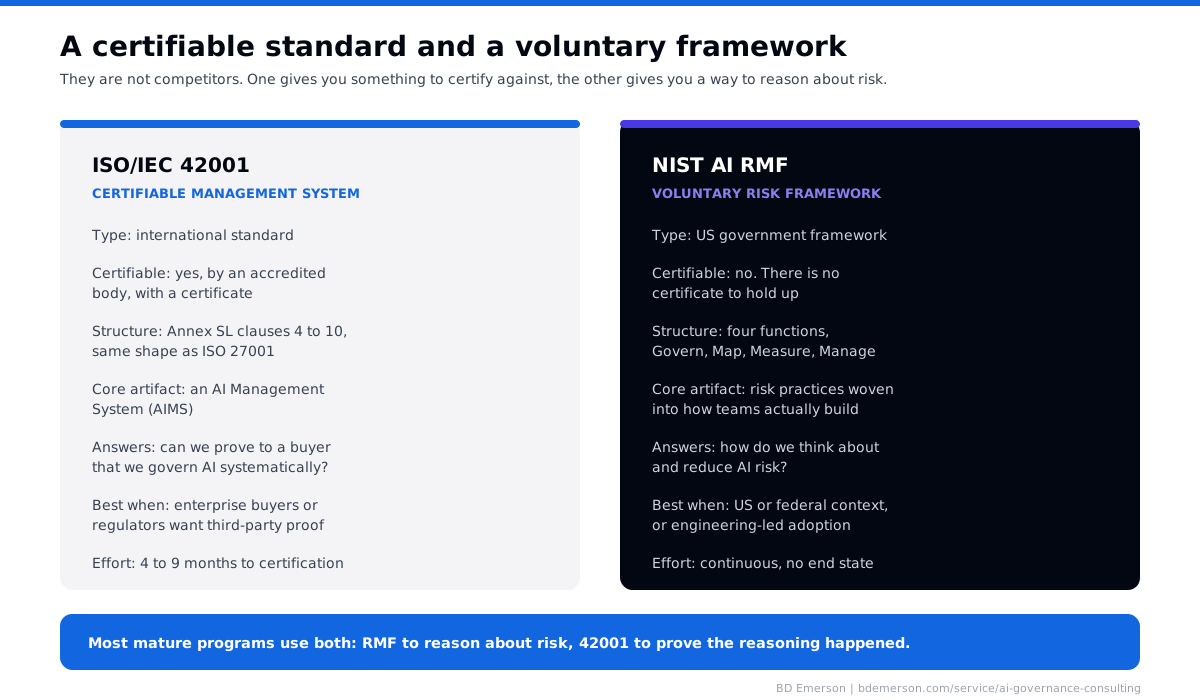
ISO/IEC 42001 is an international management system standard you can be certified against by an accredited body. The NIST AI RMF is a voluntary framework that helps you reason about and reduce AI risk, with no certification path. If a customer or regulator wants third-party proof, you need 42001. If you want a well-built way to think about risk that engineers will actually use, you want the RMF. Most mature programs run both.
What ISO 42001 gives you
Structure and provability. It follows the Annex SL shape used by ISO 27001, so clauses 4 through 10 will feel familiar to anyone who has run an ISMS: context, leadership, planning, support, operation, performance evaluation, improvement. The artifact at the center is an AI Management System, and Annex A supplies control objectives spanning policy, roles, data governance, development, third parties, operation, and decommissioning.
The practical value is that a certificate answers a procurement question without a conversation. It also forces the unglamorous work that gets deferred otherwise: naming an owner for each AI system, documenting where training data came from, and running impact assessments on a schedule rather than when someone remembers. Our 42001 implementation guide walks the clauses and Annex A controls in detail.
What the NIST AI RMF gives you
A way of thinking, organized into four functions: Govern, Map, Measure, and Manage. Govern establishes the culture and accountability. Map builds context around what a system does and to whom. Measure analyzes and tracks risk. Manage prioritizes and acts.
Its strength is that it does not pretend risk has an end state, and it is written in language engineers tolerate. Because it is voluntary and non-prescriptive, it adapts to a startup shipping one model and to a bank running hundreds. Its weakness is the same property: there is no certificate, so it cannot close a procurement question by itself.
Where they overlap
More than the framing suggests. Both require you to know what AI systems you have, to assess impact before deployment, to monitor in production, to assign accountability, and to improve based on what you learn. If you implement the RMF's Map and Measure functions properly, you have done much of the evidence-gathering that 42001 Clause 6 and Clause 8 ask for. The mapping is not one to one, but the work is largely shared, which is why sequencing matters more than choosing. Shadow AI undercuts the shared requirement to know what AI systems you have, and our shadow AI guide maps it to the specific ISO 42001 Annex A controls and NIST AI RMF provisions involved.
How to choose, in practice
Three questions settle it. First, is anyone asking you for proof? Enterprise buyers, EU-facing obligations, and regulated sectors push you toward 42001 because a certificate is the artifact they can file. Second, where are you starting? If you have no AI inventory and no owner, the RMF's Govern and Map functions are a gentler and faster entry than a certification project. Third, what is your geography? US federal and federal-adjacent work tends to speak RMF; European and global enterprise procurement tends to ask for ISO.
The sequence we most often recommend for companies with no immediate certification deadline: adopt the RMF structure to get real practices running, then formalize into an AIMS and certify once the practices are stable. Certifying an immature program produces a certificate and a lot of theater.
What neither one does
Neither is a compliance shortcut for the EU AI Act, and neither tests your systems. A 42001 certificate does not mean your agents resist prompt injection, and an RMF-aligned program does not mean your retrieval pipeline cannot be poisoned. Governance tells you what should be true. Testing tells you what is true. We cover the testing side in AI in offensive security, and the practical build sequence in how to build an AI governance framework.
Where BD Emerson fits
We implement both, and we are candid about which one your situation calls for. Our AI governance practice builds the program, ISO 42001 consulting takes it to certification, and EU AI Act advisory handles the regulatory overlay. Because the same firm runs enterprise AI implementations, the governance we design is the kind engineering teams can actually operate.

About the author