The First 100 Days: A Post-Merger Integration Framework That Holds
The deal team celebrates at closing. The integration team inherits the morning after: two payroll systems, two CRMs, three offices, one anxious customer base, and a synergy number somebody promised the board eight months ago.
Post-merger integration is where that number becomes real or becomes a write-down. Acquirers who treat the first 100 days as a structured program capture the value they modeled. Acquirers who treat integration as a task list for whoever has spare capacity watch it leak away one resigned engineer and one churned account at a time.
This is the framework we use. It starts before the deal closes.
Why value leaks after closing
The pattern repeats across deals of every size. Diligence was thorough, the price was defensible, and the thesis was sound. Then execution wobbles: key people leave in month two because nobody told them what their role would be, the top customers hear about the deal from a competitor's sales rep, the synergy plan stays a spreadsheet because no one owns line 14, and eighteen months later finance quietly rebaselines the model.
None of those failures traces to the deal. All of them trace to the ninety days after it.
Start before you close
Integration planning belongs in the deal timeline, before signing. Three things have to exist by close, and they cannot be built in a weekend.
An integration thesis. One page that says why this deal creates value and what must be true to capture it. Cost synergies in procurement? Cross-sell into the acquirer's base? A capability the buyer lacked? Every workstream decision for 100 days traces back to this page, so write it while the deal thesis is fresh.
A Day 1 definition. The short list of what must work the morning after closing: people get paid, customers get served, systems stay up, legal and banking authorities transfer, and everyone knows who they report to. Day 1 is a checklist, and it should be boring.
Named owners. An integration lead with real authority, workstream owners on both sides, and a decision forum that meets on a clock. Deals where the deal team handles integration have no owner at all, because the deal team goes back to their day jobs.
We covered the diligence inputs to this in our financial due diligence work; the findings you priced at closing become the integration backlog on Day 1.
The framework at a glance
The 100 days split into three phases with different jobs. Stabilize, then integrate, then accelerate. Running them out of order is the most common structural mistake: acquirers who start systems migrations in week two, before the business is stable and the people are settled, buy themselves a quarter of chaos.
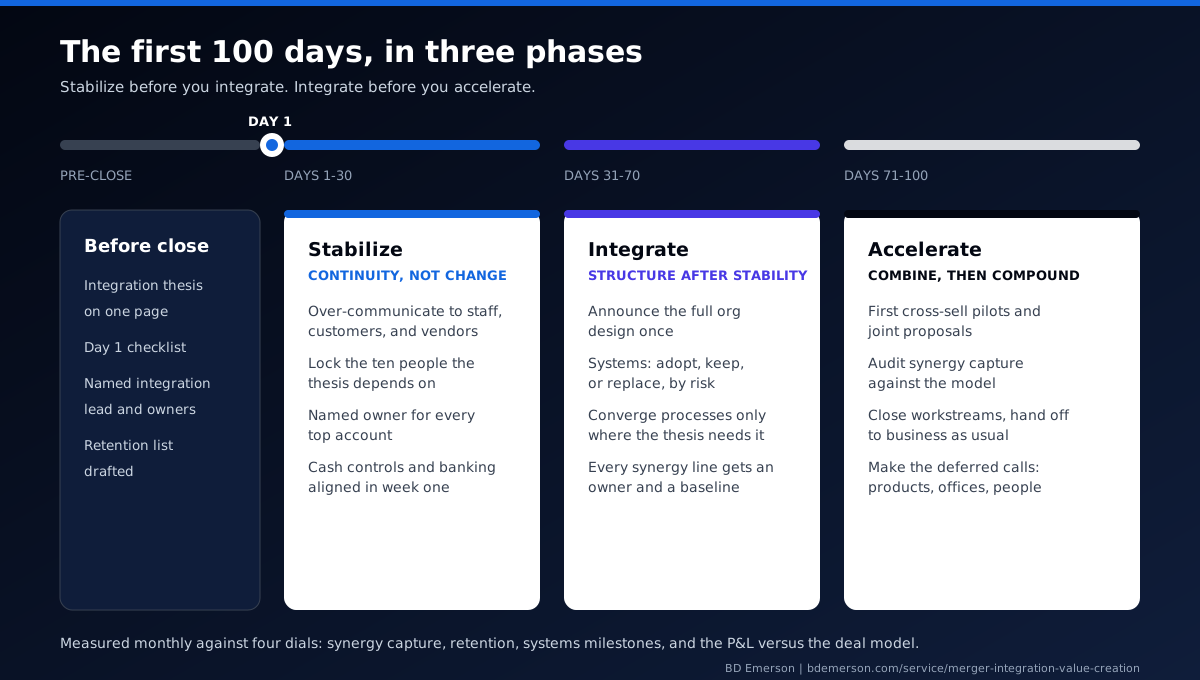
Days 1 to 30: stabilize
The first month's job is continuity, not change.
Communicate more than feels necessary. Employees, customers, and vendors each need to hear what changes, what does not, and when they'll hear more. Silence gets filled with speculation, and speculation is always worse than the plan.
Lock the flight risks. The ten people the deal thesis depends on need conversations, not memos, in week one. Retention decisions made in month three are made after the recruiter called.
Protect the customers. Top accounts get a named owner and a personal call. Any change to pricing, support, or contracts waits unless the thesis demands it now.
Establish control without breaking rhythm. Cash approval limits, banking access, and reporting calendars align in week one. The rest of the control environment can phase in.
Days 31 to 70: integrate
With the business stable, the structural work starts.
The organization comes first, because every other decision waits on it. Announce the design once, completely, rather than in dribbles that keep everyone updating their resumes.
Systems follow a decision discipline: adopt one, keep both temporarily, or replace both eventually. Migrations get sequenced by risk, and the ERP almost never goes first.
Processes converge where the thesis requires it and stay separate where it doesn't. Forcing the acquired company onto every parent process is integration theater; it burns goodwill and produces nothing the model priced.
Synergy execution starts here in earnest, and every line gets an owner, a baseline, a timeline, and a monthly number. A synergy without a baseline is a hope.
Days 71 to 100: accelerate
The last month shifts from combining to compounding.
Revenue synergies, the ones deal models love and integrations neglect, get their first real tests: joint proposals, cross-sell pilots, pricing harmonization where the market supports it. Cost synergies captured so far get audited against the model, honestly, while the team that made the promises still remembers making them.
The integration program itself starts winding down. Workstreams with finished jobs close and hand their remnants to business-as-usual owners. What remains after day 100 becomes a normal operating plan with normal accountability, not a permanent parallel government.
And leadership makes the calls that got deferred: the overlapping product, the second office, the executive who was never going to stay. Deferring them past 100 days does not make them easier. It makes them expensive.
Measuring whether it worked
Integration success is measured against the deal thesis, on four dials: synergy capture versus the model, retention of the people and customers the thesis named, systems milestones hit without business disruption, and the combined P&L against the forecast that justified the price. Baselines get set during diligence, tracking starts Day 1, and the board sees the same four dials every month.
One honest note: a divestiture runs this same discipline in reverse, and buyers of carve-outs need both playbooks at once. That work lives in our divestiture and carve-out practice.
The four ways integrations fail
After enough deals, the failure modes stop being surprising. No single accountable owner, because a committee cannot integrate anything. Synergies without baselines, which become stories instead of numbers. Change outrunning stability, with migrations launched before the business settled. And the thesis forgotten by week six, when workstreams optimize their own corner instead of the reason the deal was done.
Every one of them is preventable, and every prevention starts before closing.
If a transaction is heading toward your calendar, in either direction, the integration conversation belongs in the deal timeline now. Our merger integration and value creation team plans it alongside the deal work itself, which is exactly where it earns its keep.

About the author