Securing Palantir Deployments: A Practical Guide
Palantir platforms carry some of the strongest security primitives in enterprise software, hardened by years of government and defense deployments. That reputation creates a trap. Teams assume the platform is secure by default, when what they actually bought is a set of controls that protect exactly what they are configured to protect.
A Foundry or AIP deployment concentrates an organization's most sensitive data in one place and then hands AI agents the ability to act on it. Getting the security model right is not a compliance chore. It is the difference between a platform your CISO champions and one your next audit flags.
What the platform gives you
Four primitives do the heavy lifting. Markings classify data and follow it through every transformation, so a dataset derived from restricted sources stays restricted. Purpose-based access grants permissions for a stated purpose rather than a blanket role. Lineage records where every dataset came from and what produced it. And audit logging captures who saw what, who did what, and when, at a grain most platforms cannot match.
AIP extends the same model to AI: agents retrieve only what the requesting user could see, and act only through governed action types with full logging.
What configuration decides
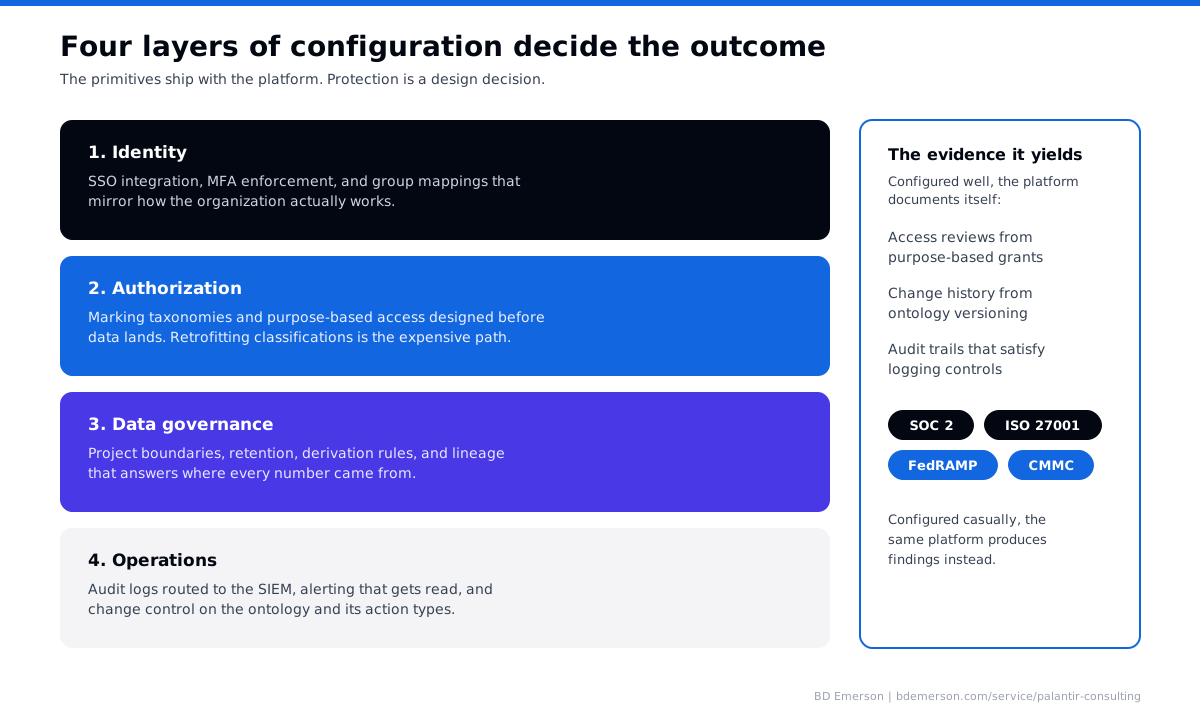
The security outcome is decided in four layers of configuration. Identity: SSO integration, MFA enforcement, and group mappings that mirror how your organization actually works. Authorization: marking taxonomies and purpose structures designed before data lands, because retrofitting classifications onto a populated platform is painful. Data governance: project boundaries, retention, and the rules for who may derive what from what. And operations: audit log routing to your SIEM, alerting, and change control on the ontology and its action types.
Every one of these has a sensible-sounding default that fails at enterprise scale. Flat group structures. One marking for everything sensitive. Audit logs nobody reads. The platform will run fine either way. It just will not protect much.
AI agents raise the stakes
An AIP agent with write actions is a new kind of privileged user: fast, tireless, and only as constrained as its action permissions. The controls that matter are action-level authorization, evaluation before autonomy, human checkpoints on consequential operations, and full prompt and output logging. Governance frameworks are catching up, and ISO 42001 and the NIST AI RMF map cleanly onto a well-configured AIP deployment. We covered the delivery side of this in our AIP and forward deployed engineering practice.
Evidence, or it did not happen
Enterprise customers and auditors will ask what the deployment inherits from your SOC 2, ISO 27001, FedRAMP, or CMMC program. A well-run Palantir deployment produces its own evidence: access reviews from purpose-based grants, change history from ontology versioning, and audit trails that satisfy the logging controls in every major framework. Configured casually, the same platform produces findings instead.
This is the seam BD Emerson works. Our Palantir consulting teams deliver Foundry implementations with the firm's security practice built into the engagement: the same people who run cloud security, cybersecurity compliance, and virtual CISO programs configure the platform and produce the evidence pack.
Deploy the platform and secure the platform are one project. Splitting them is how findings happen.

About the author