What Is Purchase Price Allocation? An ASC 805 Walkthrough
The deal closed Friday. Monday morning, your controller asks a question nobody discussed during the negotiation: what exactly did we buy?
Not philosophically. On the balance sheet. The $50 million you wired has to land somewhere in your books, split across inventory, equipment, customer relationships, technology, and a line called goodwill. That split is the purchase price allocation, and it will shape your reported earnings for the next decade.
What a purchase price allocation is
A purchase price allocation, or PPA, assigns the price paid in an acquisition to the individual assets acquired and liabilities assumed, each measured at fair value as of the closing date. Whatever the price exceeds those identified values becomes goodwill.
US GAAP requires it under ASC 805 whenever a transaction qualifies as a business combination. IFRS 3 imposes the same discipline internationally. The requirement applies whether you bought stock or assets, whether the target was public or private, and whether anyone on the deal team enjoys valuation work or not.
The allocation is not a formality. Amortization from it flows through your income statement for years. Lenders read it. Auditors test it. And if the acquired business stumbles, the goodwill you recorded becomes the impairment charge you explain to your board.
How the mechanics work
The sequence runs in three steps.
First, establish the consideration. Cash is easy. Earnouts, rollover equity, and seller notes get measured at fair value, which means an earnout promised at up to $10 million might enter the books at $6.2 million based on the probability of hitting its targets.
Second, identify and value everything you acquired. Tangible items come first: working capital, inventory, property, equipment. Then the intangibles, which is where the real work lives. ASC 805 requires you to separately recognize intangible assets that are contractual or separable: customer relationships, developed technology, trade names, backlog, non-compete agreements, licenses.
Third, the residual. Consideration minus everything identified equals goodwill. Goodwill is not an asset anyone can point to. It's the premium you paid for the future: the workforce, the synergies, the market position that didn't qualify as a separable asset.
A worked example
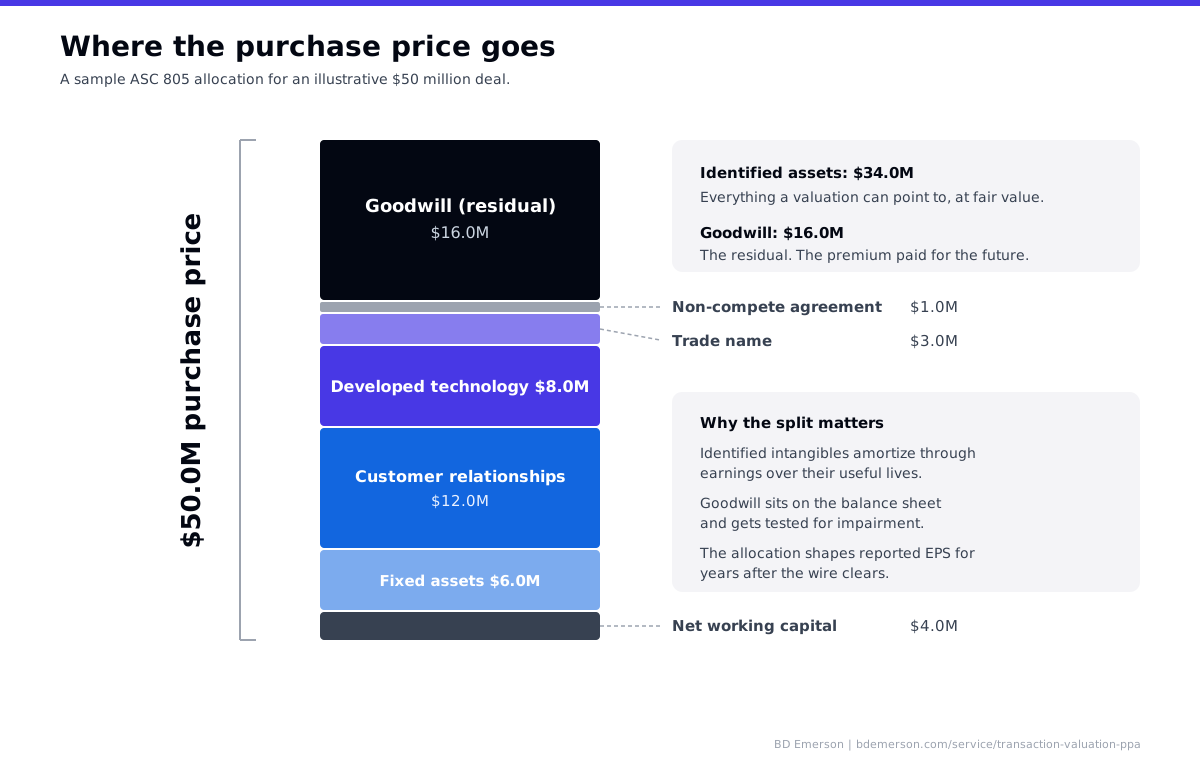
A buyer pays $50 million for a software-enabled services company. The allocation might land like this:
Net working capital comes in at $4 million, measured at closing. Fixed assets at $6 million after a fair value review of the equipment. Customer relationships get valued at $12 million, reflecting the durable revenue those accounts produce. Developed technology at $8 million. The trade name at $3 million. A non-compete agreement with the founder at $1 million. That identifies $34 million. The remaining $16 million is goodwill.
Every one of those intangible values comes from analysis, not guesswork. Customer relationships are typically valued on the earnings they generate after charging for the other assets that support them. Trade names and technology often use a relief-from-royalty approach, which asks what you'd pay to license the asset if you didn't own it. The methods have technical names; the logic is ordinary. What does this asset earn, for how long, and at what risk? The five methods, and what makes each number defensible, are set out in our guide to how to value intangible assets.
Why the allocation matters after everyone stops paying attention
The allocation reads like an accounting exercise until its consequences arrive.
Earnings drag. Identified intangibles amortize through the income statement over their useful lives. The $12 million of customer relationships amortized over 10 years takes $1.2 million off pre-tax earnings each year. Buyers who model post-close EPS without the PPA discover this in their first reporting quarter.
Impairment exposure. Goodwill doesn't amortize under US GAAP; it sits on the balance sheet and gets tested. If the acquired business underperforms, the goodwill impairment charge is public, painful, and permanent. A larger goodwill residual means more surface area for that risk.
Tax consequences. Book allocation and tax treatment diverge. In a stock deal without special elections, goodwill amortization typically provides no tax deduction. In an asset deal, or a stock deal with the right election, goodwill and intangibles often amortize over 15 years for tax purposes, which has real cash value. The allocation interacts with the deal structure your tax diligence team negotiated, which is one more reason those workstreams belong together.
Working capital and the agreement. The closing balance sheet feeding the PPA is the same one that settles the working capital true-up. Inconsistencies between the two invite disputes.
Timing and the measurement period
The initial allocation belongs in the first financial statements you issue after closing. ASC 805 allows a measurement period of up to one year to finalize provisional amounts as better information arrives, and most deals use some of it.
The practical advice runs opposite to common practice. Start the valuation work during diligence, not after closing. The same analysis that supports the quality of earnings feeds the intangible valuations, the deal model already contains the forecasts the valuation needs, and an allocation drafted before signing surfaces the earnings-drag conversation while the structure can still respond to it.
Who performs it
Valuation specialists prepare the analysis; your auditors review it and cannot prepare it for you, since they'd be auditing their own work. Middle-market PPAs typically run $15,000 to $60,000 depending on the number and complexity of intangibles, with complex technology or multi-entity deals above that.
Selecting the preparer matters less for the fee than for the friction. An allocation built with documented support and defensible assumptions clears audit review in days. One built on thin support becomes a quarter-long negotiation with your audit firm during your first close as a combined company, which is precisely when your finance team has no capacity for it.
Connected to the deal, not bolted on
The PPA touches diligence, tax structure, the purchase agreement, and the integration plan that follows. We run transaction valuation and purchase price allocation inside the deal team, so the assumptions trace to the diligence findings and the allocation is ready when your auditors ask for it, not a quarter later. When the question is what the intangible assets are worth before a price is agreed, our intangible asset valuation service answers it ahead of the deal.
If a closing is behind you or ahead of you, the allocation conversation is worth 30 minutes now. It gets more expensive with every month it waits.

About the author