Palantir for Medical Research: From Data Enclave to Discovery

Medical research has a data problem that is really a trust problem. The most valuable datasets, longitudinal health records, imaging archives, genomic panels, sit behind privacy law, institutional review boards, and data use agreements, and for good reason. The traditional answer was to ship de-identified extracts to each research team and hope the controls traveled with the files. They rarely did.
The enclave model inverts that. Data stays inside a governed platform. Researchers come to it.
The enclave model
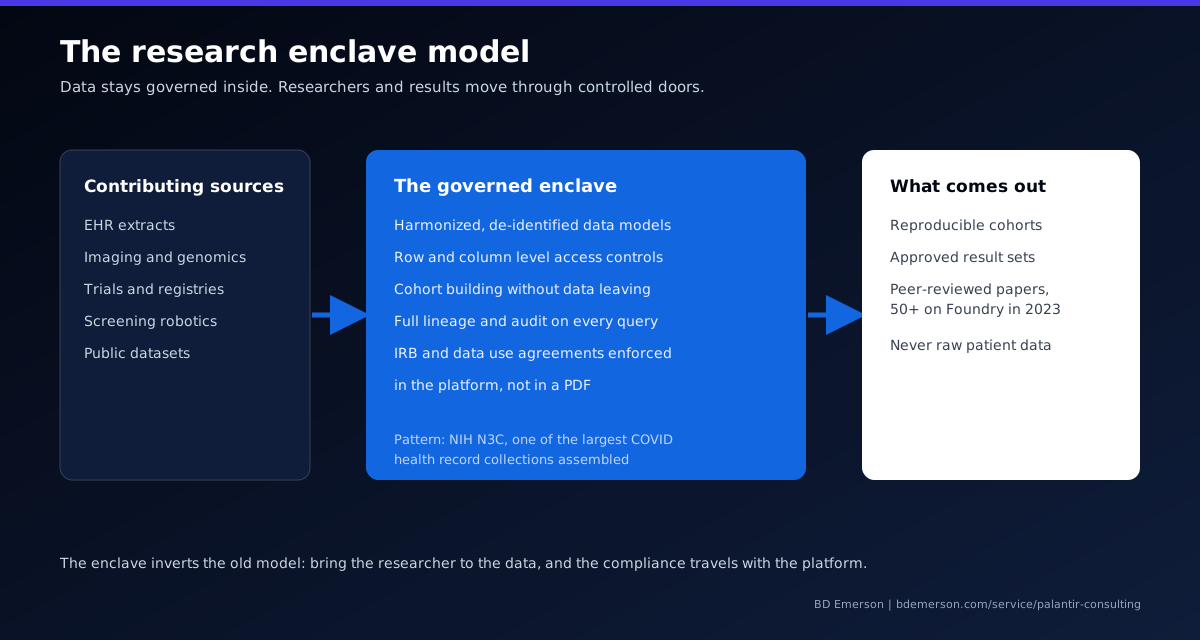
The reference case is the National Institutes of Health. Palantir has provided the data enclave for NCATS's National COVID Cohort Collaborative since 2020, assembling one of the largest collections of COVID-19 health records ever brought together for research, used heavily in the study of long COVID. Contributing institutions send harmonized records into the enclave. Researchers build cohorts and run analysis inside it. Raw patient data never leaves.
The same pattern runs elsewhere at NIH: high-throughput screening programs whose robots test hundreds of millions of compound and cell line combinations use Foundry to mine the results for drug repurposing and synergy candidates. By Palantir's count, work on the platform supported more than 50 peer-reviewed publications in 2023 alone.
What research teams actually get
Three things separate an enclave from a shared drive with rules. First, harmonization: records from dozens of institutions mapped to one model, so a cohort query means the same thing everywhere. Second, governance that executes itself: row and column level access, purpose-based grants, and IRB and DUA terms enforced by the platform rather than by a signature page. Third, reproducibility: every cohort, transformation, and result carries lineage, which is what peer review and regulators increasingly expect.
Imaging work shows the range. One biopharma research division used Foundry to turn more than 100GB of lung cancer imaging and clinical data into governed, queryable cohorts for discovery work, the kind of dataset that previously lived in folders only one lab could use.
Who this fits
Academic medical centers sitting on decades of clinical data they cannot safely share. Research consortia that need many institutions contributing to one study without surrendering custody. Biotech and pharma teams unifying trials, real-world evidence, and omics. And any organization whose review board has become the bottleneck because every project needs a bespoke data agreement.
Standing one up
The build sequence mirrors any serious Foundry implementation, with the governance turned up: define the data model with the researchers who will query it, wire the contributing sources, configure markings and purpose-based access to match the consent and DUA terms, and only then open the doors. De-identification standards, HIPAA, and human subjects rules are design inputs, not review gates at the end, which is why our Palantir practice staffs these programs with the privacy and security practitioners BD Emerson runs compliance programs with, following the model in Securing Palantir Deployments.
The payoff compounds: every study after the first inherits the enclave, the harmonized model, and the governance. The second cohort takes days, not a grant cycle.

About the author