Databricks vs Snowflake: An Honest Comparison for Enterprise Data and AI

Databricks versus Snowflake is the most common platform question we hear from data leaders, and the framing is usually wrong. Both platforms have spent years converging on each other's territory. Snowflake runs Python and trains models. Databricks serves BI dashboards and speaks fluent SQL. If you compare feature checklists, you will conclude they are interchangeable. They are not.
The short answer
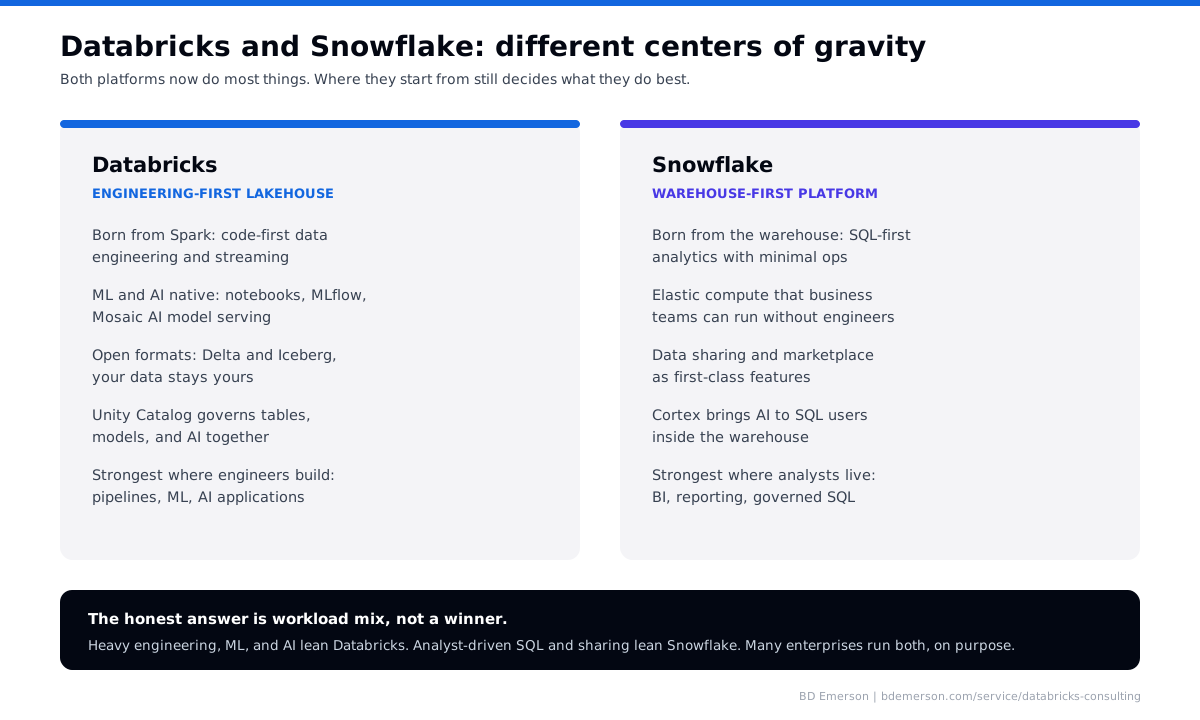
Databricks is strongest where engineers build: pipelines, streaming, machine learning, and AI applications. Snowflake is strongest where analysts live: governed SQL, BI, and data sharing with minimal operational overhead. Most large enterprises we work with run both on purpose, and the decision that actually matters is which workloads belong on which platform.
Where each platform starts from matters more than where it is going
Databricks grew out of Apache Spark. Its center of gravity is code: notebooks, jobs, streaming pipelines, and the machine learning lifecycle. Delta Lake and support for Apache Iceberg keep the data in open formats in your own cloud storage, and Unity Catalog governs tables, files, models, and AI assets in one permission model. The platform assumes your builders are engineers and rewards them with control. Our data governance tools ranking compares Unity Catalog with Snowflake Horizon Catalog and eight other platforms, with advice for Databricks-centric and Snowflake-centric stacks.
Snowflake grew out of the data warehouse. Its center of gravity is SQL that simply works: elastic compute a finance team can size without an infrastructure ticket, near-zero maintenance, and data sharing that lets two companies exchange live tables without building a pipeline. Cortex brings LLM functions directly into SQL. The platform assumes your consumers outnumber your engineers and optimizes for them.
That heritage shows up in the day-two experience. Databricks gives an engineering team leverage and expects them to use it. Snowflake gives a business team autonomy and charges for the convenience.
The AI layer changes the calculus
If your roadmap includes training or fine-tuning models, serving them behind applications, or building agents over enterprise data, Databricks currently offers a deeper native toolchain: MLflow for the model lifecycle, Mosaic AI for serving and evaluation, and vector search wired into the same governance as the tables. This is the architecture pattern we describe in our walkthrough of the Databricks AI stack.
If your AI ambition is analyst-facing enrichment, summarization inside reports, or natural language over governed marts, Snowflake Cortex delivers that with far less engineering. The question is not which AI story sounds better on stage. It is whether AI work in your company will be done by people who write code or people who write SQL.
Cost behavior differs more than list prices
Both platforms meter compute, and both can surprise you. The failure modes differ. Snowflake costs drift upward through warehouse sprawl: dozens of teams each running their own sized-for-peak warehouse. Databricks costs drift through cluster misconfiguration and jobs that nobody tuned. In our experience the platform matters less than whether someone owns FinOps for it. Budget for that role either way.
How to decide without a six-month bake-off
Inventory your top twenty workloads by spend and business value, then score each on three axes: who builds it, how much transformation it needs before consumption, and whether it feeds an application or a dashboard. Engineering-heavy, ML-bound, or streaming workloads lean Databricks. Analyst-owned, SQL-shaped, share-with-partners workloads lean Snowflake. The split usually reveals itself in a day, and the result is a defensible placement policy instead of a religious debate.
Two honest caveats. First, if you already run one platform well and your gaps are organizational rather than technical, migrating will not fix them. Second, if a vendor sales team is scoring your workloads for you, every workload will fit their platform. Keep the scoring in-house or use a firm with no resale stake.
Where this fits a broader operations strategy
Neither platform runs your operations. When the goal moves from analyzing data to acting on it with governed automation, an operations layer such as Palantir Foundry enters the picture, and we compare that pairing in Palantir vs Databricks. For the data and AI estate itself, the two-platform pattern is now the norm rather than the exception among large enterprises.
Where BD Emerson fits
We are an implementation partner, not a reseller. We run the workload scoring, negotiate the architecture with both vendors, build the landing zones with security and compliance controls in place from day one, and stand up the FinOps discipline that keeps either bill honest. Start with our Databricks consulting practice or the broader enterprise AI practice if the decision includes model strategy. If your stack must also satisfy auditors, our security and compliance team wires the evidence trail into the same build.

About the author