Palantir vs Databricks: Different Questions, One Stack
Procurement teams keep putting Palantir and Databricks in the same bake-off, and the comparison never quite works. The platforms overlap at the edges, compete for the same executive attention, and solve different problems. Choosing between them is like choosing between an ERP and a data warehouse. You can force the comparison, but the output will not help you.
The short answer
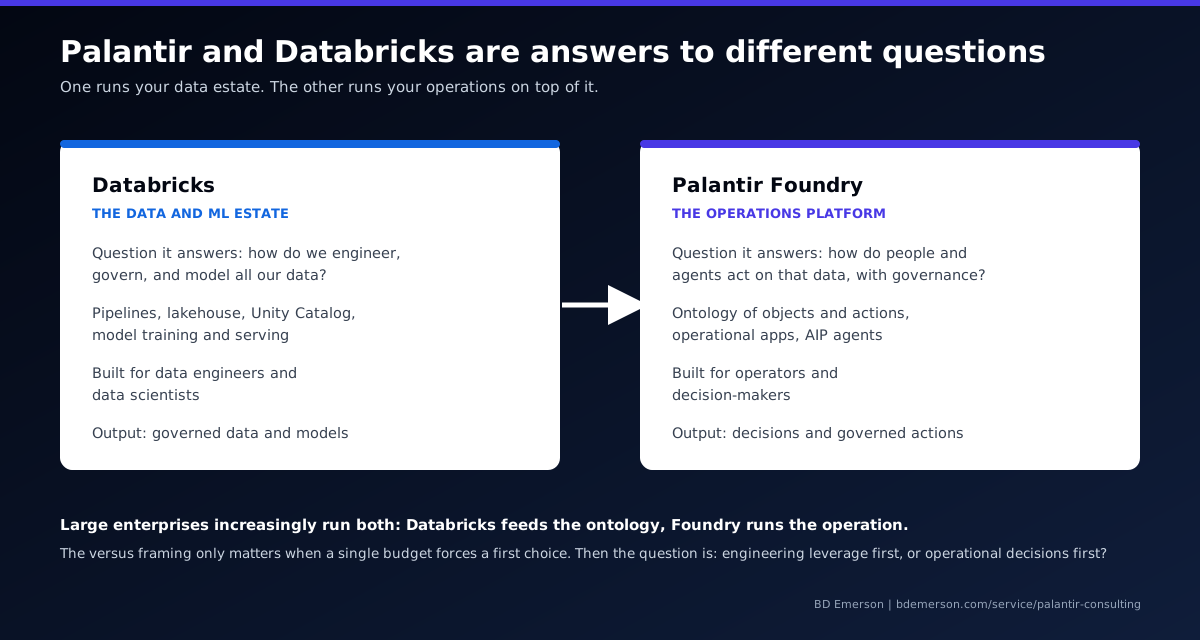
Databricks answers the question: how do we engineer, govern, and model all of our data? Palantir Foundry answers the question: how do people and AI agents act on that data, with governance, inside real operational workflows? If your pain is pipelines, model training, and analytics, that is Databricks territory. If your pain is decisions, handoffs, and operational execution, that is Foundry territory. Many large enterprises now run both.
What Foundry actually does
Foundry's defining feature is the ontology: a governed model of your business objects, the relationships between them, and the actions users may take against them. A plant, a shipment, a claim, and a customer become first-class objects with permissions, lineage, and write-back into source systems. Operational applications and AIP agents work against those objects rather than raw tables, which is why Foundry deployments tend to live inside operations, supply chain, and frontline decision-making. We cover what this looks like in a clinical setting in our piece on Palantir in hospital operations.
What Databricks actually does
Databricks is the engineering backbone of a modern data estate: ingestion, transformation, streaming, lakehouse storage in open formats, and the full machine learning lifecycle through MLflow and Mosaic AI. Unity Catalog gives one governance plane across tables, models, and AI assets. Its users are data engineers and data scientists, and its output is governed data products and models. The full pattern is in our Databricks AI stack walkthrough.
Foundry vs Databricks is a layer question
The phrase foundry vs databricks gets typed into search boxes thousands of times a month, and the answer almost never turns on features. It turns on which layer of the stack you are trying to fill. Databricks sits at the data layer: storage in open formats, compute, transformation, catalog, model training, and model serving. Foundry sits at the operations layer: a semantic model of the business, applications people use to do their jobs, and actions that write back into the systems of record. A layer comparison has no winner, only a fit.
The confusion is understandable, because each platform has grown into the other's territory at the margins. Databricks can serve dashboards and applications through Databricks Apps and Genie, and Unity Catalog carries business metadata. Foundry has pipelines, a code repository, and its own transformation engine, so you can do real data engineering inside it. Neither extension is the reason either platform exists.
Here is a test that settles it quickly. Write down the artifact you need in ninety days. If the artifact is a governed dataset, a feature table, or a trained model, you are buying at the data layer. If the artifact is a screen a dispatcher opens at 6am to reassign trucks, with permissions, an audit trail, and a write-back to the transport management system, you are buying at the operations layer. Teams that skip this question spend the first quarter of the program relitigating scope.
Cost structure follows the layer. Databricks charges for compute and storage, which you can forecast from workload volume. Foundry is licensed as a platform, so the cost per use case falls sharply once the ontology exists and the second and third applications reuse it. That asymmetry is why sequencing matters more than the feature comparison, and it is covered in more detail in what actually drives Palantir cost.
The pattern that keeps winning: Databricks feeds the ontology
In the joint deployments we see, Databricks produces the curated, governed datasets, and Foundry consumes them into the ontology where operators and agents act. Each platform does what it is engineered for. Data teams keep their tooling and open formats. Operations teams get applications with permissions and write-back. The integration is well trodden, and the vendors themselves have leaned into coexistence rather than displacement.
The anti-pattern is forcing one platform to be the other. Teams that try to make Foundry their data engineering estate discover the cost model punishes it. Teams that hand-build an operations layer on Databricks spend eighteen months recreating a fraction of the ontology, permissions, and application scaffolding Foundry ships on day one.
Palantir vs Snowflake
Snowflake turns up in the same evaluations as Databricks, and the comparison against Palantir works the same way. Snowflake is a cloud data platform: a warehouse that scales storage and compute independently, plus Snowpark for code, Cortex for model access, and Horizon for governance. It is where analysts query and where data products get published. It is not where a claims adjuster works a queue.
The differences that matter in practice:
- Unit of work. Snowflake's unit is the table and the query. Foundry's unit is the object and the action taken on it. Most of the other differences follow from that one.
- Write-back. Snowflake reads from and writes to systems of record through pipelines you build and maintain. Foundry ships action types that write back with permissions and an audit record attached, which is what operational users need.
- Users. Snowflake serves analysts and data engineers. Foundry serves operators, plus the analysts and engineers who support them.
- Governance model. Snowflake governs access to data. Foundry governs access to data and to the actions performed with it, including what an AIP agent is permitted to do.
- Deployment. Snowflake runs as a managed cloud service. Foundry also runs in your own cloud tenancy, on-premise, and air-gapped, which decides the shortlist in defense work and parts of the regulated sector.
The two stacks coexist for the same reason Databricks does. Snowflake holds the governed data, Foundry consumes it into the ontology, and operators act. If you are running a three-way evaluation, the useful framing is Snowflake against Databricks at the data layer, and Foundry against building the operations layer yourself. We walk through the rest of the field in Palantir competitors and alternatives.
One thing to check before that meeting: whether the Snowflake question is a Snowflake question at all. In several evaluations we have sat through, the incumbent warehouse was fine and the real gap was that nobody owned the operational workflow sitting on top of it. Replacing the warehouse would have cost a year and changed nothing about how the work got done.
When one budget forces a first choice
Sequencing comes down to where value is trapped. If decisions are slow because data is scattered and unreliable, start with Databricks and fix the estate. If the data exists but operations still run on spreadsheets, tribal knowledge, and swivel-chair integration, start with Foundry and put governed action on top of what you have. Foundry can connect directly to source systems, so a weak data estate delays it less than most teams assume. A Databricks-first build gives AI ambitions a deeper foundation.
Either way, define the second platform's entry criteria at the start. The most expensive path is treating the first choice as permanent, then running a second procurement cycle from scratch two years later.
When you already own Databricks
Most enterprises evaluating Palantir already run a Databricks or Snowflake estate and carry an investment they will not walk away from. That is a good starting position rather than a conflict. The question stops being which platform to buy and becomes what Foundry adds on top of what you already have, and whether the addition pays for itself.
Three conditions tend to justify it. The first is that the operations layer does not exist yet: your dashboards report the problem, nobody can act inside the tool, and the work still happens in spreadsheets and email threads. The second is that write-back and permissions are the blocker, because you need an audited action against a system of record performed by someone whose access is scoped to their role and their purpose. The third is that AI agents need something to act on. A language model pointed at a lakehouse can summarize. An agent pointed at an ontology with defined action types can do.
Three conditions argue against it. Your data estate is still unreliable, in which case fix that first and Foundry lands better later. Your operational need is one workflow in one department, which a purpose-built application will cover for far less. Or nobody in operations has agreed to own the result, which is the failure mode no platform fixes.
Where the answer is yes, the integration seam is the whole job. Databricks publishes curated tables through Unity Catalog, Foundry syncs them and maps them onto object types, and lineage carries across the seam so an auditor can trace a number on a screen back to its source. Keep the transformation logic in Databricks instead of duplicating it in Foundry, because two copies of the same business rule will drift, and the copy behind the screen is the one people trust. Write that boundary down before the first pipeline gets built.
Where BD Emerson fits
We implement both platforms and take no resale margin from either, so our sequencing advice has no thumb on the scale. Our Palantir practice covers Foundry implementation and AIP agent engineering with security controls built in. Our Databricks practice builds the lakehouse, governance, and model serving that feed it. When the two meet, we own the integration seam, which is where these programs are usually won or lost.
A normal first step is a two to three week ontology design workshop. It produces the object model, the source system inventory behind it, and a build sequence, which is enough to price the rest against real numbers and enough to walk away if the conclusion is that you do not need Foundry.

About the author