Databricks as the Enterprise AI Stack: Lakehouse, Unity Catalog, Mosaic AI
Every enterprise AI failure post-mortem finds the same body: the data. Models answered from stale extracts, permissions nobody could explain, and pipelines that broke silently the week before the demo. AI is a data problem wearing a model costume, which is why the platform question matters more than the model question.
Databricks has become a default answer because it stacks the three things an AI estate needs, data, governance, and serving, in one architecture instead of three procurements.
The stack, bottom up
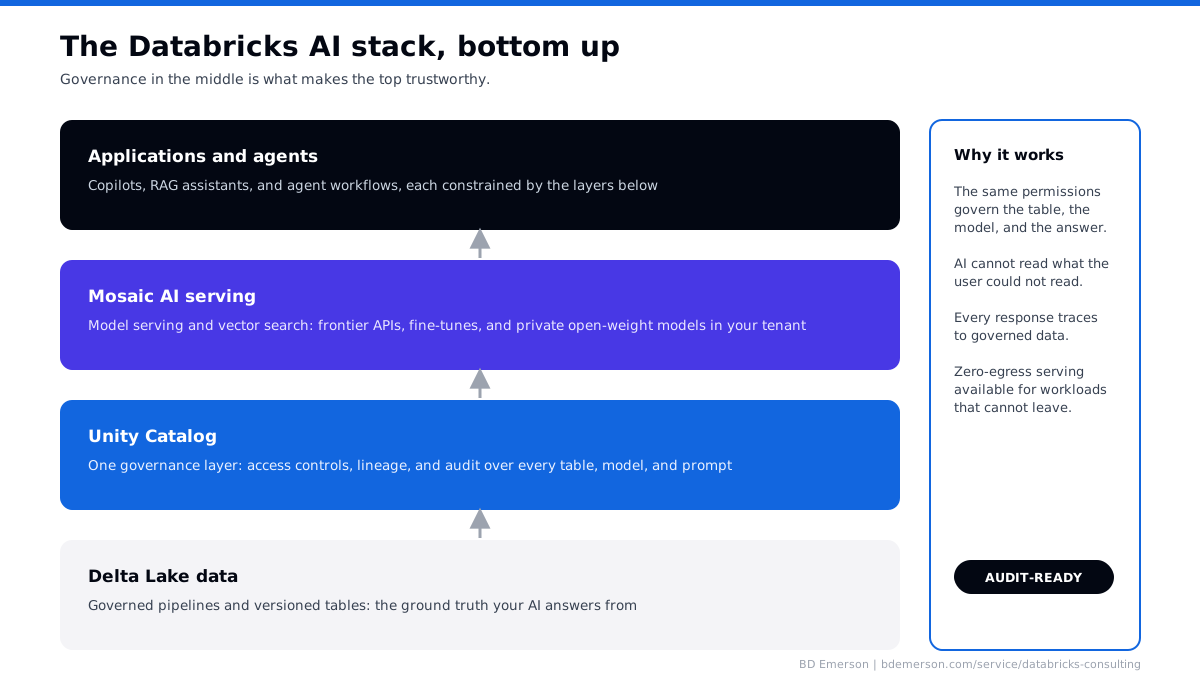
Delta Lake holds the ground truth: versioned tables fed by governed pipelines, so the AI answers from the same data the business runs on. Unity Catalog sits above it as the single governance layer, one set of access controls, lineage, and audit spanning every table, model, and prompt. Mosaic AI serves the models: frontier APIs, your fine-tunes, and private open-weight deployments, plus the vector search that grounds retrieval.
The property that matters is inheritance. Because serving sits on the catalog, an AI application cannot read what its user could not read, and every answer traces to governed data. Most competing stacks bolt governance onto serving after the fact; here it is load-bearing. Our ranking of data governance tools gives that kind of policy enforcement the most weight and compares Unity Catalog with nine other platforms.
Where this fits a multi-model strategy
Databricks pairs naturally with the routed model portfolio: Mosaic AI hosts the open-weight workhorse tier in your own tenant, brokers calls to frontier models where the router sends crucial tasks, and keeps the whole portfolio behind one governance layer. For workloads with hard containment requirements, the serving layer runs inside a zero-egress enclave without leaving the platform.
Against Palantir, the centers of gravity differ: Databricks is the engineering-first data and ML estate; Foundry is the operations platform whose ontology drives governed actions. Large enterprises increasingly run both, Databricks feeding the ontology, which is why our Palantir practice and Databricks practice share an architecture bench.
Where implementations actually spend effort
Not on the model. The hours go to Unity Catalog design before data lands, because retrofitting permissions onto a populated lakehouse is the expensive path. To pipeline discipline: tests, expectations, and owners, so the AI's ground truth does not rot. To migration sequencing that retires the legacy warehouse instead of running two estates forever. And to cost engineering, cluster policies and serverless choices made at design time, because the lakehouse bill is an architecture property. Our medallion architecture guide shows where those pipeline tests and expectations belong as data moves through bronze, silver, and gold layers.
Security and compliance ride along rather than following: private networking, customer-managed keys, and audit configuration mapped to SOC 2, ISO 27001, and sector rules, the discipline covered across our cloud security practice.
The honest boundaries
Databricks is not the answer to everything. Pure operational applications with heavy human workflows often want an ontology-first platform. Tiny estates with one warehouse and modest AI ambitions can start simpler. The platform earns its weight where data volume, ML ambition, and governance requirements are all real, which describes most of the mid-market and up.
BD Emerson delivers this as a full implementation partner through our Databricks consulting practice, inside the broader enterprise AI consulting portfolio: lakehouse build, Unity Catalog governance, Mosaic AI serving, and the compliance evidence, delivered by the same team. The model conversation is more fun. The data conversation is where the program is won.

About the author