The Portfolio Company AI Playbook
Every portfolio review now includes the AI question, and most portfolio companies answer it the same way: a pilot chatbot, a few licenses, and nothing in the numbers a year later. The problem is not the technology. It is that enterprise AI programs are designed for enterprises, and a 200-person portfolio company needs something that pays back inside a hold period.
This is the playbook we run instead. Four moves, in order.
The playbook
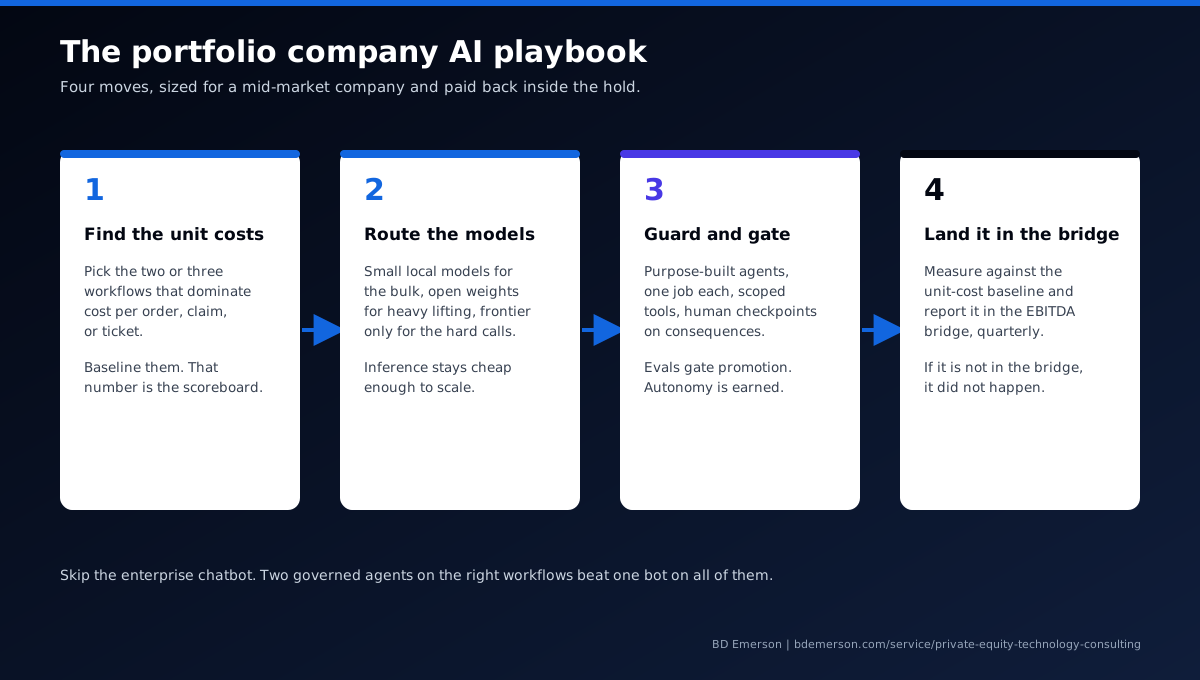
First, find the unit costs. Every operating business has two or three workflows that dominate its cost per order, claim, ticket, or shipment: document handling, intake triage, status communication, reconciliation. Baseline them. That number, not a maturity model, is the scoreboard for everything that follows.
Second, route the models. A portfolio company cannot afford frontier pricing on bulk work, and does not need it. The smart routing architecture scales down cleanly: small local models absorb classification and extraction at near-zero cost, an efficient open-weight model handles the heavy document work, and a frontier model sees only the exceptions worth premium reasoning. Inference stays cheap enough that scaling the win does not scale the bill.
Third, guard and gate. Purpose-built agents with one job each, scoped tools, human checkpoints on anything customer-visible or financial, and evaluation gates before any expansion of autonomy. This is what keeps the program defensible to the fund's risk committee now and to a buyer's diligence team later.
Fourth, land it in the bridge. AI initiatives report against the unit-cost baseline in the quarterly value review, in the same EBITDA bridge as every other initiative in the value creation plan. If the win is not in the bridge, it did not happen.
Why this beats the chatbot
The general-purpose chatbot fails at portco scale for a predictable reason: it optimizes for breadth in a business that needs depth. Two governed agents on the workflows that dominate unit costs will outperform one assistant pointed at everything, cost less to run, and produce something a buyer can actually diligence: a measured cost curve, an audit trail, and a governance file. At exit, that reads as a durable capability rather than an experiment, the same evidence logic that runs through exit readiness.
What it costs, what it needs
The first workflow typically ships in a quarter, sized for a company without a data team: modest data foundations, one or two integrations, and the routing stack deployed in the company's own cloud. Sensitive-data industries add a zero-egress hosting layer without changing the economics. The reuse compounds at the portfolio level: the second company inherits the patterns, evals, and vendor terms of the first.
Where BD Emerson fits
We run this playbook through our portfolio technology practice, with the model routing, guardrails, and governance drawn from our enterprise AI work and sized for the mid-market. The fund gets one playbook, comparable reporting, and AI that shows up where it counts: in the bridge.

About the author