EBITDA Adjustments: What Survives Diligence and What Gets Struck
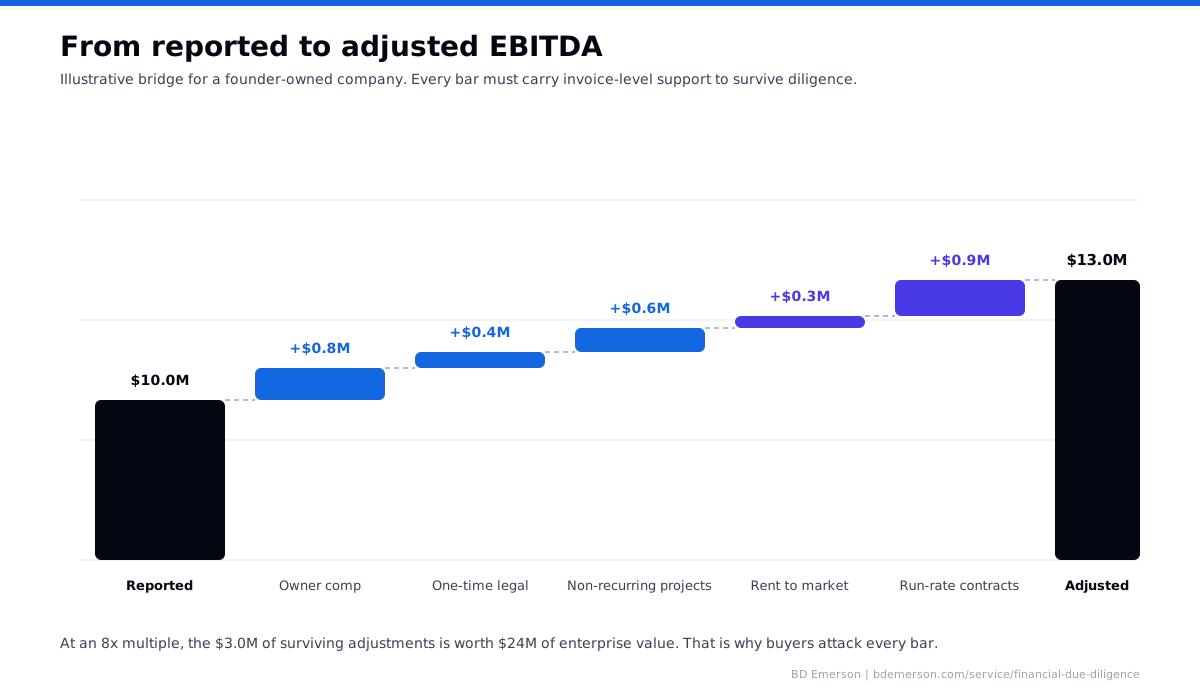
Adjusted EBITDA is the number deals price on, and every adjustment in the bridge is a claim about the future: this cost will not recur, this expense was never market, this contract is already signed. Buyers pay for the claims you can prove. This guide covers the add-backs that survive diligence, the ones that get struck, and the documentation standard that separates them.
Why adjustments exist at all
Reported EBITDA describes the company as it was run. Adjusted EBITDA describes the company a buyer is actually purchasing. A founder who paid herself below-market salary, ran a one-time lawsuit through the P&L, and signed a major contract in month eleven has a business whose reported number understates its run-rate earnings. Adjustments exist to close that gap. The abuse of adjustments exists because every dollar of add-back is worth a multiple of itself at close.
The categories that survive
Owner compensation normalization is the classic and the cleanest: the delta between what owners paid themselves and what a market-rate replacement costs, supportable with comp studies. True one-time items follow: litigation settlements, a failed acquisition's deal fees, a flood. The test is that the event has a name, a date, and no plausible sequel.
Normalization to market covers related-party arrangements, most commonly rent paid to an owner's real estate entity above or below market. Discontinued operations earn their add-back when the exit is complete and the costs are cleanly separable in the general ledger. Run-rate adjustments for signed contracts or completed price increases survive when the paper exists and the revenue has started, with buyers crediting the portion the trailing period missed.
The add-backs buyers strike
Recurring non-recurring items lead the list: the third consecutive year of one-time consulting fees is a cost structure, not an anomaly. Growth spending dressed as exceptional comes next, because recruiting fees, launch marketing, and system implementations recur in any company that keeps growing. Unsupported synergies and pro forma savings get struck on contact in a sell-side bridge; those belong to the buyer's model, not the seller's earnings. And adjustments without invoice-level support die quietly in the quality of earnings process, which is exactly what a QoE team is engaged to do, as we cover in our guide to quality of earnings reports.
The documentation standard
An add-back that survives has four properties. It maps to specific general ledger entries. It carries source documents: invoices, settlement agreements, comp studies, signed contracts. It is consistent, meaning the same logic applied to items that cut against the seller too. And it is presented before diligence finds it, because an adjustment the buyer's advisors discover reads as an attempt. The math on the stakes is blunt: at an eight times multiple, a struck one million dollar add-back removes eight million dollars of enterprise value.
Sell-side and buy-side read the same bridge differently
Sellers should build the bridge months before a process starts, pressure-test it with their own advisors, and cut the weak add-backs themselves. A bridge with eight bulletproof adjustments prices better than one with fifteen arguable ones, a discipline we walk through in our exit readiness guide and run for clients through sell-side advisory. Buyers should treat the bridge as a map of where the seller's story is weakest and focus diligence hours accordingly. Both sides ultimately converge on the same evidence standard; the difference is who gets paid for finding the truth first. Our guide to buy-side vs sell-side M&A explains how each mandate shapes scope, timing, and fees.
Where BD Emerson fits
Our transaction advisory team builds and defends adjustment bridges from both chairs: financial due diligence for buyers testing a seller's bridge, sell-side readiness for owners building one that holds, and valuation work that translates surviving EBITDA into price. If your bridge has to face a QoE team in the next twelve months, the cheapest time to fix it is now.

About the author