Carve-Out Financial Statements: Preparing a Business for Separation

When a company sells a division, it is selling a business that has never existed on paper. The division has revenue, people, and customers, but its costs are tangled into the parent: shared IT, one payroll run, a treasury function three floors up that nobody bills for. Before a buyer can price it, someone has to answer a question the general ledger was never designed to answer. What would this business look like on its own?
Carve-out financial statements are that answer, and building them is the long pole in almost every divestiture timeline.
Why carve-out financials are hard
The parent's books were built to run the parent. Revenue may sit in the division's ledger, but costs rarely do. Corporate overhead gets allocated by formulas invented for management reporting, not for a sale. Shared contracts cover both businesses on one signature. Intercompany balances net out at the top and mean nothing below it.
The job is to draw a defensible boundary around the carved-out business and restate its history inside that boundary. Every allocation choice will be tested by the buyer's financial due diligence team, so the methodology matters as much as the math.
What has to be untangled
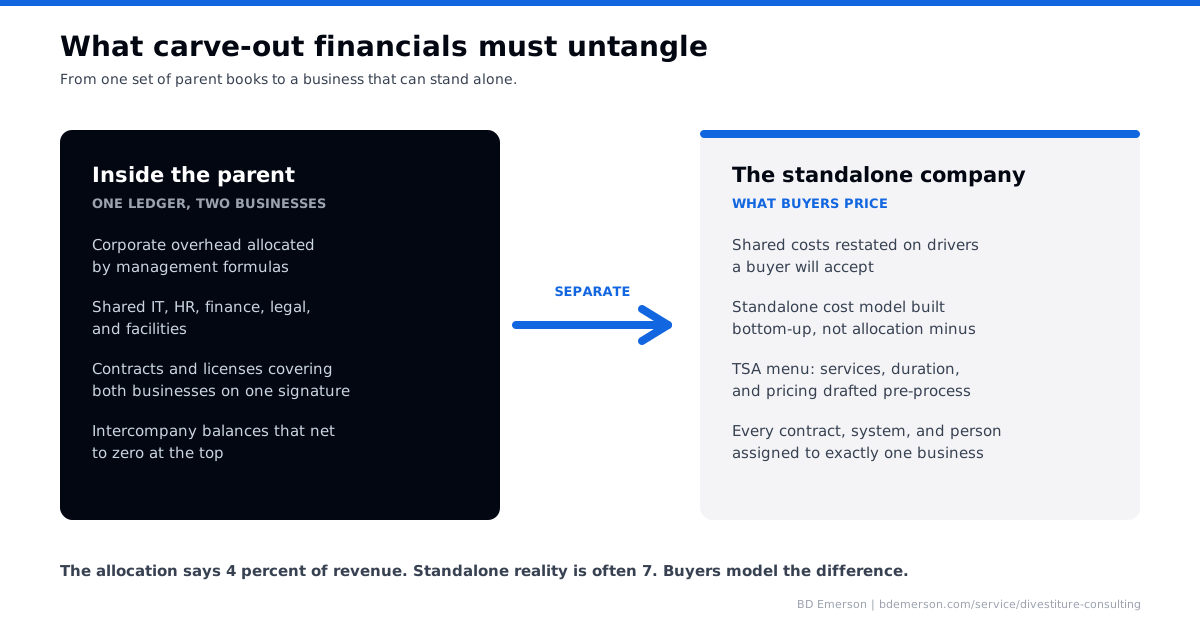
Four threads dominate the work. Shared costs: what the division actually consumed in IT, HR, finance, legal, and facilities, allocated on drivers a buyer will accept. Standalone costs: what the business will need to spend to replace parent services after separation, which is almost never what the allocation says. Transition services: what the parent will keep providing under a TSA, for how long, and at what price. And commingled assets: contracts, licenses, systems, and people who serve both businesses and must be assigned to one.
The gap between allocated cost and standalone cost deserves special attention, because buyers model it ruthlessly. A division carrying a 4 percent corporate allocation may need 7 percent of revenue to run itself. That difference comes straight out of the multiple.
What buyers test
Diligence on a carve-out runs all the usual quality of earnings questions plus a second layer. Are the allocations consistent across periods, or tuned to flatter the exit year? Do the carve-out financials tie back to the parent's audited statements? Is the standalone cost model built bottom-up, or is it the allocation with a haircut? What breaks on day one when the parent's systems go dark?
Sellers who cannot answer these quickly watch exclusivity stretch and price drift. Sellers who prepared answer them from the data room.
The seller's sequence
The work runs in order. Define the perimeter: legal entities, assets, contracts, people. Build the carve-out P&L and balance sheet on defensible allocations. Model standalone costs bottom-up. Draft the TSA menu before buyers ask for it. Then commission sell-side diligence on the package, the same exit readiness logic that governs any sale, applied to a business that has never stood alone.
Done early, this is six months of manageable work. Started after the LOI, it is the reason carve-out deals die.
Getting the separation right
BD Emerson supports divestitures and carve-outs from perimeter definition through TSA exit, as part of our sell-side M&A advisory and broader M&A advisory services. If a separation is on your board's agenda, the financials are the critical path. Start them first.

About the author