AI Acceptable Use Policy: What It Must Cover
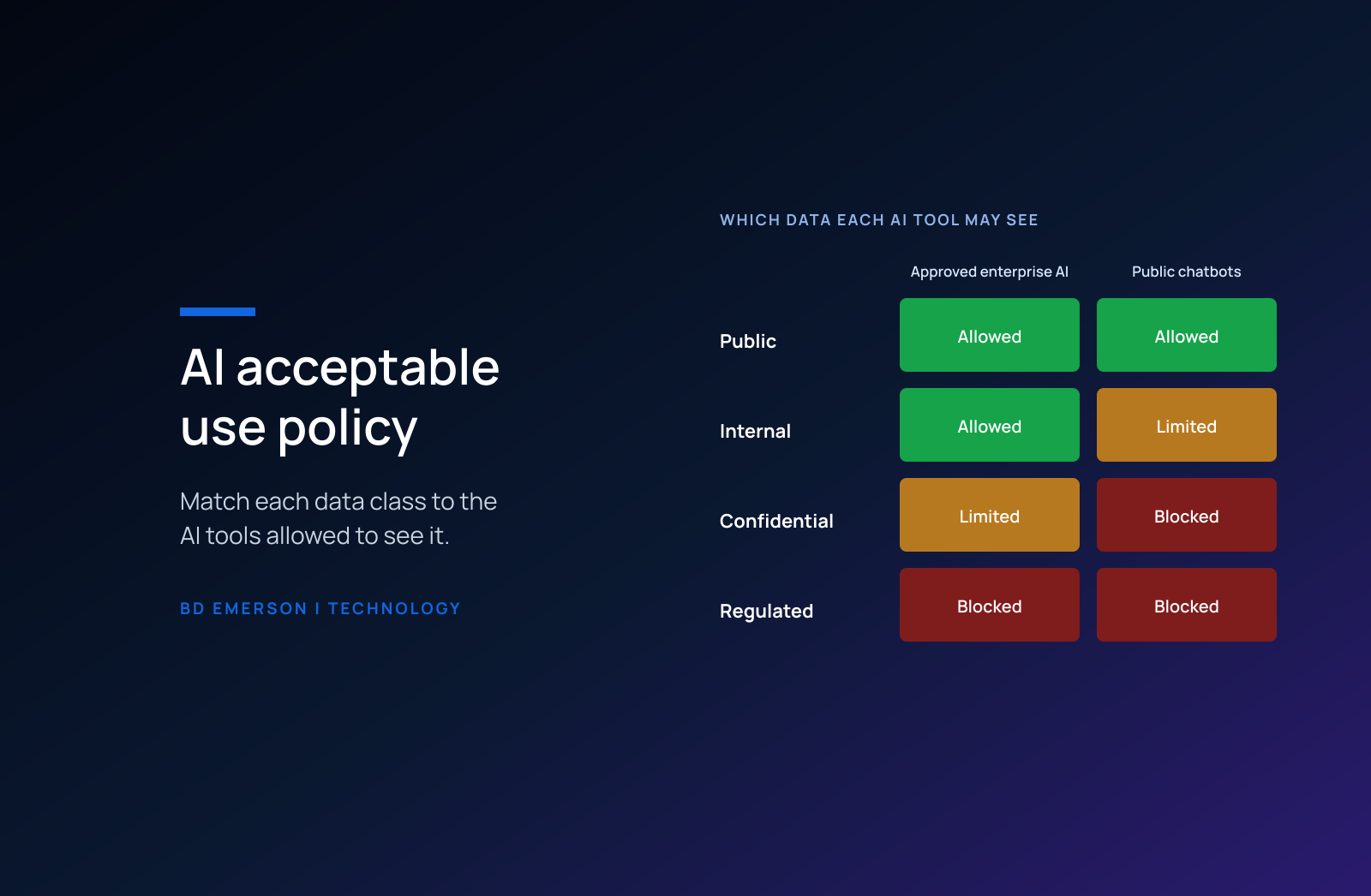
An AI acceptable use policy tells employees which AI tools they may use, what data each tool may receive, when a person must review AI output, and what happens when someone breaks the rules. A policy that works fits on four or five pages and covers eight areas: scope, approved tools, data rules, output review, prohibited uses, agents and integrations, requests for new tools, and enforcement. Each clause should be specific enough that an employee can apply it at the moment they open a chatbot, and each should map to a control IT can enforce, such as single sign-on to approved tools, blocking of unsanctioned apps, and data loss prevention rules for AI sites.
Why write a separate AI acceptable use policy?
Most companies already have an acceptable use policy for IT systems. It covers devices, email, and web use, but it rarely says where data goes when an employee pastes it into a model, who answers for AI output, or whether an AI feature added to an approved SaaS product is approved too. A short AI policy, referenced from the general one, lets you update the approved tools list every month without reopening the whole IT policy.
It also gives your AI governance program a document to point to. In the NIST AI Risk Management Framework core, GOVERN 1.2 calls for the characteristics of trustworthy AI to be integrated into organizational policies, processes, procedures, and practices, and GOVERN 1.4 calls for risk management outcomes to be established through transparent policies, procedures, and other controls. ISO/IEC 42001, the AI management system standard, is written for organizations that use AI-based products and services as well as those that build them, so an employee use policy belongs in any program headed for certification. Before you write the rules, find the tools people already use; our shadow AI guide covers discovery and the data class matrix that the data rules below depend on.
The eight areas and sample clauses
The clauses below are starting language. Adjust the roles, data classes, and turnaround times to your organization, and have counsel review the final text, especially the monitoring and disciplinary language.
Scope and definitions
Cover employees, contractors, and anyone acting for the company, and define AI use broadly enough to include AI features inside approved software, browser extensions, and personal accounts used for work. Sample clause: "This policy applies to all employees, contractors, and temporary staff who use any AI system for company work, including AI features embedded in approved software, AI browser extensions, and personal accounts on public AI services."
Approved tools register
Point to a live register instead of listing tools in the policy, because the list changes faster than the policy will. For each tool, the register records the business owner, the account type, whether the vendor may train on your data, and the highest data class the tool may receive. Sample clause: "Employees may use only the AI tools listed in the Approved AI Tools Register, signed in through company single sign-on. Using a personal account on any AI service for company work is prohibited."
Data rules
Data rules carry most of the risk, so tie them to the classification scheme you already use and name the data that never goes into an AI tool without a specific approval. Many companies start from a simple matrix: approved enterprise tools may receive public and internal data, confidential data only for uses the register names, and regulated data not at all without a specific approval, while consumer chatbots, if the register lists them, receive public data and little else. Sample clause: "Confidential data may be entered only into tools the register approves for confidential data. Passwords, API keys, private keys, payment card data, and protected health information may not be entered into any AI tool unless the register lists a specific approval and the required agreement, such as a business associate agreement, is in place."
Output review and disclosure
Treat AI output as a draft that a named person must check before it reaches customers, regulators, courts, financial statements, or production code. The clause should also say when the company discloses AI use, for example where a client contract requires it. Sample clause: "The employee who uses an AI tool is accountable for its output. A qualified person reviews AI-generated content for accuracy, confidentiality, and intellectual property concerns before it is sent outside the company, filed, or merged into production systems."
Prohibited uses
List the uses that are off limits in every tool: consequential decisions about people without human review, impersonation of real people, uploading third-party material your license does not cover, and attempts to bypass a tool's safety controls. Sample clause: "AI tools may not be used to make or materially support decisions about hiring, promotion, termination, credit, insurance, or housing without documented human review, and may not be used to impersonate any real person."
Agents, connectors, and extensions
Agents and connectors act with the employee's own access, so they need their own rule. Require approval before anyone grants an AI app access to mail, calendars, file stores, or code repositories, and before anyone installs an AI browser extension or runs an agent that can change data. Sample clause: "Employees may not grant any AI application or agent access to company accounts, data stores, or systems, or install AI browser extensions, unless the tool and its specific permissions are approved in the register."
Requests for new tools and uses
The request path decides whether the policy holds, because people work around a policy that answers every request with silence. Publish a turnaround time, review each request for data classes, vendor terms, and integration scope, and grant approvals that expire unless renewed. A ten business day standard review is a BD Emerson planning range that most mid-size companies can sustain. Sample clause: "Requests for new AI tools or uses go to the AI governance committee through the service desk. Standard requests receive a decision within ten business days, and approvals expire after twelve months unless renewed."
Monitoring, enforcement, and ownership
Say what the company monitors, what happens after a violation, and who owns the policy, and set a review at least every six months, because approved tools and vendor terms change that quickly. Sample clause: "The company monitors use of AI services on company devices and networks. Violations are handled under the disciplinary policy and may result in loss of access. The chief information security officer owns this policy and reviews it at least every six months."
How do you enforce an AI acceptable use policy?
A policy without technical controls depends on memory and goodwill. Map each area to a control before you publish, so the first violation is blocked or logged instead of discovered months later in an incident review.
| Policy area | Control that enforces it | Example |
|---|---|---|
| Approved tools | Single sign-on and blocking of unsanctioned apps | Consumer AI sites marked unsanctioned in a cloud access security broker and blocked on managed devices |
| Data rules | Data loss prevention on AI destinations | An endpoint DLP rule that blocks pasting confidential content into AI domains not in the register |
| Agents and connectors | Admin consent for OAuth apps | Users cannot grant an AI app access to mail or files without administrator approval |
| Output review | Workflow and code review gates | Pull requests require human approval, and client deliverables require reviewer sign-off |
| Training | Attestation tied to access | Access to approved AI tools is granted after the employee completes training and acknowledges the policy |
In Microsoft environments, Defender for Cloud Apps lets administrators mark discovered apps as sanctioned or unsanctioned, and unsanctioned apps can be monitored or blocked. Purview Endpoint DLP can detect when a user pastes content into a restricted service domain and audit or block the action, and it evaluates the pasted content itself rather than the label on the source file. Google Workspace and most secure web gateways offer equivalent controls.
How do you roll the policy out?
Publish the policy and the approved tools at the same time. If employees lose their consumer chatbot on the day the policy takes effect and have no sanctioned alternative, usage moves to personal phones, where you see nothing. An enterprise assistant with single sign-on and no-training terms should be live before the announcement.
Train people on the rules that apply to their work, and record the training. The NIST AI RMF's GOVERN 2.2 calls for personnel and partners to receive AI risk management training so they can perform their duties consistent with related policies, procedures, and agreements. Engineers need the agent and code review rules; finance and legal staff need the data and disclosure rules; everyone needs the short version of the prohibited uses.
Pilot with one or two departments, then expand. For a mid-size company, 30 to 60 days from first draft to company-wide rollout is a BD Emerson planning range, with most of that time spent on the register and the controls rather than the text.
How do you know the policy is working?
Track four numbers each month: the share of AI traffic that goes to approved tools, the median time to decide a tool request, data loss prevention events on AI destinations, and training completion. A rising share of approved traffic with falling DLP events means the sanctioned tools are good enough that people stop working around the policy. A growing queue of undecided requests predicts the next wave of shadow AI. Report the numbers to the AI governance committee, and use them to set priorities for the next review, as described in our guide to building an AI governance framework.
BD Emerson writes AI acceptable use policies, builds the approved tools register and the controls that enforce it, and implements ISO/IEC 42001 management systems that an accredited certification body then assesses. Our AI governance consulting page describes how those engagements start.

About the author