Custom Software Development Cost in 2026: Ranges, Rates, and a Worked Example
Custom software development costs $150,000 to $600,000 for an internal workflow tool, $250,000 to $1.5 million for a customer-facing web or mobile app, $500,000 to $2 million for a data platform or integration hub, and $2 million to $6 million or more for an enterprise platform or a regulated core system replacement, in BD Emerson's 2026 planning ranges. Every one of those numbers comes from the same formula: team size times blended hourly rate times duration, plus the run cost that starts the day the system goes live. Integrations, data migration, compliance scope, and undocumented legacy behavior decide where a project lands inside its band. If you have not decided whether to build at all, run your numbers through our build vs buy framework and calculator first.
This guide expands the short cost section in our custom software vs off-the-shelf analysis with the arithmetic, sourced labor rates, the cost lines proposals leave out, and the pricing models that decide who pays when an estimate is wrong.
How much does custom software cost by project type?
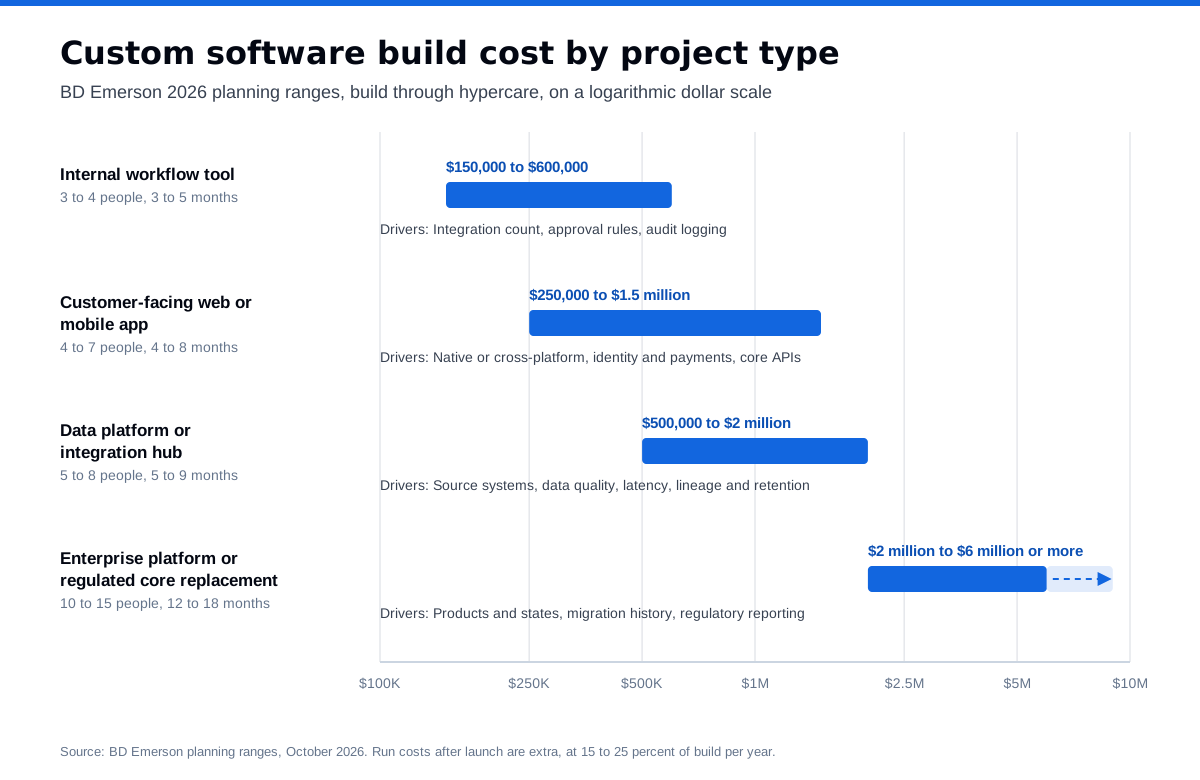
Project type sets the order of magnitude, and the drivers in the last column set the position inside the range. The table gives BD Emerson planning ranges for build cost through hypercare, the stabilization period after launch, in regulated industries such as insurance, banking, fintech, and healthcare. The ranges assume AI-assisted delivery, and run costs come on top.
| Project type | Typical scope | Team and duration | Build cost (BD Emerson planning range) | What moves it within the range |
|---|---|---|---|---|
| Internal workflow tool | One department, 10 to 40 screens, one to three integrations, single sign-on | 3 to 4 people for 3 to 5 months | $150,000 to $600,000 | Integration count, approval rules, audit logging |
| Customer-facing web or mobile app | Customer accounts, documents or payments, web plus iOS and Android, accessibility | 4 to 7 people for 4 to 8 months | $250,000 to $1.5 million | Native or cross-platform apps, identity and payments, core system APIs, app store review |
| Data platform or integration hub | 5 to 20 source systems, pipelines, APIs, reporting or event streams | 5 to 8 people for 5 to 9 months | $500,000 to $2 million | Source system count, data quality, latency targets, lineage and retention rules |
| Enterprise platform or regulated core system replacement | Policy administration, claims, loan servicing, or a member or clinical platform, with migration and parallel runs | 10 to 15 people for 12 to 18 months | $2 million to $6 million or more | Products and states, migration volume and history, regulatory reporting, undocumented rules |
Integration count moves cost more than screen count, because each external system brings its own authentication, error handling, test environment, and owner. Data migration moves the top band most, because replacing a system of record means converting, reconciling, and proving every historical record before cutover.
How do you calculate software development cost?
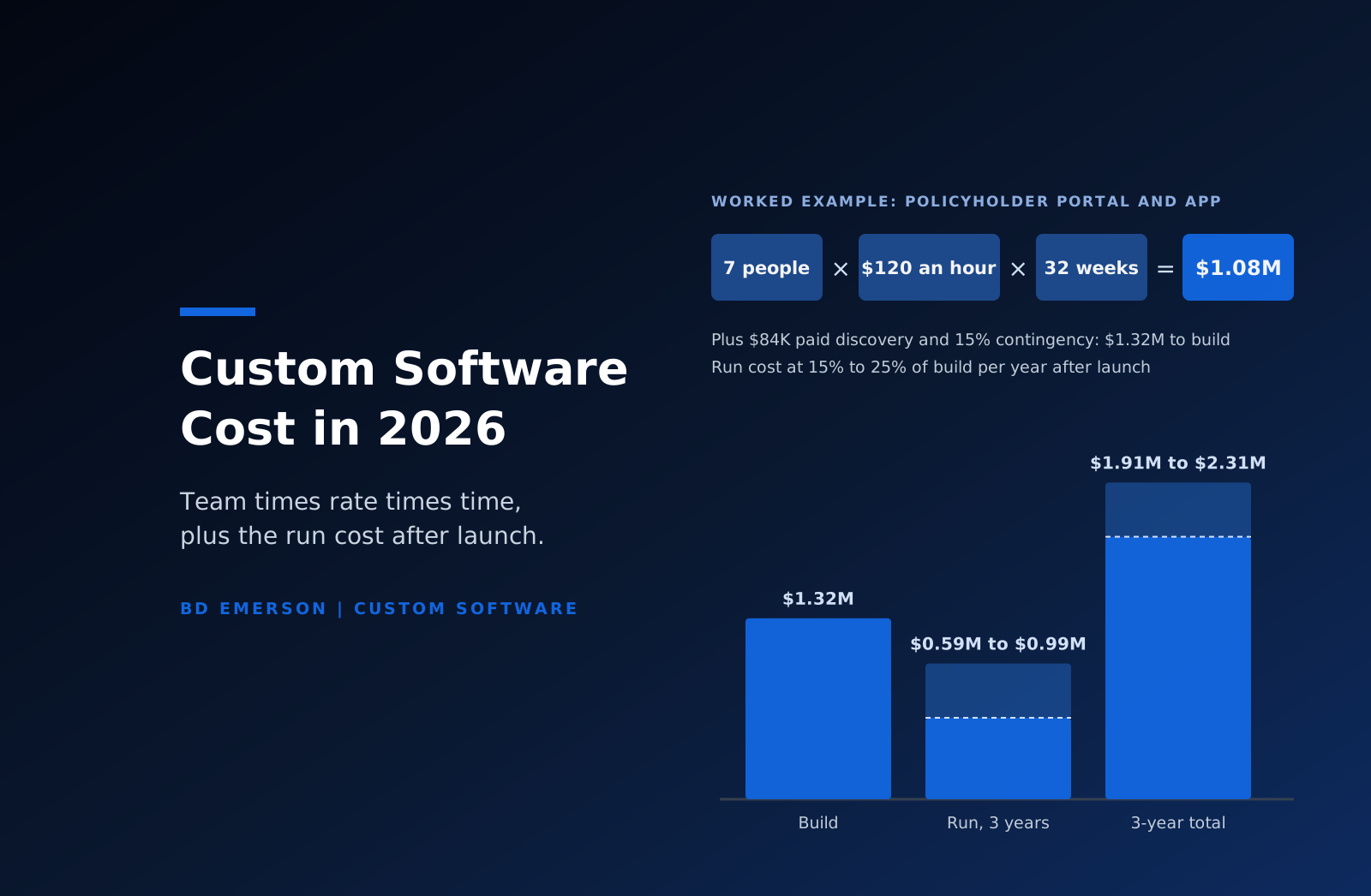
Software development cost equals team size times blended hourly rate times duration, plus contingency, plus the run cost after launch. The formula is simple, and estimates go wrong in the inputs. The worked example below prices a hypothetical regional insurer's policyholder portal and companion mobile app with claims status, document upload, and premium payments.
| Cost line | Inputs | Cost |
|---|---|---|
| Paid discovery | 3 people × 4 weeks × 40 hours × $175 | $84,000 |
| Design, build, testing, release, and hypercare | 7 people × 32 weeks × 40 hours × $120 blended | $1,075,200 |
| Contingency | 15% of the build line | $161,280 |
| Total build | Sum of the three lines | $1,320,480 |
| Run cost, year one | 15% to 25% of total build | $198,072 to $330,120 |
| Three-year cost of ownership | Total build plus three years of run | $1.91 million to $2.31 million |
The seven-person team is a product owner, a tech lead, a designer and a DevOps and security engineer at half time each, three engineers, and a QA engineer. Three onshore full-time equivalents at an average $190 an hour and four nearshore engineers and testers at an average $67.50 blend to $120: (3 × $190 + 4 × $67.50) ÷ 7 = $120. The same 8,960 hours at an all-onshore $175 blended rate would cost $1,568,000, or $492,800 more, and the saving holds only when time zones overlap enough for decisions to happen inside a shared working day.
Ask for every estimate in these terms. When a proposal names roles, hours, rates, weeks, and contingency, you can change one input and watch the total move. When it shows only a total, the vendor is asking you to trust it.
What do software developers charge per hour?
A US software developer earns a median $65.38 an hour in wages, US onshore firms bill $150 to $250 an hour for senior engineers and architects, and nearshore and offshore firms bill $24 to $76 an hour depending on region and seniority. Benefits, unbilled time, overhead, and margin fill the gap between wage and rate.
The Bureau of Labor Statistics reports a median annual wage of $135,980 for software developers in May 2025, the latest Occupational Employment and Wage Statistics data year. The lowest 10 percent earned less than $82,460 and the highest 10 percent more than $214,670. Dividing $135,980 by 2,080 paid hours gives $65.38 an hour. Software quality assurance analysts and testers earned a median $104,300, or $50.14 an hour.
The BLS Employer Costs for Employee Compensation release for June 2026 shows wages and salaries at 68.5 percent of total compensation for private-industry management, professional, and related occupations, so $65.38 in wages implies about $95.45 an hour with benefits ($65.38 ÷ 0.685). A firm that bills a developer for 1,600 of 2,080 paid hours, after holidays, training, and gaps between projects, needs about $124 per billed hour to cover that cost alone ($95.45 × 2,080 ÷ 1,600). Recruiting, management, tools, insurance, and margin carry onshore billed rates into the $150 to $250 range we use for planning.
| Source | Who | Hourly figure | Basis |
|---|---|---|---|
| BLS, May 2025 | US software developer, median wage | $65.38 | $135,980 ÷ 2,080 hours, wage only |
| BLS, June 2026 | Same developer, wages plus benefits | About $95 | Wages are 68.5% of compensation for professional occupations |
| Accelerance, November 2025 | Latin America | $33 to $45 junior, $60 to $75 senior | Survey of 60 software development partners |
| Accelerance, November 2025 | Central and Eastern Europe | $31 to $39 junior, $64 to $76 senior | Same survey |
| Accelerance, November 2025 | Asia | $24 to $31 junior, $31 to $41 senior | Same survey |
| BD Emerson planning assumption | US onshore firm, senior engineer to architect | $150 to $250 | Billed rate including overhead and margin |
The nearshore and offshore figures come from Accelerance's November 2025 summary of its 2026 rates guide, which reports that Latin American rates fell 7.1 percent in 2025. Accelerance helps engineering leaders choose outsourcing partners, so read these as vendor rates. The lowest rate rarely produces the lowest project cost: a team at half the rate that needs 40 percent more hours saves 30 percent (0.5 × 1.4 = 0.7), and rework can erase even that.
Software development cost by phase
Build is the largest phase, and testing is the one buyers cut first and regret most. The shares are BD Emerson planning figures for a regulated customer-facing app.
| Phase | Share of build budget | Typical duration | What it produces |
|---|---|---|---|
| Discovery | 4% to 8% | 2 to 6 weeks | Backlog, architecture, integration inventory, estimate range |
| Design (user experience and architecture) | 10% to 15% | 4 to 8 weeks, overlapping build | Clickable prototype, design system, architecture decision records |
| Build | 40% to 50% | 4 to 8 months | Working software every two weeks |
| Testing (QA, security, performance, user acceptance) | 15% to 25% | Runs through build, plus 3 to 6 weeks of hardening | Test evidence, penetration test report, accessibility audit |
| Release and cutover | 3% to 5% | 1 to 3 weeks | Release runbook, app store approval, rollback plan |
| Hypercare | 4% to 8% | 4 to 8 weeks after launch | Defect fixes, performance tuning, handover to the run team |
Regulated programs carry more testing because the evidence is part of the product. Insurance examiners, a bank's third-party risk team, and a hospital privacy office each ask how the system was tested, and reconstructing that proof after launch costs more than capturing it during the build.
The costs buyers forget
Most proposals price the build and leave out seven cost lines that arrive anyway. The figures are planning numbers for a regulated customer-facing application.
| Cost line | What drives it | Planning figure |
|---|---|---|
| Cloud hosting | Environments, availability target, data volume, disaster recovery | $2,000 to $15,000 a month (BD Emerson planning range) |
| Third-party licenses | Monitoring, identity, messaging, maps, AI tokens | Monitoring for 20 hosts at Datadog list prices costs $11,040 a year |
| Security testing | Web, API, and mobile scope, retests, frequency | $8,000 to $30,000 per manual web application penetration test |
| SOC 2 or other attestations | Trust Services Criteria in scope, Type 1 or Type 2, readiness work | $30,000 to $90,000 in the first year, all in |
| Accessibility | WCAG level, platforms, design and testing effort | 3% to 6% of build when designed in; more when retrofitted |
| Data migration | Source systems, data quality, history depth, reconciliation | 10% to 20% of build for a system-of-record replacement |
| Maintenance and support | Defects, patches, dependency upgrades, minor enhancements, infrastructure | 15% to 25% of build per year |
Datadog lists infrastructure monitoring at $15 and application performance monitoring at $31 per host per month, billed annually, as of October 2026, so 20 hosts with both cost 20 × $46 × 12 = $11,040 a year before logs. The penetration testing and SOC 2 figures are BD Emerson market ranges. If your platform will need a SOC 2 report, budget for it from the first sprint and keep the auditor independent: BD Emerson performs SOC 2 examinations through its CPA attest practice, and the firm that examines a system does not also implement its controls.
Accessibility has dates attached. WCAG 2.2 has been a W3C Recommendation since October 5, 2023. HHS's Section 504 rule requires recipients of HHS federal financial assistance to meet WCAG 2.1 Level AA in web content and mobile apps, and an interim final rule published May 11, 2026 moved the date for recipients with 15 or more employees to May 11, 2027.
The maintenance line decides whether a custom system stays healthy. Underfund it and the gap compounds into the debt our guide to managing technical debt describes, with every later change costing more than the last.
Software development pricing models compared
The pricing model decides who pays when the estimate is wrong. Every model moves overrun risk somewhere, and the vendor prices whatever risk it accepts into the rate or the total.
| Model | How it bills | Fits when | Who carries overrun risk | Watch for |
|---|---|---|---|---|
| Fixed price | One price for a defined scope | Discovery has specified the scope and it will hold | Vendor, priced in as a risk premium | Change orders, padded estimates, disputes over what was in scope |
| Time and materials | Hours at agreed rates, plus expenses | Scope will change as you learn and you direct priorities weekly | Buyer | No built-in cost control; needs strong product ownership |
| Capped time and materials | Time and materials with a not-to-exceed ceiling | You want flexibility inside a fixed budget | Buyer up to the cap, vendor above it | A cap set before discovery, or scope trimmed quietly near the cap |
| Dedicated team | Monthly fee for a named team | A long-running product with a roadmap | Buyer for output, vendor for staffing continuity | Paying for capacity nobody directs, team rotation |
| Outcome-based | Fees tied to delivered results or business metrics | The outcome is measurable and inside the vendor's control | Vendor, priced in | Metric gaming, attribution disputes, high premiums |
Federal acquisition rules state the trade plainly, and commercial contracts behave the same way. FAR 16.202-1 says a firm-fixed-price contract "places upon the contractor maximum risk and full responsibility for all costs and resulting profit or loss." FAR 16.601 says a time-and-materials contract "provides no positive profit incentive to the contractor for cost control or labor efficiency," which is why it requires "a ceiling price that the contractor exceeds at its own risk."
Fixed price vs time and materials
Use capped time and materials for discovery and the first release, then fixed price for later releases that discovery has specified. A fixed price quoted before discovery carries either a large risk premium or a change-order strategy, and the buyer pays for one of them. Uncapped time and materials works only when someone on your side owns the backlog and makes trade-offs every week.
What AI coding tools change and do not change
AI coding tools cut the time engineers spend writing code, and the measured size of that cut runs from large to negative depending on the task and the codebase.
In a controlled experiment published in February 2023, Peng and coauthors randomly assigned 95 developers recruited through Upwork to build an HTTP server in JavaScript with or without GitHub Copilot. The Copilot group finished 55.8 percent faster, with a 95 percent confidence interval of 21 to 89 percent. A 2024 randomized trial with 96 Google engineers estimated a 21 percent cut in time on task.
Mature codebases tell a different story. METR's July 2025 study followed 16 experienced open-source developers through 246 real issues in repositories averaging more than 1 million lines of code. With early-2025 tools, mainly Cursor Pro with Claude 3.5 and 3.7 Sonnet, tasks took 19 percent longer, while the developers believed they had gained 20 percent. METR's February 2026 update on late-2025 tools measured 18 percent faster work for returning developers and 4 percent for new recruits, with confidence intervals that cross zero, and calls the data "very weak evidence" of how much the speedup has grown. The 2025 DORA report, drawn from nearly 5,000 technology professionals, found AI adoption positively related to delivery throughput and still negatively related to delivery stability.
Project cost moves less than coding speed because coding is only part of the project. If coding and unit testing are 40 percent of total effort and AI makes that work 30 percent faster, the project gets 12 percent cheaper (0.40 × 0.30); at 60 percent faster, it gets 24 percent cheaper. Discovery, integration testing against systems you do not control, security review, data migration, and user acceptance set the floor. AI also adds a line item: GitHub lists individual Copilot plans from $10 to $100 a month as of October 2026, with extra usage billed in AI credits at $0.01 each.
How do you get a software estimate you can trust?
Buy a paid discovery before you buy the build. An estimate made at the idea stage can miss by a factor of four in either direction, according to Construx's account of the Cone of Uncertainty, and the cone narrows only as decisions remove variability from the project. Discovery makes those decisions. In BD Emerson's planning, it runs 2 to 6 weeks, costs $40,000 to $150,000 depending on how many systems and stakeholders it covers, and equals 4 to 8 percent of the build it scopes. A discovery worth paying for produces six things:
- A prioritized backlog for the first release, with acceptance criteria a tester can check.
- An architecture and an integration inventory that names every system, interface, owner, and test environment.
- A data migration assessment built from profiling real production records.
- A risk register that ranks the risks most likely to move cost and names an owner for each.
- An estimate stated as a range, with the cost the team expects to beat half the time (P50) and four times out of five (P80), plus the assumptions behind each.
- A release plan and a fixed-price or capped offer for the first release.
Discovery also gives you an exit. If the estimate exceeds what the business case can carry, you learned it for 4 to 8 percent of the build, and you keep the backlog and architecture.
When the cost says buy
Price the build against the license before you commit. Commodity software stays bought at any scale, and heavily licensed vertical systems are where building tends to win, as our build vs buy analysis shows over ten years. If your system works but sits on an aging stack, application modernization can cost less than a rebuild, and our ranked shortlist of custom software development companies gives a weighted rubric for scoring the firms that bid.
Frequently asked questions
How much does it cost to build an app? A customer-facing web or mobile app for a regulated business costs $250,000 to $1.5 million to build in BD Emerson's 2026 planning ranges, and a single-platform app with no payments or regulated data can come in below that band. The biggest drivers are whether you build native iOS and Android apps or one cross-platform codebase, how many core systems the app calls, and the identity, payments, and accessibility work regulated customers require.
What is the average hourly rate for a software developer? The median US software developer earned $65.38 an hour in wages in May 2025, based on the BLS median annual wage of $135,980, and about $95 an hour including benefits. Firms bill more: US onshore firms bill $150 to $250 an hour for senior engineers in BD Emerson's planning, while Accelerance reports $60 to $75 for senior developers in Latin America and $31 to $41 in Asia.
Is fixed price or time and materials better for software development? Use capped time and materials for discovery and the first release, when scope is still moving, and fixed price for later releases that discovery has specified. Fixed price moves overrun risk to the vendor, who prices it in. Time and materials keeps the risk with you and gives the vendor no built-in incentive to control cost, so it needs a ceiling and strong product ownership.
How much does software maintenance cost per year? Plan 15 to 25 percent of the original build cost per year to run custom software, covering defect fixes, security patches, dependency upgrades, minor enhancements, infrastructure, and AI tokens. That range is a BD Emerson planning assumption. Systems with many integrations, frequent regulatory change, or aging frameworks sit at the top of it, and penetration tests and SOC 2 examinations come on top.
How long does custom software development take? An internal workflow tool takes 3 to 5 months, a customer-facing web or mobile app 4 to 8 months, a data platform or integration hub 5 to 9 months, and a regulated core system replacement 12 to 18 months or more, including discovery and hypercare. Integration count and data migration stretch timelines more than feature count, and parallel runs for systems of record add months.
Does AI reduce software development cost? AI coding tools reduce the cost of writing code, and the studies disagree on how much: Copilot users finished a scoped task 55.8 percent faster in a 2023 controlled experiment, while METR measured experienced developers taking 19 percent longer on mature codebases in early 2025. Because coding is only part of a project, total cost falls less than coding speed rises, and discovery, integration, security testing, and migration take as long as before.
If you're pricing a build, our custom software development team can run a paid discovery and hand back the estimate in the formula's terms: roles, hours, rates, weeks, contingency, and the run cost after launch.

About the author