Palantir Certifications: What Each One Proves and Which Your Platform Team Needs
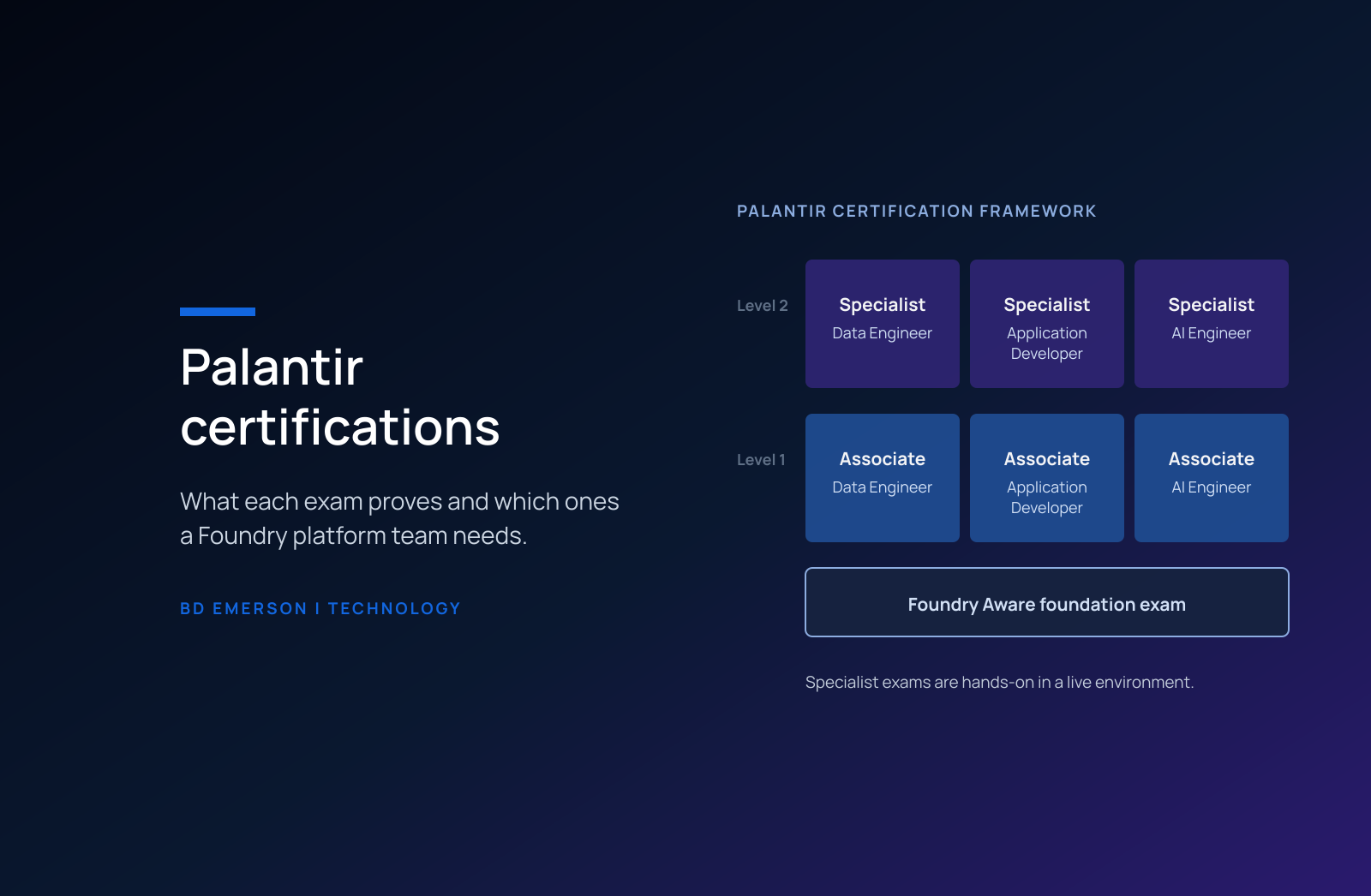
Palantir's certification framework, as published on Palantir Learn when we checked it in November 2026, has one foundation credential and two levels across three tracks. Foundry Aware is the entry point. Level 1 Associate certifications in Data Engineer, Application Developer, and AI Engineer are timed, open-book, multiple-choice exams valid for two years. Level 2 Specialist certifications in the same three tracks are hands-on exams in a live Foundry and AIP environment, with AI tooling permitted. Palantir's courses are free, and its exams carry a cost and require an access code from your Palantir contact or Foundry administrator. A team taking over a Foundry build needs the Associate level in every role it staffs and at least one Specialist in each track it runs in production.
What certifications does Palantir offer?
Palantir organizes its certifications by where the work sits relative to the ontology. The Palantir Certification Framework labels the Data Engineer track "South of the Ontology," the Application Developer track "North of the Ontology," and the AI Engineer track "AIP across the platform." The table summarizes what Palantir says each credential validates and how each exam runs.
| Level | Credential | What Palantir says it validates | Exam format |
|---|---|---|---|
| Foundation | Foundry Aware | "The recommended foundation for every new builder" | Timed multiple choice, open book |
| Level 1 Associate | Data Engineer | Knowledge of data integration, pipelines, and ontology construction | Timed multiple choice, open book, valid two years |
| Level 1 Associate | Application Developer | Knowledge of applications and logic on ontology objects | Timed multiple choice, open book, valid two years |
| Level 1 Associate | AI Engineer | Knowledge of AIP capabilities across the platform | Timed multiple choice, open book, valid two years |
| Level 2 Specialist | Data Engineer | Building and deploying production-grade pipelines and an ontology in a live environment | Hands-on live exam, AI tooling permitted |
| Level 2 Specialist | Application Developer | Delivering a working application backed by ontology objects | Hands-on live exam, AI tooling permitted |
| Level 2 Specialist | AI Engineer | Designing and deploying end-to-end AI workflows using AIP in a live environment | Hands-on live exam, AI tooling permitted |
The framework page states a two-year validity for Level 1 and does not state one for Level 2. Palantir delivers the Specialist exams through Ontologize, a training company named on the same page. The current framework lists no Professional level, so check the status of any older Palantir certification on your team before you count it toward staffing.
What do north and south of the ontology mean for your team?
The labels map to the way a Foundry build divides its labor. South of the ontology sits everything that turns source data into trusted objects: connections to source systems, pipelines, and the construction of object types. North of the ontology sits everything that uses those objects: Workshop applications, functions, and the logic that runs on objects. The Palantir ontology is the contract between the two halves, which is why a platform team needs certified people on both sides and one person who owns the boundary between them.
The AI Engineer track cuts across both halves, because AIP workflows depend on the objects the data engineers build and run inside the applications the developers build. If your build runs AIP workflows in production, the AI Engineer credential belongs to whoever is accountable for their behavior. Our explainer on what Palantir AIP is covers the platform those workflows run on.
How much do Palantir certifications cost, and who can take them?
Palantir does not publish exam prices on its learning site. The Palantir Learn FAQ says "All Palantir Learning courses are free" and "Certification exams have an associated cost," and it directs candidates to their Palantir point of contact or Foundry administrator for exam access. Access codes are required for certification exams. Most courses also need a Foundry environment provided by your employer, although the Foundry Foundations course is open to anyone with an interest in the platform.
Two scheduling rules matter for a team working toward a roll-off date. The FAQ sets a 14-day cooling-off period between exam attempts, and after a candidate passes a Foundry certification exam, that person waits 11 months before taking another instance of the same exam. Build the exam plan with the retake window inside it, because a failed attempt two weeks before Palantir's forward deployed engineers (FDEs) leave pushes that certification past the handoff.
Which certifications does a Foundry platform team need?
Staff certifications to the work your team will own after the handoff. The data engineers who will maintain pipelines and object types need the Data Engineer Associate, and at least one of them should hold the Data Engineer Specialist, because that exam requires building and deploying pipelines and an ontology in a live environment. The application developers who will change Workshop applications need the Application Developer Associate, with one Specialist among them. If AIP workflows run in production, the person who owns them needs the AI Engineer Associate, and the engineer on call for them should hold the AI Engineer Specialist.
Some roles have training without a matching certification. Palantir Learn publishes six training tracks: Data Engineer, Application Developer, AI Engineer, Data Scientist, Frontend Developer, and Data Analyst. It also tags a small number of courses for a Platform Administrator audience. The certification framework covers only the first three tracks. Analysts who build in Contour and Quiver can take the Data Analyst courses, and frontend developers who build on the Ontology SDK have their own track. Your Foundry administrator, who manages groups, markings, and usage limits, should take Foundry Aware and then pair with the outgoing team on every permission and cost setting before roll-off, since no exam covers your enrollment's configuration.
How does an AIP bootcamp differ from training?
An AIP bootcamp is a deployment event, and attendees leave with a working workflow and no credential. Palantir's 10-K for fiscal 2024 says Palantir introduced AIP bootcamps during 2023, which "allow us to deliver real workflows on actual customer data in days," and it lists bootcamps among its sales and marketing approaches. A bootcamp proves a use case on your data. Maintaining that use case after the bootcamp is a separate skill, and the training tracks and exams are how your team builds it.
Treat the week after a bootcamp as the start of the training plan. The workflow the bootcamp produced becomes the first real system your engineers learn to change, which gives every course in the track a concrete target inside your own enrollment.
What does a Palantir certification leave untested?
An Associate exam tests knowledge in an open-book format, and a Specialist exam tests whether a person can build in a live Foundry and AIP environment. Neither exam covers your enrollment. A certified data engineer still has to learn your source systems, your markings, your usage limits, and the reasons behind design choices the FDEs made. Treat certification as the floor for a role, then require each person to complete supervised work in your own environment before joining the on-call rotation: one pipeline change through your release process, one runbook exercise, and one access review.
How do you verify a Palantir certification?
Palantir issues a verifiable badge to each person who earns a credential, and its FAQ says the candidate receives an email with a link to that badge. Ask for the link whenever a certification matters to a decision, whether you are hiring a data engineer, moving an analyst into a builder role, or staffing an internal platform team. Check three things on the badge: the level, because an Associate badge and a Specialist badge prove different skills; the track, because a Data Engineer credential says little about Workshop applications; and the date, because Level 1 credentials are valid for two years. Your platform team plan should list each named person's badges next to the role they cover, with the expiry dates on the same page so renewals land on the calendar before a credential lapses.
A 90-day certification plan before the FDEs leave
The BD Emerson planning range for certifying a three- to five-person platform team is 60 to 90 days, run in parallel with the last phase of the build. In the first month, everyone takes the Foundry & AIP Aware course, which Palantir Learn lists at about eight hours, and sits the Foundry Aware exam. In the second month, each person completes the courses in their track and sits the Associate exam, leaving the 14-day cooling-off period as slack before month three. In the third month, the engineers who will carry on-call duty sit the Specialist exam and work tickets alongside the FDEs, so the last weeks of the build double as supervised production work.
BD Emerson builds and certifies Foundry platform teams as part of the handoff from Palantir's forward deployed engineers. Our engineers pair with your data engineers and application developers on real changes in your enrollment, prepare them for the Associate and Specialist exams, and run the build with them until they carry it on their own. Our Palantir managed services page describes how that enablement fits into the handoff.

About the author