

What Is Shadow AI? Risks, Detection, and an AI Acceptable Use Policy
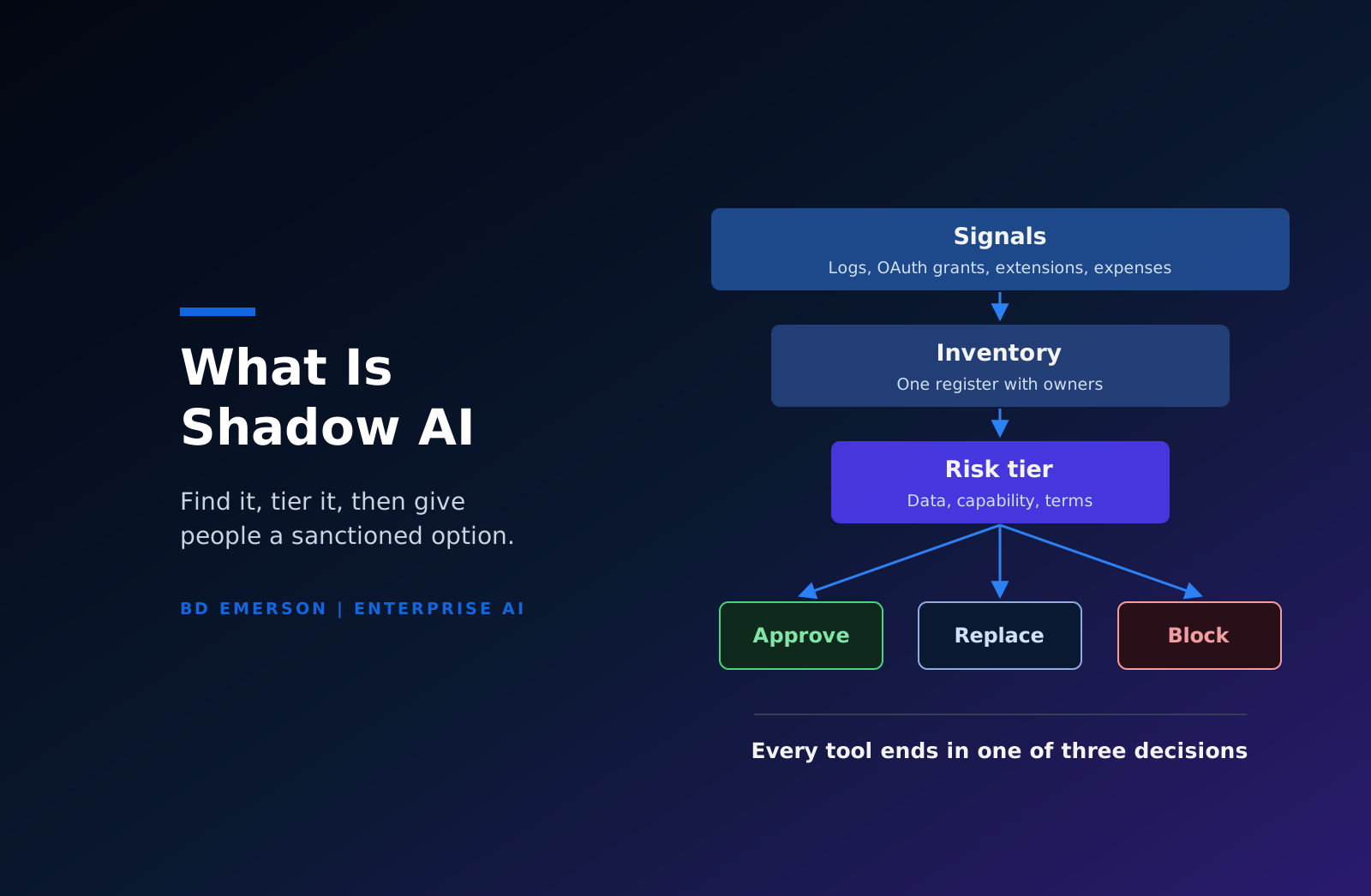
Shadow AI is the use of AI tools, models, agents, or AI features by employees or teams without the knowledge or approval of the people responsible for security, privacy, and the data involved. It covers a consumer chatbot on a personal account, an AI note-taker granted access to a corporate calendar, a browser extension that reads every page, and model API credits bought on a corporate card. The exposure is concrete: company data reaches providers whose retention and training terms nobody reviewed, with no data processing agreement (DPA) or business associate agreement (BAA) in place. In the KPMG and University of Melbourne global study of more than 48,000 people in 47 countries, almost half of employees admitted using AI in ways that contravene company policies. The fix is discovery, risk tiering, an AI acceptable use policy, and sanctioned tools good enough that people stop working around the rules.
What counts as shadow AI?
Shadow AI is a subset of shadow IT with two properties that raise the stakes: the tool processes whatever the user pastes or connects, and agentic tools act with the user's own credentials. The table lists each form and the signal that exposes it.
| Form | Example | Why it is shadow AI | Signal that exposes it |
|---|---|---|---|
| Consumer AI assistants on personal accounts | An employee pastes a customer contract into a free chatbot | No enterprise terms, no admin visibility, possible training use | Web gateway and cloud access security broker (CASB) logs, DNS queries |
| AI features inside approved SaaS | A vendor turns on an AI summarizer in an existing CRM or help desk | The vendor was reviewed, but the AI feature never was | Vendor release notes, admin consoles, renewals |
| OAuth-connected AI apps | A meeting note-taker granted calendar and mail access | Its token keeps reading data after the user logs off | OAuth grant inventories in Microsoft Entra ID or Google Workspace |
| AI browser extensions | A writing assistant that can read and change data on every site | It reads internal apps through the user's session | Browser extension inventory reports |
| Self-serve API keys | A team buys model API credits on a corporate card to build an internal bot | Production data flows through an unreviewed integration | Expense and card data, egress to model API hostnames |
| Local models and MCP servers | A developer runs an open-weight model or a community MCP server on a laptop | It runs with the user's privileges, outside endpoint policy | Endpoint software inventory, MCP configuration files |
| Unvetted agents | An agent with delegated access files tickets or sends email on its own | It acts without review, logging, or a way to stop it | OAuth grants, unusual API activity under a user identity |
Why does shadow AI happen?
Shadow AI happens because demand for AI outruns the approved supply. A free assistant drafts and summarizes in seconds while a new enterprise tool waits on budget and review cycles, and a ban without an alternative pushes the same use onto personal phones and accounts. Microsoft and LinkedIn's 2024 Work Trend Index, a survey of 31,000 knowledge workers in 31 markets that Edelman Data and Intelligence fielded from February 15 to March 28, 2024, found that 75% of knowledge workers used generative AI at work and that 78% of AI users brought their own AI tools to work, rising to 80% at small and medium-sized companies.
Policy and training trail that usage. In the KPMG and University of Melbourne study, fielded from November 2024 to mid-January 2025, 58% of employees said they intentionally use AI at work, but only 40% said their workplace has a policy or guidance on generative AI use, and only 47% said they had received AI training. Over half, 57%, said they hide their use of AI and present AI-generated work as their own. Two structural drivers add to the problem: vendors switch on AI features inside software the company already approved, and a slow or missing request process leaves employees no legitimate path to a new tool.
What are the risks of shadow AI?
Shadow AI risk falls into six groups, most of them traceable to contract terms and permissions nobody reviewed.
| Risk | What happens | Rule or obligation at stake | Control |
|---|---|---|---|
| Data leakage to model providers | Prompts, uploads, and connected files leave the company and sit in a third party's systems | Confidentiality clauses, export controls, client data handling terms | Approved enterprise tenants and data loss prevention (DLP) on AI destinations |
| Retention and training terms | Consumer tiers can use content for training. OpenAI states it may train on content from its services for individuals unless the user turns off "Improve the model for everyone," and excludes ChatGPT Business, Enterprise, Edu, and the API by default | Data minimization, client contracts, privacy notices | Enterprise agreements with no-training and retention terms |
| IP and confidentiality | Source code, deal documents, and client work product go to a tool with no contractual protection | Client NDAs, engagement terms, trade secret protection | Data classes per tool; work with counsel on trade secret questions |
| Regulatory exposure | PHI enters a tool with no business associate agreement, or personal data enters a tool with no processor contract | HIPAA business associate rules; GDPR Article 28 | A signed BAA or DPA before any regulated data |
| Inaccurate output | Unchecked AI output reaches customers, regulators, or production code | Professional duty of care, contract warranties | Human review rules by use case |
| Agents and extensions acting with user credentials | An extension or agent reads mail, files, and internal apps through the user's session or OAuth token | Least privilege requirements in SOC 2 and ISO/IEC 27001 | OAuth consent restrictions and extension allowlists |
Under HHS guidance on cloud computing, a cloud provider that creates, receives, maintains, or transmits electronic PHI for a covered entity is a business associate even if it stores only encrypted data, so a clinician who pastes patient details into a consumer chatbot hands PHI to a vendor with no BAA. Under GDPR Article 28, a controller may use only processors that give sufficient guarantees and must bind them by contract, which an employee's personal AI account never does. On accuracy, the KPMG and University of Melbourne study found that 66% of employees rely on AI output without evaluating its accuracy and 56% have made mistakes in their work because of AI.
The consequences now show up in breach data. IBM's Cost of a Data Breach Report 2026, researched by the Ponemon Institute across breaches at 602 organizations from March 2025 to February 2026 according to IBM's July 29, 2026 release, found that roughly one in five organizations reported an AI-related breach, that 92% of those lacked proper AI access controls, and that only 40% of organizations used access controls on AI models and data, per IBM's X-Force analysis.
How do you detect shadow AI?
No single control finds all shadow AI, so discovery merges network, identity, browser, finance, endpoint, and people signals into one inventory.
| Method | What it finds | What it misses |
|---|---|---|
| Secure web gateway and CASB logs | Traffic to known AI apps; Microsoft Defender for Cloud Apps keeps a Generative AI category in its app catalog with risk assessments across more than 90 factors | Personal devices off the corporate network, and AI features inside sanctioned domains |
| DNS logs | Lookups for AI domains from managed networks | Encrypted DNS that bypasses corporate resolvers, and AI inside approved SaaS |
| OAuth app grants in Microsoft 365 and Google Workspace | Connected AI apps, the scopes they hold, and how many users granted them; Google Workspace lists accessed apps with user counts and requested OAuth scopes | Tools used by copy and paste with no account link |
| Browser extension inventories | AI extensions, install counts, and requested permissions on enrolled browsers, as in the Chrome Enterprise app and extension usage report | Unmanaged browsers and personal profiles |
| Expense reports and corporate card data | Paid AI subscriptions and API credits bought outside procurement | Free tiers |
| Network egress to model APIs | Code and services calling api.openai.com, api.anthropic.com, or generativelanguage.googleapis.com | Calls routed through a third-party wrapper or proxy |
| Endpoint software inventory | Local model runners, AI desktop apps, and MCP client configuration files | Devices outside management |
| Employee survey | Why people use each tool and what data they put in | Anything people choose not to report |
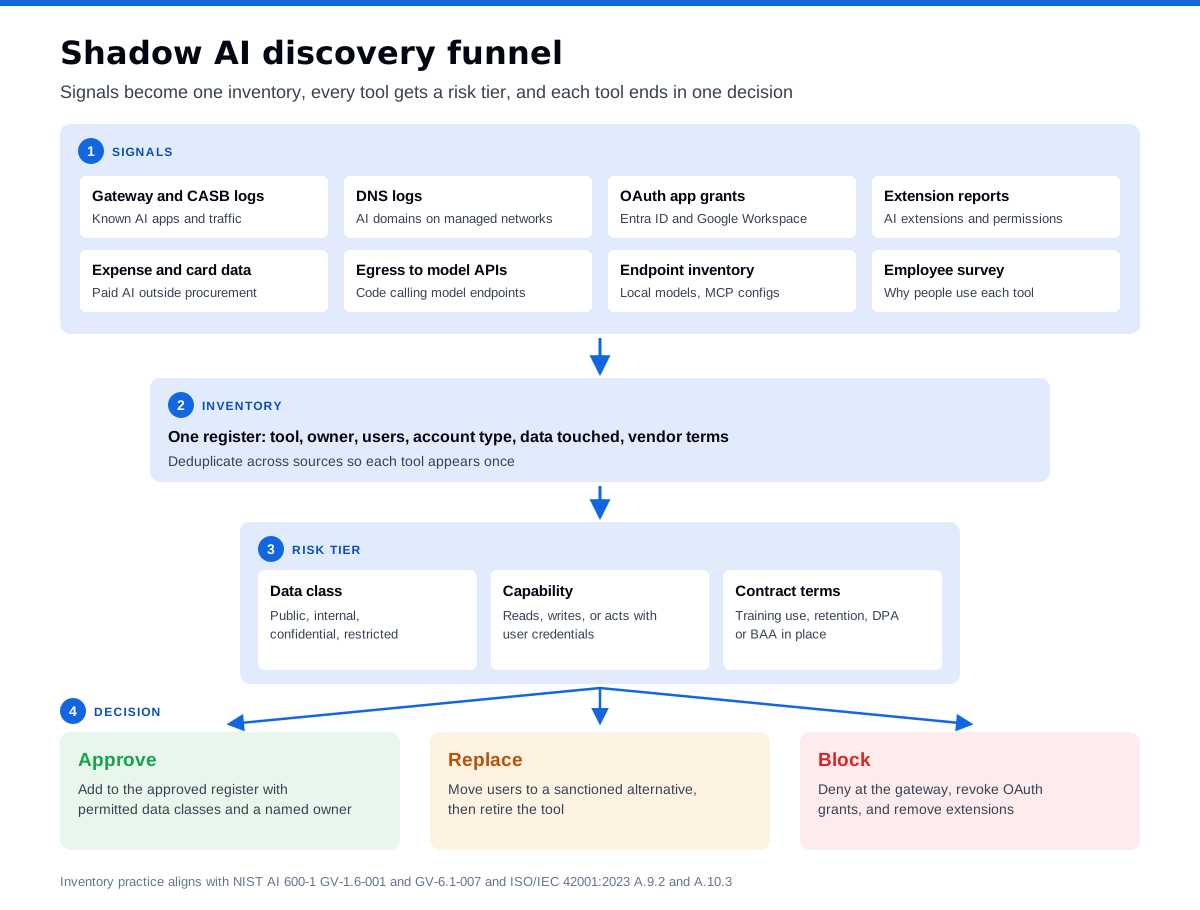
Announce the first pass as a census with an amnesty period, because people who expect punishment hide usage.
What do ISO 42001, the NIST AI RMF, and the EU AI Act require?
Each of the three frameworks asks for something shadow AI makes impossible: a complete inventory of AI in use, controlled use, or trained staff.
| Framework | Provision | What it asks for | Where shadow AI breaks it |
|---|---|---|---|
| ISO/IEC 42001:2023 | Annex A controls A.2.2 (AI policy), A.4.2 (resource documentation), A.9.2 (processes for responsible use of AI systems), and A.10.3 (suppliers) | A documented AI policy, records of the AI resources in use, defined processes for responsible use, and supplier controls | Unknown tools sit outside the management system's scope, records, and supplier reviews |
| NIST AI RMF and NIST AI 600-1 | GOVERN 1.6, GV-1.6-001, GV-6.1-007, and GV-6.1-010 | Mechanisms to inventory AI systems, an enumeration of generative AI systems, approved generative AI technology and service provider lists, and acceptable use policies that cover contractors and third-party personnel | The inventory and the approved lists are incomplete by definition |
| EU AI Act, Regulation (EU) 2024/1689, as amended by Regulation (EU) 2026/1744 | Article 4, AI literacy | Providers and deployers take measures to support the AI literacy of staff who operate or use AI systems on their behalf | You cannot train people on tools you do not know they use |
Article 4 has applied since February 2, 2025. The Digital Omnibus on AI, Regulation (EU) 2026/1744 of July 8, 2026, entered into force on July 27, 2026 and replaced the article's text. Providers and deployers now "shall take measures to support the development of AI literacy" of their staff and others operating AI systems on their behalf, and the obligation "does not require providers or deployers to guarantee any specific level of AI literacy of any individual." The duty moved from a result to an effort, and it still reaches any organization whose staff use AI systems for work, because the AI Act defines a deployer as anyone using an AI system under its authority outside personal, non-professional activity. Confirm with counsel how the amended text applies to your EU entities.
How to write an AI acceptable use policy
An AI acceptable use policy works when an employee can apply it in the moment, so it has to answer three questions: which tools are approved, what data each tool may receive, and how to ask for something new. Start with the data rules, because they carry most of the risk.
| Data class | Examples | Enterprise AI tenant with no-training terms | AI feature in approved SaaS | Consumer AI tool |
|---|---|---|---|---|
| Public | Published marketing copy, public filings | Allowed | Allowed | Allowed |
| Internal | Procedures, non-sensitive email | Allowed | Allowed | Not allowed |
| Confidential | Client deliverables, source code, financials, contracts | Allowed for approved use cases | Allowed if the vendor contract covers AI processing | Not allowed |
| Restricted | PHI, cardholder data, government IDs, CUI, material under NDA | Only where the required agreement or authorization exists, such as a BAA for PHI, and a data owner approves | Not allowed unless the contract covers that data class | Not allowed |
BD Emerson's outline for a short AI acceptable use policy has nine sections:
- Purpose and scope: who it covers, contractors included, and which uses count, including AI features in approved software.
- Approved tools register: the live list of approved tools, each with an owner, permitted data classes, and a corporate account and single sign-on requirement.
- Data rules: the data class matrix, plus outright bans on credentials, secrets, and regulated data in unapproved tools.
- Use rules: human review before AI output reaches customers, regulators, courts, or production code, and disclosure where required.
- Agents, connectors, and extensions: no OAuth grants, browser extensions, MCP servers, or agents with write access without approval.
- Exceptions: how to request a new tool or use case, who decides, and the response time.
- Training: the AI literacy training each role completes, which doubles as Article 4 evidence for EU deployers.
- Monitoring and enforcement: what the company monitors and what happens after a violation.
- Ownership and review: the policy owner and a review at least twice a year.
The exceptions process decides whether the policy holds. Publish a fixed turnaround, for example ten business days for a standard request, review each request for data classes, vendor terms, and integration scope, and grant time-boxed approvals that expire unless renewed. Both major identity platforms support it: Google Workspace lets admins allow users to request access to unconfigured third-party apps, and the Microsoft Entra ID admin consent workflow lets users request review of apps they cannot approve themselves.
Offer sanctioned alternatives so people stop working around the policy
Blocking holds only when the approved option is nearly as good as the blocked one. Plan for three sanctioned options: an enterprise AI assistant with no-training terms and single sign-on, a governed path for teams that need model API access, and an approved list of extensions and connectors. Where regulated data cannot leave the company's environment, privately hosted open-weight models are a fourth.
Configure the identity layer to steer people toward those options. Microsoft recommends allowing user consent only for apps from verified publishers, and Entra ID can limit user consent to permissions an admin classifies as low impact. Google Workspace can block sign-in to unconfigured third-party apps until an admin reviews them. Pair each restriction with the request flow above, and publish the approved list where employees look first. Route agent connections to internal systems through governed MCP servers with per-server identities, as our Model Context Protocol guide describes.
How do you measure progress on shadow AI?
Track a small set of metrics, and have the AI governance owner review them monthly.
| Metric | Definition | Source | Healthy direction |
|---|---|---|---|
| Unsanctioned AI apps in use | Distinct unapproved AI apps with more than five users in 30 days | CASB and DNS logs | Down |
| Sanctioned share of AI traffic | Share of AI requests that reach approved tools | Gateway logs | Up |
| Unreviewed AI OAuth grants | AI apps holding tokens without a completed review | Entra ID and Google Workspace | Down |
| Exception turnaround | Median business days from request to decision | Ticketing system | At or below the published target |
| AI literacy coverage | Share of staff in AI-using roles who completed role-based training | Learning system | Up |
| AI data loss events | DLP blocks and alerts on AI destinations, by data class | DLP console | Up at first as visibility improves, then down |
A 30-day plan to get shadow AI under control
Thirty days is enough to move from no visibility to a published policy and a tiered inventory with owners, if the work runs as four weekly sprints. BD Emerson recommends this sequence.
| Week | Work | Output | Owners |
|---|---|---|---|
| Week 1: Discover | Pull 30 days of CASB, DNS, and egress logs; export OAuth grants; run the extension report; pull card and expense data; send an anonymous survey | Raw signal list | Security operations, IT, finance |
| Week 2: Inventory and tier | Merge signals into one register with tool, users, data touched, account type, and vendor terms; tier each tool by data class, capability, and contract terms | Tiered AI inventory | Security, privacy, legal |
| Week 3: Decide and publish | Decide approve, replace, or block for each tool; publish the AI acceptable use policy, the approved tools register, and the exceptions process | Policy, register, and decision log | CISO, CIO, general counsel |
| Week 4: Enforce and measure | Restrict OAuth consent, block high-risk tools with a redirect to approved options, turn on DLP for AI destinations, start training, and baseline the metrics | Enforced controls and a metrics baseline | IT, security, HR |
Repeat the discovery pull every month. Vendors add AI features to approved software between contract renewals, so the inventory is only as current as the last pull.
How BD Emerson helps
BD Emerson's AI governance consulting team runs shadow AI discovery, builds the tiered inventory, and writes the AI acceptable use policy and exceptions process. Where certification is the goal, our ISO 42001 consulting practice implements the AI management system and performs internal audits, and an accredited certification body issues the certificate. Our data privacy consulting team runs the vendor privacy reviews and privacy impact assessments that sanctioned tools need, and our guide to building an AI governance framework shows where shadow AI discovery fits in the wider program.
Frequently asked questions
What is shadow AI? Shadow AI is the use of AI tools, models, agents, or AI features without the knowledge or approval of the people responsible for security, privacy, and the data involved. Examples include consumer chatbots on personal accounts, AI note-takers with calendar access, AI browser extensions, and API credits bought on a corporate card. It creates data, contract, and regulatory exposure because nobody reviewed the tool's terms.
What is the difference between shadow AI and shadow IT? Shadow AI is a subset of shadow IT. Both involve unapproved technology, but AI tools process whatever users paste or connect, may retain or train on that content under consumer terms, and can act with the user's credentials when they run as agents or extensions. Those properties make shadow AI harder to find and faster to cause harm than an unapproved file-sharing app.
Is using ChatGPT at work shadow AI? It depends on the account and the approval. A personal ChatGPT account used for work without approval is shadow AI, and OpenAI states that it may use content from its services for individuals to train models unless the user opts out. A ChatGPT Business or Enterprise workspace the company approved is sanctioned AI, and OpenAI does not use those inputs for training by default.
Should we ban generative AI tools at work? A blanket ban rarely holds, because employees move the same use to personal phones and accounts where the company loses all visibility. Block specific high-risk tools, approve an enterprise alternative with no-training terms and single sign-on, publish which data classes each tool may receive, and run an exceptions process with a fixed turnaround so people have a legitimate path to new tools.
What should an AI acceptable use policy include? An AI acceptable use policy should cover scope, an approved tools register, data rules by data class, human review rules for AI output, limits on agents, connectors, and browser extensions, account rules, an exceptions process with a response time, role-based training, monitoring and enforcement, and a named owner with a review cadence. Keep it short enough that employees can apply it in the moment.
Does the EU AI Act require AI literacy training? Article 4 requires providers and deployers to take measures to support the AI literacy of staff who operate or use AI systems on their behalf. It has applied since February 2, 2025, and since July 27, 2026 the amended text states that it does not require a guaranteed level of literacy for any individual. Training records remain the practical evidence. Confirm scope with counsel.
If you're starting a shadow AI program, our AI governance team can run the discovery pull, build the tiered inventory, and draft the policy and exceptions process with your security, privacy, and legal owners.

About the author

















