Palantir Gotham: What It Is, Who Uses It, and How It Differs From Foundry

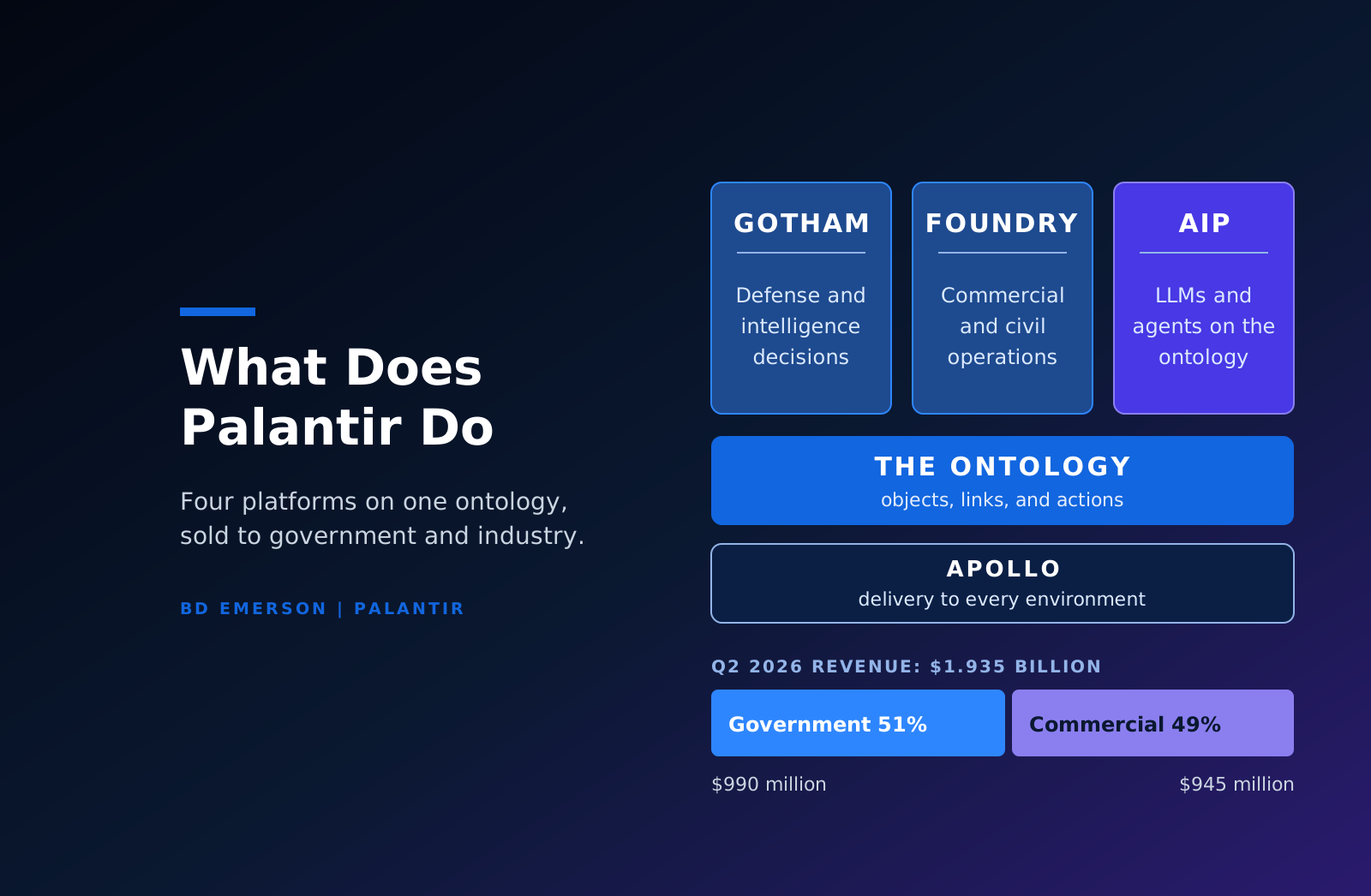
Palantir Gotham is Palantir Technologies' software platform for defense, intelligence, and law enforcement agencies. It pulls data from many sources into one model of people, places, organizations, events, and equipment, then gives analysts and operators the tools to search that model, map relationships, plan missions, and act on what they find, from an operations center out to the tactical edge. Palantir's product page calls Gotham "The Operating System for Defense Decision Making." It was the company's first platform, built after Palantir's 2003 founding for analysts at US defense and intelligence agencies. Commercial companies buy Foundry and AIP instead, which share Gotham's ontology-based design and its delivery infrastructure.
Facts in this guide are current as of October 2026. For the full map of Palantir's products and business model, see what Palantir does.
What does Palantir Gotham do?
Gotham turns records scattered across agencies and sensors into one picture an analyst can investigate, then supports the decisions that follow. Palantir's listing on the UK government's G-Cloud 14 marketplace describes Gotham as "an enterprise platform for planning missions and running investigations using disparate data," and its 2024 service definition document names the applications behind each capability. The table maps them.
| Capability | What it does | Named tool |
|---|---|---|
| Data integration | Ingests structured and unstructured data, including federated sources that update from the system of origin | Back-end and front-end integration tools |
| Object model | Converts records into objects with properties and links, which together form the Ontology | Ontology |
| Search | Runs one search across internal and external data sources | Browser, Object Explorer |
| Link analysis | Draws networks of people, organizations, and events on a shared canvas | Graph |
| Geospatial analysis | Places objects on a collaborative map for command and control | Gaia |
| Time analysis | Plots the time ranges of objects, properties, and links | Timeline |
| Collaboration | Lets analysts co-write reports in real time and share findings with partner agencies | Dossier, Chat, Inbox, Slides |
| Mission planning and targeting | Supports targeting, fires control and execution, and intelligence, surveillance, and reconnaissance (ISR) workflows | Available from Palantir on request, not listed publicly |
| Security and audit | Controls access per object and per property, and keeps an audit trail that can be configured to be tamper-evident | Palantir security model |
| Deployment | Runs on public, private, and classified clouds, in multi-level security environments, and on edge hardware | Apollo, Palantir's delivery platform |
Two design choices separate Gotham from a search engine or a case management system. Every record becomes an object with typed properties and links, so an analyst works with one person or one vehicle instead of rows from a dozen databases. And Gotham enforces access on each object and each property, down to a single field such as a building's address, which is what lets agencies share one workspace across teams, partner organizations, and classification levels.
Palantir Gotham vs Foundry: how do they differ?
Gotham and Foundry apply the same core design to different buyers. Gotham serves government missions and investigations, and Foundry serves commercial and civil operations. Palantir's 2025 Form 10-K describes Gotham as used broadly across government functions and says all of Palantir's commercial customers use Foundry. Both platforms model data as an ontology, both are delivered by Apollo, and AIP runs on both.
| Dimension | Palantir Gotham | Palantir Foundry |
|---|---|---|
| Origin | Palantir's first platform, built for analysts at US defense and intelligence agencies | Built for commercial organizations with the same data integration problems |
| Primary buyers | Militaries and defense ministries, intelligence services, police forces, immigration agencies | Commercial enterprises, plus civil bodies such as NHS England |
| Typical workloads | Investigations, intelligence analysis, targeting, mission planning, battlespace awareness | Supply chain, manufacturing, finance, risk and compliance, customer operations, and the data layer for AI |
| Main user | An analyst working a case or an operator running a mission | A planner, operator, or analyst running a business process |
| Data model | Objects, properties, and links, with access controls down to individual properties | Object types, link types, action types, and functions, with project, role, and marking controls |
| Deployment | Government clouds, classified and multi-level security networks, on-premises, tactical edge | Typically Palantir-hosted SaaS for commercial buyers; government cloud, on-premises, and edge where required |
| How you buy it | Direct government contracts and frameworks, such as the US Army's 2025 enterprise agreement or the UK G-Cloud listing | A commercial subscription, usually after a pilot or AIP bootcamp; civil agencies use government contract vehicles |
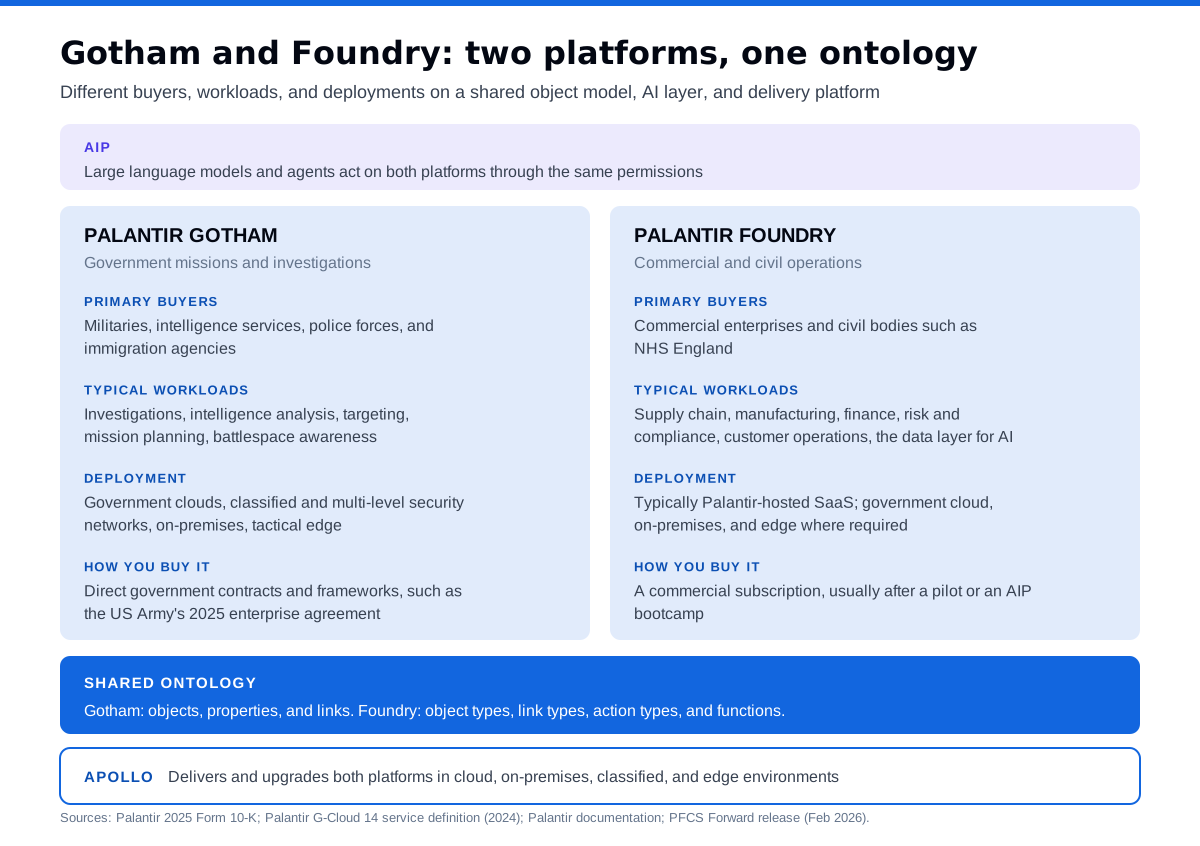
How Gotham relates to the ontology, Foundry, and Apollo
The ontology is the idea Gotham introduced and Foundry inherited. A Palantir patent filed on November 20, 2006 and granted on June 14, 2011, US 7,962,495, "Creating data in a data store using a dynamic ontology", describes storing an ontology for a data store along with parser definitions that transform incoming data to fit the ontology's property types. That mechanism is how a signals report, a case file, and a vehicle registry land in Gotham as one set of typed objects. Palantir's ontology documentation uses the same vocabulary today and calls the ontology "the digital twin of an organization," built from object types, properties, link types, action types, and functions. Our Palantir ontology guide covers how those primitives work in practice.
The two platforms have also converged at the product level. Palantir's G-Cloud 14 service definition says Gotham "incorporates Palantir Foundry's capabilities," and the government authorizations covered below apply to Gotham and Foundry together.
Apollo is what makes Gotham deployable where defense customers need it. Palantir's 2025 Apollo solution overview describes automated delivery to "on-premise data centers, edge hardware and classified networks," including disconnected environments, and the 10-K describes Apollo as a single control layer for features, security updates, and configurations. For an agency, that means a Gotham instance on a classified network can take a security patch without a manual upgrade project. Our Palantir Apollo guide covers the hub-and-spoke model. AIP, Palantir's generative AI platform, runs in the same environments: Palantir's February 2026 announcement of PFCS Forward, described below, lists Apollo, Gotham, Foundry, and AIP as one authorized stack.
Where Gotham came from
Gotham grew out of counterterrorism work for the US intelligence community. Palantir's 2020 S-1 registration statement says the company was founded in 2003 and "started building software for the intelligence community in the United States to assist in counterterrorism investigations and operations," and that Gotham, its first platform, "was constructed for analysts at defense and intelligence agencies." The same filing says Gotham lets users "identify patterns hidden deep within datasets, ranging from signals intelligence sources to reports from confidential informants."
The early customer base followed from that origin. AFP reported that In-Q-Tel, the CIA's venture arm, began investing in Palantir in 2005. Michael Steinberger's 2025 history of the company, excerpted by Fast Company South Africa, identifies the CIA as Palantir's first major customer and dates the Los Angeles Police Department's relationship with Palantir from 2009 to 2021. The American Immigration Council reports that Palantir has supplied US Immigration and Customs Enforcement (ICE) with systems including FALCON and Investigative Case Management (ICM) since 2013. In 2019, Palantir took over the Pentagon's Project Maven work after Google withdrew, according to the same AFP report, and that work led to the Maven Smart System covered below.
Who uses Palantir Gotham?
Gotham's users are governments: militaries, intelligence services, police forces, and immigration agencies in the United States and allied countries. Palantir does not publish a Gotham customer list, so the examples below come from government announcements, court records, journalism, and peer-reviewed research. Where a source names a different Palantir product, or none, the last column says so.
| Organization | What public sources report | Product named |
|---|---|---|
| German state police | Hesse has used Gotham since 2017, North Rhine-Westphalia since 2019 to 2020, and Bavaria since 2024, according to The Local | Gotham |
| Danish police | Palantir customized Gotham into POL-INTEL, the police's data integration and analysis platform, according to a 2024 peer-reviewed study in Information, Communication and Society | Gotham, as POL-INTEL |
| UK public sector | Palantir lists "Palantir Platform: Gotham" on G-Cloud 14, with supplier staff cleared up to Developed Vetting | Gotham |
| US Department of Defense and the military services | Maven Smart System, with a contract ceiling of nearly $1.3 billion through 2029 | Maven Smart System |
| NATO | The NATO Communications and Information Agency acquired Maven Smart System NATO for Allied Command Operations on March 25, 2025 | Maven Smart System NATO |
| US Army | An enterprise agreement dated July 31, 2025, with a $10 billion ceiling over up to 10 years, consolidating 75 contracts | Palantir's commercial products, not individually named |
| US Army | The TITAN ground station, an ISR program: a $178.4 million agreement for 10 prototypes, announced March 6, 2024 | Not named |
| US Immigration and Customs Enforcement | FALCON and ICM since 2013, plus a $30 million ImmigrationOS contract with a prototype due September 25, 2025 | FALCON, ICM, ImmigrationOS |
| French intelligence services | AFP reported in June 2026 that France had moved to drop Palantir from its intelligence services | Not named |
Palantir's government business is large and growing, and it covers every Palantir product sold to government, Gotham included. In the quarter ended June 30, 2026, Palantir reported $990 million of government segment revenue out of $1.935 billion in total, according to its Form 10-Q, and US government revenue of $809 million, up 90 percent year over year, according to its earnings release. Palantir reports revenue by customer segment, so no public figure isolates Gotham.
How does the Maven Smart System relate to Palantir?
Maven Smart System, or MSS, is Palantir's software for the Pentagon's Maven program, which DefenseScoop reports began in 2017 to expand AI tools that detect, tag, and track objects in surveillance imagery from aircraft and satellites. Palantir took over the Maven work in 2019. In 2022, the Pentagon split Maven's management between the National Geospatial-Intelligence Agency (NGA) and the Chief Digital and AI Office (CDAO), as DefenseScoop also reported.
The contract record is public. The Defense Department signed a $480 million, five-year indefinite delivery, indefinite quantity (IDIQ) contract for MSS in May 2024. In September 2024, Palantir announced a contract worth up to $99,804,561 over five years to extend MSS access to the Army, Air Force, Space Force, Navy, and Marine Corps. In May 2025, the Pentagon raised the MSS ceiling by $795 million to nearly $1.3 billion through 2029, and NGA's director confirmed more than 20,000 active Maven users. NATO's communications agency acquired MSS NATO on March 25, 2025. On March 9, 2026, Deputy Secretary of Defense Steve Feinberg directed that MSS become a formal program of record, with a CDAO program office taking over its administration from NGA, according to DefenseScoop.
Palantir describes MSS as "the connective tissue between operators and sensor feeds, platforms (hardware and software), and algorithms," supporting battlespace awareness, contested logistics, and joint fires and targeting workflows. Palantir's announcements present MSS as its own product and do not say which Palantir platform it is built on, so this article does not treat MSS as a version of Gotham.
Where can Gotham run? Accreditation and hosting
Gotham holds US government authorizations that run from FedRAMP High cloud up to Secret classified networks and edge hardware. The authorizations attach to Palantir Federal Cloud Service (PFCS), the government environment that hosts Palantir's products, so they cover Gotham, Foundry, AIP, and Apollo together.
| Authorization | What it covers | Date |
|---|---|---|
| DoD Impact Level 6 provisional authorization from the Defense Information Systems Agency (DISA) | A Secret region in PFCS for classified workloads, per ExecutiveBiz | October 2022 |
| Azure Government Secret and Top Secret clouds | Palantir and Microsoft agreed to deploy Foundry, Gotham, Apollo, and AIP there, subject to government accreditation | August 8, 2024 |
| FedRAMP High | PFCS and PFCS Supporting Services, covering AIP, Apollo, Foundry, Gotham, FedStart, and Mission Manager, building on earlier FedRAMP Moderate, IL5, and IL6 authorizations | December 3, 2024 |
| PFCS Forward | Extends the IL5 and IL6 provisional authorizations to on-premises and edge deployments on customer-chosen hardware, with an authorization package that every end customer inherits | February 12, 2026 |
| UK G-Cloud 14 | Gotham listed for UK public sector buyers, with supplier staff cleared up to Developed Vetting and ISO/IEC 27001 certification | 2024 listing |
In plain terms, FedRAMP is the US federal authorization program for cloud services, and Palantir describes its High baseline as covering "the most sensitive unclassified workloads." Impact Levels are the Defense Department's scale for cloud workloads, and IL6 covers classified information at the Secret level. For field units, PFCS Forward means skipping site-specific assessment of software security controls when they run the authorized stack on their own hardware, according to Palantir. Our guide to Palantir FedStart and FedRAMP explains how software vendors inherit the same authorizations.
The privacy and civil liberties criticism
The public criticism of Palantir centers on government uses of its software, and it falls into three areas: immigration enforcement, police data analysis, and the sovereignty questions raised when foreign governments rely on a US vendor.
Amnesty International concluded in September 2020 that Palantir was failing to conduct human rights due diligence around its ICE contracts, and named the ICM and FALCON systems. Germany's Federal Constitutional Court ruled on February 16, 2023 that the Hesse and Hamburg provisions allowing police to run automated data analysis violated the right to informational self-determination. The court named Hesse's hessenDATA platform, which Reuters reported uses Palantir software, declared the Hamburg provision void, and gave Hesse until September 30, 2023 to rewrite its law. The German civil rights group GFF has since filed a constitutional complaint against Bavaria's large-scale data analysis, according to The Local. In June 2026, AFP reported that governments and lawmakers in France, Germany, and Britain were rethinking their ties with Palantir, with foreign clients asking whether a US vendor would side with them or with the White House on sensitive decisions.
Palantir's position is that its software protects privacy and that it does not trade in data. Its 2025 Form 10-K states, "We are not in the business of collecting, mining, or selling data," and its G-Cloud listing names auditing of all user activity and built-in provisions for protecting data, privacy, and civil liberties among Gotham's features. Those controls govern who can see and change data inside the system. The criticism concerns which missions governments use the system for, which is a question of law and policy that each customer answers.
What should a commercial company take from Gotham?
For a commercial buyer, Gotham is evidence and a boundary. It is evidence that Palantir's ontology model and access controls have run on classified government networks. It is a boundary because every Palantir commercial customer uses Foundry, according to the 10-K, and AIP runs on Foundry. The table is the decision rule BD Emerson uses when a client asks which Palantir platform it would buy.
| If your organization is | You would buy | How the contract usually starts |
|---|---|---|
| A bank, insurer, manufacturer, retailer, or health system | Foundry with AIP | A pilot or AIP bootcamp, then a multi-year subscription |
| A civil government agency or public health body | Foundry with AIP | A government contract vehicle, as with NHS England's Federated Data Platform, which is built on Foundry |
| A defense, intelligence, police, or immigration agency | Gotham, often with Foundry, AIP, or Maven Smart System | A direct government contract or framework agreement |
| A software company selling into US government | FedStart | An agreement to run your product inside Palantir's accredited environment |
| A manufacturer running complex production lines | Warp Speed with Foundry and AIP | A commercial subscription, as in Lear's 2025 expansion |
If a proposal puts Gotham in front of a commercial workload, ask what the workload needs that Foundry lacks. Traversing links between entities and restricting access field by field both exist in Foundry. Our guide to Palantir Foundry is the next read for most commercial evaluations.
How BD Emerson helps
BD Emerson is an independent implementation consultancy for Palantir platforms. We are not Palantir, we do not resell licenses, we take no margin on the software, and we claim no Palantir partner tier or badge. Our Palantir work centers on Foundry and AIP for commercial and regulated enterprises: choosing the first use case, building the pipelines and ontology, configuring markings and audit before production data arrives, and getting operators to adopt the result. When a client is still deciding which Palantir platform fits, or whether Palantir fits at all, we answer that question against the specific workload before any license discussion.
Frequently asked questions
What is Palantir Gotham used for? Defense, intelligence, police, and immigration agencies use Palantir Gotham to integrate data from many sources and act on it. Analysts run investigations, map networks of people and organizations, and analyze activity on maps and timelines. Military users plan missions and coordinate operations, from headquarters to the tactical edge. Palantir's 2025 Form 10-K describes Gotham as used broadly across government functions.
What is the difference between Palantir Gotham and Foundry? Gotham is Palantir's platform for government missions and investigations, and Foundry is its platform for commercial and civil operations. Both model data as an ontology of objects and links, both are delivered by Apollo, and AIP runs on both. Gotham's applications center on search, link analysis, geospatial command and control, and classified deployment. Foundry's center on data pipelines, operational applications, and write-back to business systems.
Can a private company buy Palantir Gotham? In practice, private companies buy Foundry and AIP. Palantir's 2025 Form 10-K says all of its commercial customers use Foundry, and Palantir positions Gotham for defense, intelligence, and law enforcement work. A company that wants Gotham-style capabilities, such as traversing links between entities or restricting access field by field, gets them through Foundry's ontology and security model.
Is the Maven Smart System built on Palantir Gotham? Palantir's public announcements about the Maven Smart System do not say which Palantir platform it runs on. Palantir markets MSS as its own product for the Pentagon's Maven program and describes it as connective tissue between operators, sensor feeds, platforms, and algorithms. Its contract ceiling reached nearly $1.3 billion through 2029 in May 2025, and a March 2026 directive set MSS on a path to become a program of record.
Is Palantir Gotham authorized for classified networks? Yes. Palantir Federal Cloud Service, which hosts Gotham with Foundry, AIP, and Apollo, received DoD Impact Level 6 provisional authorization for Secret workloads in October 2022 and FedRAMP High authorization in December 2024. In February 2026, DISA authorized PFCS Forward, which extends the IL5 and IL6 authorizations to on-premises and edge hardware.
Does Palantir Gotham collect or sell personal data? Palantir says it does not. Its 2025 Form 10-K states, "We are not in the business of collecting, mining, or selling data." Gotham integrates data that a customer agency already holds or is authorized to access, and the agency decides what goes in and who can see it. Critics, including Amnesty International and German civil rights lawyers, focus on how governments use the integrated data.
If you are weighing Palantir for a commercial or regulated workload and need to know which platform and which first use case fit, our Palantir consulting team can scope both with you before a license conversation starts.

About the author