Vanta vs. ServiceNow GRC: What Changes as You Scale?
In a Vanta vs ServiceNow GRC choice, the deciding factor is how your program runs. Vanta automates evidence for framework audits by testing the systems it connects to. ServiceNow GRC runs risk and compliance as workflows across IT, cyber, and business operations on the ServiceNow platform. As the program grows, who owns risk and which systems it must reach start to weigh more than evidence collection.
Revisit the choice when you add a second or third framework, start reporting risk to the board, or add internal audit, and sooner if IT runs on ServiceNow. Choose wrong and you either pay to configure an enterprise platform you do not need yet, or keep risk work outside the ServiceNow platform your IT team already uses.
This comparison is for security and compliance leads at US SaaS, fintech, and healthcare technology companies that run Vanta for SOC 2 or ISO 27001, and for ServiceNow platform owners asked whether GRC belongs on the instance. For a wider field, see our GRC software evaluation.
What is Vanta?
Vanta is a compliance automation platform that connects to the systems you run and tests them continuously against the frameworks you are audited on. Its comparison page calls it an agentic trust platform. The same page shows more than 400 integrations and more than 1,400 automated tests that run hourly, as listed in October 2026.
Vanta lists these product lines:
- Automated Compliance
- Continuous GRC
- Third Party Risk Management
- Streamlined Audits
- Questionnaire Automation
- Risk Management
- Trust Center
- Personnel and Access
- Customer Commitments
- AI Governance
- Vanta AI
The framework menu includes SOC 2, ISO 27001, ISO 42001, HIPAA, HITRUST, GDPR, NIST AI RMF, CMMC, FedRAMP, NIS2, DORA, and the EU AI Act, plus custom frameworks. For companies with several units, each business unit can have a separate Workspace in Vanta GRC, where it customizes and automates its own compliance program under one account. More than 100 audit firms partner with Vanta, and auditors can work through its Auditor API.
What is ServiceNow GRC?
ServiceNow GRC is the set of risk and compliance products ServiceNow sells on its platform. The company describes it as a way to "improve compliance and achieve resilience by unifying GRC with AI insights, automated workflows, and connected data." Its GRC tools page lists four products:
- Integrated Risk Management
- Third-party Risk Management
- Business Continuity Management
- Privacy Management
ServiceNow lists Integrated Risk Management (IRM) first among its GRC products, and we treat it as the core one. Our ServiceNow IRM vs GRC article explains how IRM and GRC relate.
ServiceNow says IRM connects risk and compliance across IT, cyber, and business operations and routes remediation work to the right teams. Its listed use cases run from enterprise and operational risk to operational resilience, and the page's related links include Policy and Compliance Management and Audit Management.
Compliance work on the instance follows a fixed object model, set out in ServiceNow's documentation:
- Authority documents and citations: a regulation or standard such as HIPAA or GDPR is an authority document, and each requirement in it is a citation.
- Control objectives: these are "the main hub" of Policy and Compliance Management.
- Controls and entities: a control is created for each entity in an entity type, so one objective yields a separate control for every entity in scope.
- Indicators: scheduled tests, from daily to quarterly; when a test task fails, the control is marked non-compliant and an issue is created.
Key differences between Vanta and ServiceNow GRC
In our reading, the widest capability gap between the two is risk scope. Vanta's register scores and tracks risks beside its compliance work, while ServiceNow lists enterprise risk, operational risk, and resilience among its IRM use cases. Table 1 compares the two platforms on 11 points that change as a program grows.
Table 1. Vanta and ServiceNow GRC on 11 scaling points
| Parameter | Vanta | ServiceNow GRC |
|---|---|---|
| Built for | Compliance automation: continuous tests against connected systems for framework audits | Integrated risk and compliance across IT, cyber, and business operations on the ServiceNow platform |
| Frameworks and control mapping | Framework library plus custom frameworks; one control mapped to several frameworks; controls uploaded by CSV | Each regulation is an authority document, its requirements are citations, and control objectives are the hub |
| Evidence and testing | 400+ integrations and 1,400+ automated tests, run hourly (as listed, October 2026) | Indicators collect data automatically or through manual tasks; a failed test task opens an issue |
| Risk scope | Risk register with owners, inherent and residual scoring, and 100+ risk scenarios; Vanta says its enterprise risk management is still developing in linking risk types to strategic objectives | Enterprise, tech and cyber, and operational risk, plus operational resilience, listed as IRM use cases |
| Third-party risk | TPRM agent discovers and assesses vendors; findings feed the risk register | Centralized vendor risk, automated assessments, vendor monitoring, remediation routed to teams, vendor portal |
| Business units | Workspaces, one per business unit or product, under one account | Entity types group entities; a control is created for each entity |
| Audit model | 100+ partner audit firms; Auditor API | Audit Management, listed among the related links on ServiceNow's IRM page |
| Day-to-day work | Tickets created from Vanta; two-way ticket sync with 12 trackers such as Jira, Linear, and Asana | Remediation routed to the responsible teams inside ServiceNow |
| What setup involves | Connecting your systems; Vanta says it deploys "in weeks, not months" | Configuring your instance: authority documents, entity types, control objectives, and indicators |
| Pricing model | Four plans; personalized pricing after a demo | Custom demo with product experts; no prices on the GRC and IRM pages |
| AI features | Vanta AI Agent drafts policies, completes questionnaires, and flags issues; Vanta AI comes with the products a customer buys | AI agents assess controls, monitor for emerging risks, and identify gaps, per ServiceNow's IRM page |
Sources: Vanta compare, GRC, risk, TPRM, auditor, help, pricing, and AI pages; ServiceNow GRC, IRM, TPRM, and documentation pages; read October 2026.
If your company already runs IT on ServiceNow, start with the risk scope and day-to-day work rows.
What changes as your compliance program scales
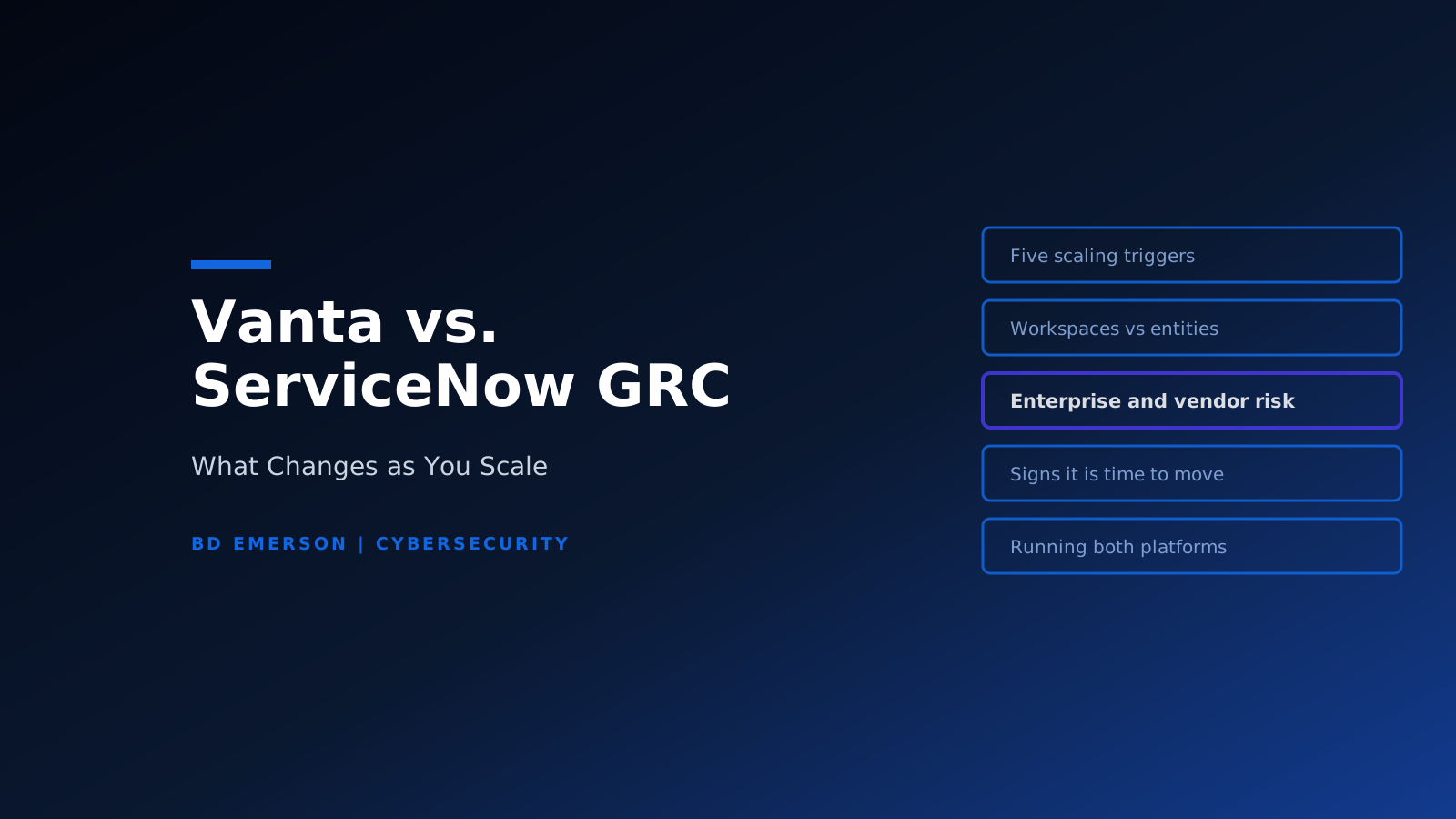
We see five changes in a growing compliance program that move the fit between Vanta and ServiceNow GRC.
More frameworks: one control, many requirements
With each added framework, you have to decide where the master control set lives. In Vanta, you can map a single control to multiple frameworks and upload existing controls by CSV into a custom framework. ServiceNow handles the same overlap through its object model, where each framework is an authority document and control objectives sit between its citations and your controls.
Both platforms cross-map controls, so the choice turns on where the mapping is maintained. In Vanta, it sits with the security team that runs the audits. On ServiceNow, it sits on the shared instance where other teams already keep their records. Once the control set has to serve legal, IT, and operations as well as security, that location starts to matter more than the mapping feature.
Enterprise risk: where Vanta's risk register stops
In a May 2026 post, Vanta's chief product officer accepted an analyst finding that its enterprise risk management "is still developing in the ability to connect multiple risk types to top-down strategic objectives." In a separate passage, he agreed that risk quantification and scenario modeling "aren't yet natively supported" and said deeper quantification is on the roadmap for later in 2026. Vanta's risk register still assigns an owner, scores inherent and residual risk, and records a treatment plan. It ships with a library of more than 100 risk scenarios.
ServiceNow lists enterprise risk, operational risk, and operational resilience as IRM use cases. If your risk reporting must tie to strategic objectives, test that gap first.
More business units: Workspaces versus entities
Vanta separates business units with Workspaces, which manage the security and compliance programs of several business units or products within a single organization. Within each Workspace, a unit keeps its own frameworks, controls, and policies, and an org-wide parent Workspace aggregates information from the business unit Workspaces. ServiceNow scopes by entity: an entity type groups the items that match a set of filter conditions, and one control is created for each entity it holds. Entities let one control objective apply across many systems, locations, or units.
Which model fits depends on how alike your units are:
- Same controls across units: ServiceNow's entities fit. You set a control objective once and get a control and a test result for each unit.
- Separate frameworks and controls per unit: Vanta's Workspaces fit. Every unit works in its own space, and the parent Workspace gives the company one view.
More owners: who runs the program day to day
As more people own controls, the work has to reach them where they already take tasks. In Vanta, admins can create tickets straight from a failing test, and two-way ticket sync covers 12 trackers, including Jira, Linear, Asana, and Freshservice, but not ServiceNow (list dated October 16, 2025).
For larger teams, Vanta's enterprise page lists roles and permissions, SCIM provisioning, and event logs. ServiceNow routes remediation work to the responsible teams. For a company whose engineers and IT staff already work tickets in ServiceNow, that keeps control remediation on the same platform as their other work.
Third-party risk: from vendor reviews to a lifecycle program
Vendor risk work in Vanta runs through a TPRM agent that discovers vendors, speeds up assessments, and monitors third-party risk. Its findings feed directly into Vanta's risk register. ServiceNow's Third-party Risk Management product centralizes vendor risk, automates assessments, and monitors vendor changes. It also routes remediation tasks to the right teams and gives vendors a secure portal.
The difference shows once vendor risk becomes a program with its own owners across business units. Vanta keeps findings beside your compliance posture in one register, which suits a security team that runs vendor reviews itself. ServiceNow's routing fits when those owners sit across the business. For the program side, from due diligence to ongoing monitoring, see our guide to vendor risk management.
Signs it is time to move from Vanta to ServiceNow GRC
Moving makes sense when the work outgrows a security-team tool and has to run across the business. Four signals point that way:
- Risk has to roll up to strategic objectives: Vanta's chief product officer says its enterprise risk management is still developing here, and ServiceNow lists enterprise risk as an IRM use case.
- Remediation already runs in ServiceNow: Vanta's two-way ticket sync covers 12 task trackers, and ServiceNow is not among them. If remediation has to start as a ServiceNow ticket, check first whether a workflow built on the Vanta API closes that gap.
- Vendor risk is a program across business units: ServiceNow says its Third-party Risk Management product "routes remediation tasks to the right teams."
- Internal audit wants to work beside the risk records: ServiceNow's IRM page lists Audit Management among its related links, next to Policy and Compliance Management.
Staying on Vanta is the better call when these three conditions hold:
- The program is organized around framework audits: Vanta's automated tests, partner audit firms, and cross-framework control mapping cover that kind of work.
- Business units fit in Workspaces: every unit keeps separate frameworks and controls, and a parent Workspace gives your executive team the company-wide picture.
- Your evidence sources are within reach: Vanta's integrations already test them, or a private integration through the Vanta API can reach your on-premise and homegrown systems.
Vanta pricing and ServiceNow GRC pricing
Vanta's pricing page shows no prices. It lists four plans (Essentials, Plus, Professional, and Enterprise) and offers personalized pricing after a demo. Three of the plans are described this way:
- Essentials: one compliance framework with an agentic policy generator.
- Professional: risk management with customization, dashboards, and reporting.
- Enterprise: a fully customizable package for advanced GRC needs.
Plans also differ in questionnaire volume, Trust Center tier, and access management.
ServiceNow's GRC page invites buyers to talk to its experts about evaluating risk and compliance solutions, and its IRM page offers a custom demo with product experts. Neither page shows a price. Ask for a quote scoped to the ServiceNow GRC products you would license, and for either platform, budget implementation as its own line next to the subscription.
Plans and pricing terms as listed on the vendors' pages in October 2026.
Moving from Vanta to ServiceNow GRC, or running both
You can move in one step or run both platforms for a while. The connections each platform documents today shape the split, and your audit calendar sets the cutover date.
Vanta's ServiceNow integration: what it connects today
Through the Vanta ServiceNow integration, Vanta connects one ServiceNow instance per account. It reads users, tasks, and attachment metadata from that instance and writes comments back to ServiceNow task records. ServiceNow is missing from Vanta's list of trackers with two-way ticket sync, so confirm with Vanta whether tickets can be opened in your instance. For data that has to travel further, the Vanta API can feed Vanta data into custom dashboards and reports, and when a test fails it can set off an external workflow or script that starts remediation.
Running both: splitting the work
Running both works when each platform keeps the work its documentation supports. Vanta keeps framework evidence, automated tests, and the auditor workflow for the business units it covers. ServiceNow carries enterprise risk, the third-party lifecycle, and audit management.
The condition is one master control set. Decide which platform owns control definitions and mapping, and let the other consume results, so two teams never maintain the same control in two places. Plan any hand-off of results on documented points, the Vanta API on one side and ServiceNow indicators on the other. Indicators gather supporting information through automatic data collection or manual tasks. Write the split down by business unit and by framework, and review it whenever a unit or a framework is added, because each addition is a fresh decision about which side it lands on.
Cutting over without breaking an audit period
Cut over between two audit periods. If a period is still open, run Vanta beside ServiceNow until it closes, and keep the Vanta subscription until your auditor has every sample they need. Map controls before you move any evidence. Each Vanta control needs a home under a ServiceNow control objective and its citations, or the evidence history will not line up with the new structure. Move one framework at a time, starting with the one whose next audit is furthest away. Our comparison of Vanta and Drata covers switching between those two platforms without breaking the audit period.
Vanta or ServiceNow GRC: which should you choose?
Choose by how your program runs today and who will own it next year.
Choose Vanta if:
- the program is built around SOC 2, ISO 27001, and other framework audits run by the security team;
- each business unit can run its own program in a separate Workspace;
- evidence comes from cloud and SaaS systems that Vanta's integrations or its API can reach.
Choose ServiceNow GRC if:
- risk must be managed across the business, including operational risk and operational resilience, alongside compliance;
- IT service management, engineering tickets, and remediation already run on ServiceNow at your company;
- vendor risk, internal audit, and compliance teams need to work from one shared set of records.
Vanta fits a program run by the security team around audits, and ServiceNow GRC fits a program run as a cross-team workflow on a platform the company already uses. If you sit between the two, running both with one master control set can carry you until you decide whether to move.
How BD Emerson implements both platforms
BD Emerson implements both Vanta and ServiceNow GRC. In our view, Vanta suits a company that needs SOC 2 or ISO 27001 evidence quickly with little configuration. ServiceNow GRC suits a company that already runs ServiceNow and needs entity scoping, risk workflows, and third-party risk across the enterprise. Each engagement starts from that fit:
- Vanta: through Vanta Implementation Services, we tailor Vanta to the frameworks you face, such as GDPR and HIPAA.
- ServiceNow GRC: through ServiceNow GRC Implementation, we usually start with Policy and Compliance Management, since the other modules depend on the control set and entity scoping it builds. Our plans allow 8 to 16 weeks for that first module.
Our CPA arm performs SOC 2 examinations, and on ServiceNow we configure the platform around what auditors sample.
Planning a Move From Vanta to ServiceNow GRC?
BD Emerson offers professional ServiceNow GRC Implementation to help your organization decide which module comes first, which frameworks to map, and where evidence automation should replace manual testing. Contact us today.

About the author