Private Equity Carve-Outs: Returns, Diligence, and the Path to Standalone

A private equity carve-out is a buyout in which a sponsor acquires a business unit, division, or product line from a corporate parent and turns it into a standalone company. The buyer often gets a unit its parent underinvested in, along with a business that has never run on its own systems, contracts, or management team. That trade-off now decides returns. Bain & Company found that the average private equity carve-out since 2012 returned 1.5 times invested capital, against about 3.0 times before 2012, as operating gains shrank and prices rose (Bain, March 2025). Sponsors who still earn carve-out returns price the separation during diligence: standalone cost, the transition services agreement, IT and data separation, people, and contracts.
This guide covers why sponsors buy carve-outs, what changed in the returns data, how buy-side diligence works when the target has no standalone financial statements, what to negotiate in the transition services agreement, and the red flags that move price. BD Emerson (now Andersen Consulting) works on both sides of carve-outs, covering separation planning, standalone cost, IT and cybersecurity separation, and Day 1 readiness. For the general mechanics of a separation, start with what a carve-out is in M&A.
Why do private equity firms buy carve-outs?
Sponsors buy carve-outs because a corporate parent selling a non-core unit is usually a motivated seller, and a business that competed for capital inside a larger group often has operating improvements its parent never funded. The parent's reasons are strategic. In the eighth AURELIUS Carve-Out Survey, fielded in the fourth quarter of 2025 among 140 senior dealmakers, nearly 80% of respondents predicted that more global corporates would divest non-core businesses in 2026, and 73% named refocusing on core operations as the main driver (AURELIUS, 2026).
Deal share has recovered after a long slide. PitchBook data cited by FTI Consulting shows carve-outs and divestitures at 15.8% of all US buyouts in 2013, falling to 5.7% in the fourth quarter of 2021 and recovering to 12.6% in the first quarter of 2024 (FTI Consulting, January 2025). Activity is building on both sides. KPMG's 2026 Global M&A Outlook, a survey of 700 dealmakers, found 71% of private equity dealmakers actively pursuing or open to portfolio separations and 55% with one already under consideration (Consulting.us, April 2026), and 77% of the AURELIUS respondents said the number of buyers pursuing corporate carve-outs is rising, up from 59% a year earlier.
What happened to private equity carve-out returns?
Carve-out returns fell to the buyout average. Bain's analysis of DealEdge data on realized and partially realized global buyouts with equity checks above $100 million found that carve-outs earned an average multiple on invested capital of around 3.0x before 2012, against 1.8x for all buyouts. Since 2012 the average carve-out has earned 1.5x, roughly in line with the buyout average, and top-quartile carve-outs reached 2.5x against 2.7x for top-quartile buyouts.
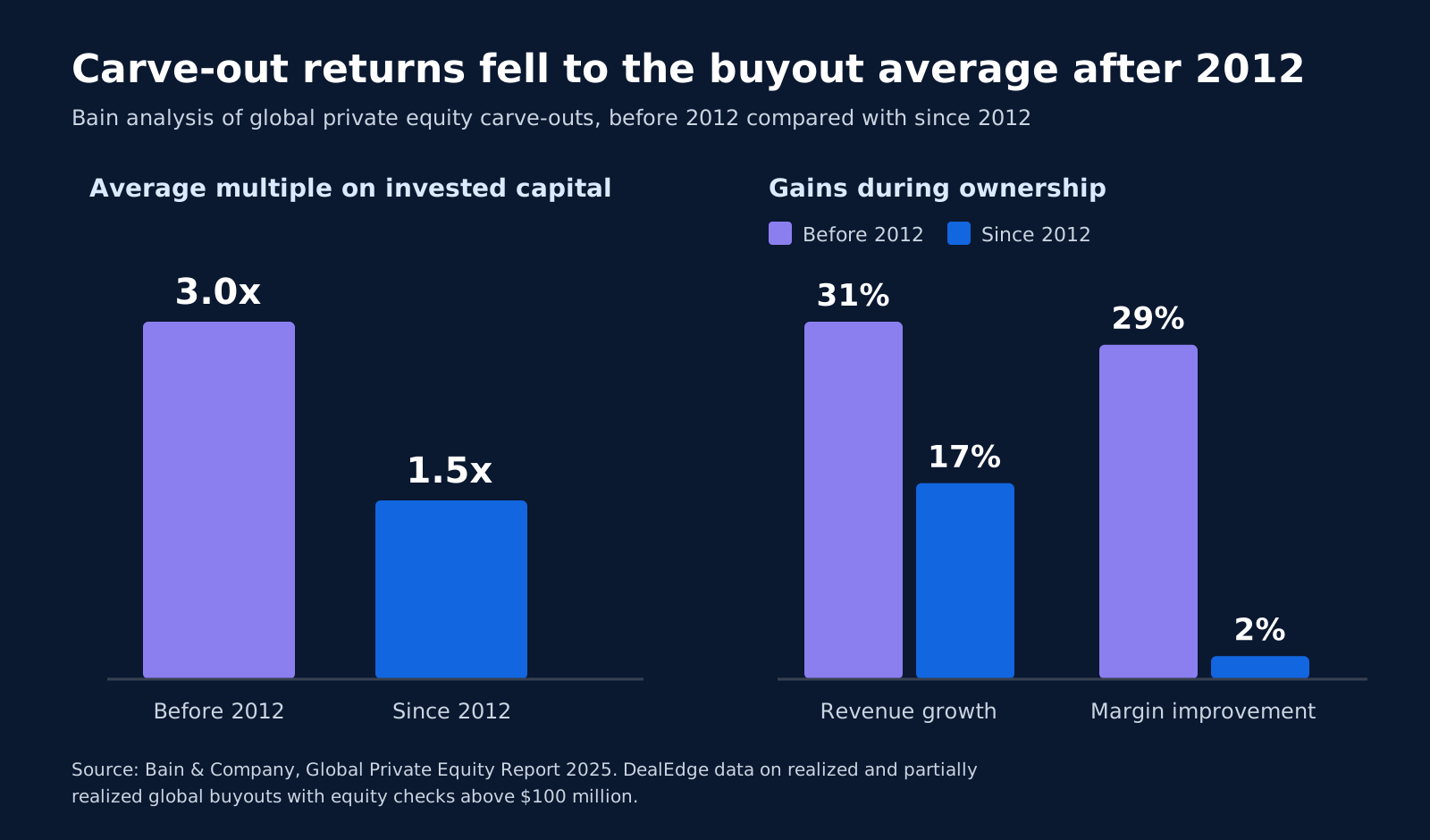
The operating record explains most of the gap. Before 2012, carve-outs raised revenue by 31% and margins by 29% during ownership. Since 2012 those gains have slipped to 17% and 2%, and multiple expansion fell by a similar amount. Bain names the causes: more competition for carve-outs pushed up purchase multiples, corporate sellers learned to run competitive auctions, separation is costly and complex enough to limit the number of buyers, and few carve-outs have standalone financial reporting, which hides true profitability and shared costs from the buyer.
Bain's review of 25 carve-outs completed between 2013 and 2024 points to what still works. The sponsors with strong results underwrote a value-creation plan in diligence and tied the separation plan, talent, and execution to it, avoided two-step separations, made hard operating calls early, and put leaders with the right skills in place from the start.
How is buying a carve-out different from buying a standalone company?
A standalone company arrives with its own books, systems, contracts, and management team. A carve-out arrives with pieces of the parent's, and the buyer has to price the gaps. The table sets out where the buyer's work changes.
| Dimension | Standalone company | Carve-out |
|---|---|---|
| Financial history | Audited statements for the legal entity | Carve-out statements built from the parent's books, with allocated corporate costs |
| Cost base | The costs the business pays today | Allocated costs that rarely match what the business will pay on its own |
| Systems and data | Owned and run by the target | Shared with the parent, so applications and data have to be separated, cloned, or rebuilt |
| People | Management team and back office in place | Shared functions, missing roles, and employees who sit in two org charts |
| Contracts | In the target's own name | Shared customer, supplier, and license agreements that need assignment, consent, or replacement |
| Day 1 | The business keeps running as it did | The business depends on the parent's services under a transition services agreement |
| Security and compliance | Controls, reports, and certifications held by the target | Controls, audit reports, and certifications often held at the parent level |
| Central diligence question | Are the earnings as good as the numbers say? | What will this business cost to run on its own, and how long will separation take? |
How does buy-side diligence work without standalone financial statements?
Buy-side diligence on a carve-out tests the seller's numbers twice: once for what the business earned inside the parent, and again for what it will cost to run alone. The starting point is the carve-out financial statements, which take the parent's books and allocate shared costs such as IT, finance, HR, facilities, and insurance to the business. Those allocations follow accounting conventions, and they rarely match the price of buying the same services in the market or building them. The quality of earnings work has to separate three things a seller's model tends to blend: the costs that transfer with the business, the parent charges that disappear at close, and the new standalone costs the buyer will pay from Day 1. Our private equity due diligence guide covers the full list of workstreams, and a carve-out adds depth to four of them.
The standalone cost build comes first. It should be built function by function, from the finance team the business will need to the insurance it will buy and the software it will license at its own volume, and then compared line by line with the allocated cost in the seller's model. IT and data come second. The buyer needs an inventory of what is shared: an ERP instance with no clean partition between the two businesses, a single identity tenant covering both workforces, a shared data warehouse, and software licenses that do not permit assignment to a new owner. People come third, because parents often perform functions invisibly for the unit, such as tax, treasury, internal audit, and security operations, and those roles have to be hired or bought. Contracts and intellectual property come fourth: shared customer agreements, supplier contracts priced on the parent's volume, and technology the parent owns and plans to license back.
Security and compliance deserve a specific check. If the business sells to customers who require a SOC 2 report, ISO 27001 certification, or CMMC status, the buyer should confirm whether those belong to the business or to the parent, because a new company usually has to earn its own.
What should a buyer negotiate in the transition services agreement?
The transition services agreement is how a carve-out operates on Day 1 when it cannot yet run its own payroll, IT, finance, or procurement, and a buyer should negotiate it as an operating plan. The amount of contract work is large. Bain notes that separating a carve-out can require amending hundreds or thousands of agreements. Deloitte's guide for financial buyers, written with Kirkland & Ellis, advises buyers to define the scope and duration of each service, to aim for fair and reasonable pricing, and to add service levels and key performance indicators. It also observes that "it is not unusual for the seller to have a modest single-digit markup" on the cost of the services, which a buyer should negotiate (Deloitte and Kirkland & Ellis, April 2025).
In our experience the terms that matter most are a term for each service rather than one end date for the whole agreement, extension rights with fixed notice periods, pricing that states the cost basis and any step-up after the initial term, exit criteria and migration support such as data extracts, and security obligations covering who at the seller can see the buyer's data and how incidents get reported. A reverse TSA belongs in the same negotiation when the parent still needs services from the unit. The TSA also affects the bid itself: the Deloitte guide notes that a buyer can position itself favorably in a competitive process by relying less on the TSA. Our transition services agreement guide covers scoping and pricing in more detail.
How do standalone cost and the 100-day plan fit together?
The standalone cost build and the 100-day plan describe the same business at two points in time. The cost build tells the investment committee what the business will cost once it stands alone, and the 100-day plan names who will build each piece and by when. For a carve-out the plan has a fixed spine: Day 1 readiness, the TSA exit sequence, the IT separation program, the leadership roles the parent used to fill, and a security and compliance program in the new company's own name. Our Day 1 readiness checklist covers the first item function by function, and our IT carve-out services cover the separation program behind the second and third.
Timing drives cost. As BD Emerson planning ranges, most mid-market carve-outs take six to twelve months from perimeter definition to Day 1, and transition services typically run another twelve to twenty-four months. Every month a service stays on the TSA costs the buyer the service fee and delays the standalone cost structure the model assumes. Deloitte's 2026 Global Divestiture Survey found that most businesses are far from fully separated at close (Deloitte, 2026), so the buyer usually inherits the hardest part of the separation along with the business.
Which red flags change price or structure?
In our experience, six findings most often change price or structure in a private equity carve-out:
- A standalone cost build that applies a percentage to the allocated cost instead of building each function from the bottom up.
- A shared ERP instance or identity tenant with no clean data partition, which lengthens the TSA and adds a cloning or rebuild cost.
- Customer, supplier, or software agreements that need consent to assign, especially where the largest customers sit on parent-level contracts.
- Key people and functions that do not transfer, such as tax, treasury, security operations, or the engineers who run the systems.
- Security and compliance status held by the parent, including SOC 2 reports, ISO 27001 certificates, or CMMC status that the business's customers rely on.
- A TSA with short terms, no extension rights, or steep price step-ups, which turns any migration delay into a cost the seller controls.
Each finding has a deal mechanism. Recurring cost belongs in the standalone cost line and therefore in the purchase multiple. One-time separation cost belongs in the price, an escrow, or a seller-funded separation budget. Consents and key people belong in closing conditions or specific covenants. Security gaps belong in the 100-day plan with an owner and a cost, and TSA terms belong in the agreement itself, negotiated before signing, when the buyer still has the most negotiating power.
Frequently asked questions
What is a private equity carve-out? A private equity carve-out is a buyout in which a sponsor acquires a business unit, division, or product line from a corporate parent and sets it up as a standalone company. The buyer takes over a business that ran on the parent's systems, contracts, people, and shared services, so the deal includes a separation program and usually a transition services agreement.
Why do private equity firms buy carve-outs? Corporate parents sell non-core units to refocus on their core operations, which makes them motivated sellers, and a unit that competed for capital inside a larger group often has operating improvements its parent never funded. In the eighth AURELIUS Carve-Out Survey, 73% of respondents named refocusing on core operations as the main driver of corporate divestments.
Do carve-outs still outperform other buyouts? On average they no longer do. Bain found that the average private equity carve-out since 2012 returned 1.5 times invested capital, roughly the buyout average, against about 3.0 times before 2012. Top-quartile carve-outs since 2012 reached 2.5 times, against 2.7 times for top-quartile buyouts.
What is a buy-side carve-out? A buy-side carve-out is the acquirer's side of the transaction: diligence, negotiation, separation, and Day 1 readiness for a business it is buying out of a corporate parent. The buyer's main questions are what the business will cost to run alone, which parent services it needs under a transition services agreement, and how long the separation will take.
How long does a private equity carve-out take? As BD Emerson planning ranges, most mid-market carve-outs take six to twelve months from perimeter definition to Day 1, and transition services typically run another twelve to twenty-four months. Deloitte's 2026 Global Divestiture Survey reported a median of about three months from signing to close for divestitures above $100 million, with some deals taking ten months or more.
What should a buyer negotiate in a carve-out TSA? A buyer should negotiate the scope and service level of each service, a term per service with extension rights, the cost basis and any markup, exit criteria and migration support, data access and security obligations, and a governance structure such as a steering committee. Deloitte's guide for financial buyers notes that a modest single-digit markup on cost is not unusual and should be negotiated.
If you are evaluating a carve-out, our carve-out advisory team can build the standalone cost model, size the IT and security separation, and draft the TSA schedules on your exclusivity timeline, so the separation is priced before you sign.

About the author