Confidential Information Memorandum (CIM): What It Contains and How Buyers Read It

A confidential information memorandum (CIM) is the marketing document a seller and its adviser give qualified buyers after they sign a nondisclosure agreement, describing the business, its financials, and the investment case. Buyers use it to decide whether to bid and at what price. In a sell-side process the CIM follows the anonymous teaser and the NDA and goes out with a deadline for first-round bids, and investment bank Capstone Partners notes that a CIM can easily reach 50 pages. Each number in it becomes a claim the buyer's diligence and quality of earnings teams will test. This guide covers what a CIM contains section by section, who drafts it, how buyers read it, the mistakes that cost sellers value, and BD Emerson's checklist for a CIM that survives diligence.
Where does the CIM sit in a sell-side process?
The CIM is the first document in a sale that names the company, and it reaches only buyers that have signed an NDA. The adviser sends an anonymous teaser to a target list, interested buyers sign the NDA, and the CIM goes out with a bid deadline. Capstone Partners describes about two weeks for buyers to review the CIM and express interest, and it puts the full process at six to nine months. Buyers whose indications of interest make the cut attend management presentations and enter the data room, and second-round bids lead to a letter of intent and exclusivity. Our guide to the sell-side M&A process covers each phase, and our guide to the letter of intent covers the document that ends the competition.
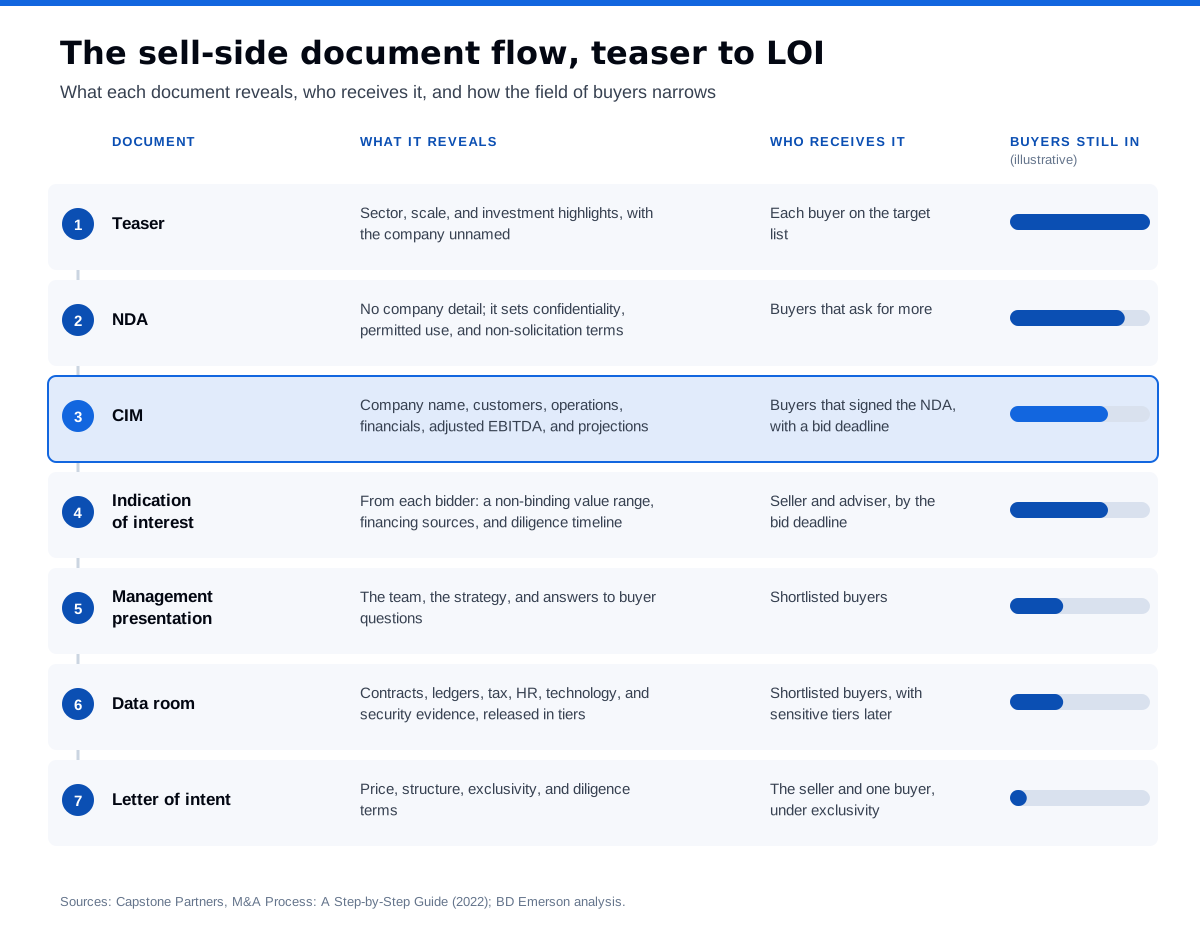
What is an M&A teaser?
An M&A teaser is a short, anonymous summary of a business that an adviser sends to potential buyers before anyone signs an NDA. Capstone Partners describes it as a one-page, high-level overview that generates interest while the company stays anonymous. A teaser gives the sector, the scale of the business, and the investment highlights in terms that do not identify the company, and buyers that want more sign the NDA and receive the CIM.
What does a CIM contain?
Most CIMs follow the same sequence of sections, and experienced buyers read each one against a specific question. Advisers outside the US often call the same document an information memorandum, and EY's guide to preparing an information memorandum lists similar contents for capital raises. The table lists the sections in their usual order and what buyers check first in each.
| Section | What it covers | What buyers check first |
|---|---|---|
| Executive summary | The business, its scale, the transaction, and the reasons to buy | Whether headline revenue and adjusted EBITDA match the financial section exactly |
| Investment highlights | The handful of reasons the company is worth owning | Which highlights the rest of the CIM proves with numbers and which it only asserts |
| Business overview | History, ownership, locations, and headcount | The corporate structure, which defines what is for sale |
| Products and customers | Offerings, pricing, segments, top customers, contract terms, and retention | Customer concentration, contract length, change-of-control clauses, and churn |
| Market | Market size, growth, share, and named competitors | Whether market figures are sourced and bottom-up, and whether the share claim is plausible |
| Operations | Facilities, suppliers, processes, and capacity | Supplier concentration, capacity limits, and the capital spending the plan needs |
| Technology | Platforms, architecture, roadmap, security, and certifications | Which claims a code scan, architecture review, or audit report can confirm |
| Management | Leadership biographies, organization chart, and staffing | Who stays after closing and how much of the business depends on the founder |
| Historical financials | Income statement, balance sheet, cash flow, and operating metrics for recent years and year to date | Whether the numbers tie to audited or reviewed statements and to the data room |
| Adjusted EBITDA bridge | Reported EBITDA, each add-back, and adjusted EBITDA | The support for each add-back and whether any of them recur |
| Projections | Management's forecast and its assumptions | The gap between the first projected year and the trailing twelve months, and the pipeline behind it |
| Transaction overview | What is for sale, the structure sought, the process, and bid instructions | Stock or asset sale, what the seller expects to retain, and the bid deadline |
How do buyers read a CIM?
Buyers read a CIM as the seller's best case, and their first pass measures the distance between that case and what the evidence will support. Four areas draw the most skepticism, because each one moves the price in an indication of interest and each becomes a diligence workstream if the buyer advances.
Adjusted EBITDA and add-backs
Buyers price most private companies on a multiple of adjusted EBITDA, so they treat each add-back in the bridge as a claim that a cost will not recur. Public companies face a written test for that claim: Item 10(e) of the SEC's Regulation S-K bars a registrant from adjusting a non-GAAP performance measure to remove an item labeled non-recurring when a similar charge occurred within the prior two years or is reasonably likely to recur within two years. A private seller's CIM is outside that rule, but in our experience quality of earnings teams apply the same logic, and an add-back that fails it gets struck. At eight times EBITDA, a struck $500,000 add-back removes $4 million of value. Our guide to EBITDA adjustments covers which add-backs survive.
Customer concentration
Buyers look for any customer large enough to change the valuation if it leaves. Under ASC 280-10-50-42, public companies must disclose the revenue from each customer that accounts for 10% or more of revenue, though not the customer's name, and that 10% line is a sensible first screen for a private company's customer list. A CIM that shows the top ten customers' share of revenue, tenure, and contract terms answers the question before buyers ask it. A CIM that hides concentration inside segment totals invites buyers to assume the worst and price accordingly.
Projections and the growth story
Buyers rebase management's projections to the trailing twelve months and ask what has to be true for the forecast to happen. A first projected year that runs well above the trailing growth rate needs a signed backlog, a priced pipeline, or a completed price increase behind it, or buyers will discount the forecast to the trend. The commercial workstream in sell-side due diligence tests the growth story the CIM will tell, and running it before drafting lets the seller write projections it can defend.
How the CIM feeds diligence and the QoE
The CIM becomes the buyer's diligence plan. After an LOI, the buyer's accountants rebuild the CIM's EBITDA from the general ledger in a quality of earnings review, its lawyers test the customer and contract claims against the data room, and its technology advisers test the technology section against the code and the infrastructure. Each difference between the CIM and that evidence becomes a price conversation held under exclusivity, with no competing bidders.
Who writes the CIM, and how long does it take?
The sell-side adviser, usually an investment bank or M&A advisory firm, drafts the CIM from information management provides, and management reviews each page because the company owns the facts. The CFO supplies the financial sections, the accountants who ran the sell-side quality of earnings supply the adjusted EBITDA bridge, and deal counsel reviews the disclaimer and the transaction overview. Capstone Partners describes the information-gathering stage as one of the more time-intensive parts of a sale for the owner. As a BD Emerson planning range, drafting takes four to eight weeks once the financial numbers are final, and the range moves with the condition of the company's records, the number of business lines, and how many review rounds management needs.
BD Emerson is not an investment bank or broker-dealer, and it does not draft, market, or distribute CIMs. On a sale, our role is the evidence behind the numbers: sell-side due diligence, quality of earnings through our financial due diligence practice, and data room readiness, so the CIM's figures arrive already tested. That work starts months before drafting, as our exit readiness guide explains.
Mistakes in a CIM that cost sellers value
The costliest CIM mistakes are claims the seller cannot support once diligence starts, because buyers price a disproven claim twice: once for the claim and again for what it suggests about the rest of the numbers.
| Mistake | What diligence finds | What it costs the seller |
|---|---|---|
| Unsupported add-backs | Add-backs with no invoice, contract, or ledger support, or that recur year after year | Struck adjusted EBITDA, multiplied by the deal multiple |
| Numbers that disagree with the data room | Revenue, customer counts, or KPIs that do not tie to the data room or the QoE | Lost credibility on the other numbers and a longer request list |
| Technology claims diligence disproves | A proprietary platform built on open source with license conflicts, or certifications that cover less than the CIM implies | Remediation cost, special indemnities, escrows, or a price cut |
| Projections with no bridge | A forecast that starts above the current run-rate with no backlog or pipeline support | No credit for the forecast, because buyers value the trailing numbers |
| Hidden concentration | A customer above 10% of revenue that appears only in the data room | A lower price or an earnout tied to that customer |
| Stale financials | A CIM built on the last fiscal year while the current year runs below plan | A retrade once the QoE adds the latest months |
Codebase audits show why technology claims need checking before the CIM goes out. Black Duck's 2026 Open Source Security and Risk Analysis, which covers 947 codebases audited between November 2024 and October 2025, including 197 M&A transactions, found open source in 98% of codebases and license conflicts in 68%. Its M&A summary reported license conflicts in 94% of transactions and unpatched vulnerabilities in 97%. A technology section that calls the platform proprietary, or describes security the audit reports do not cover, hands buyers a finding they will price.
Confidentiality and securities law points
A CIM is confidential by contract. The NDA a buyer signs first limits use of the information to evaluating the deal, limits who can see it, and commonly bars the buyer from soliciting employees or contacting customers and suppliers without permission. Competing bidders raise a second issue: the FTC's Bureau of Competition has warned that exchanging current and future prices, costs, and strategic plans during due diligence can facilitate coordination between competitors, contribute to gun-jumping under the HSR Act, and support a separate claim under Section 1 of the Sherman Act, and it recommends clean teams that exclude pricing and strategy staff. Sellers should keep customer names and pricing out of the CIM sent to a competitor and release them later through a clean team.
In a stock sale, a CIM is also a statement made in connection with the sale of securities. The US Supreme Court held in Landreth Timber Co. v. Landreth (1985) that stock sold in the sale of an entire business is a security, rejecting the sale-of-business doctrine, so SEC Rule 10b-5 applies: it prohibits any untrue statement of a material fact, or an omission that makes a statement misleading, in connection with the purchase or sale of a security. An asset sale transfers assets instead of stock, so the federal securities laws generally do not reach it, although contract and state fraud law still apply; our guide to asset sales and stock sales covers the other structural differences.
CIMs carry a disclaimer stating that the seller makes no representation about the document's accuracy or completeness and that only the representations in a signed purchase agreement will bind it, and the purchase agreement adds a non-reliance clause. In ABRY Partners V v. F&W Acquisition (Del. Ch. 2006), the Court of Chancery enforced a non-reliance clause against fraud claims based on statements outside the contract, such as data room materials and management presentations, while holding that public policy keeps a seller liable for intentional lies in the contract's own representations. A disclaimer narrows the seller's exposure for the CIM, and the same facts still reappear in the representations and disclosure schedules, so an inaccurate CIM stays a liability.
Securities rules also govern who markets the company. Federal law requires brokers to register with the SEC unless an exemption applies, and an adviser paid a success fee on a stock sale can fall within that requirement. Since March 29, 2023, Section 15(b)(13) of the Exchange Act has exempted M&A brokers that facilitate the transfer of control of a privately held company with EBITDA below $25 million or gross revenue below $250 million in the prior fiscal year, according to Goodwin's summary of the exemption, and Foley Hoag's July 2026 alert lists the same thresholds. State broker rules still apply. Work with deal counsel on the NDA, the disclaimer, the non-reliance clause, and the adviser's engagement terms as one set, because each depends on the others.
BD Emerson's checklist for a CIM that survives diligence
BD Emerson's view is that a seller should write the CIM as if the buyer's accountants, lawyers, and technology advisers will check each sentence, because they will. Before the CIM goes out, the seller should be able to confirm each item below.
- Each figure ties to the data room, the sell-side quality of earnings, and the audited or reviewed statements, with one file that maps each number to its support.
- Each add-back has documents behind it, passes the two-year recurrence test, and appears in the bridge with its amount and rationale.
- The customer section shows the top ten customers' share of revenue, tenure, and contract terms, including any customer above 10% of revenue.
- The first projected year bridges from the trailing twelve months, with backlog, pipeline, and pricing assumptions stated.
- The technology section claims only what an architecture review, an open source scan, and current audit reports confirm, and it states the scope of any SOC 2 or ISO 27001 report.
- Market size and share figures cite named sources and survive a bottom-up rebuild.
- Known issues appear in the CIM or the management presentation with the remediation under way.
- Deal counsel has reviewed the disclaimer, the NDA, and what will be withheld from competing buyers.
Frequently asked questions
What is a confidential information memorandum (CIM)? A confidential information memorandum is the marketing document a seller and its adviser give qualified buyers after they sign a nondisclosure agreement. It describes the business, its products and customers, its market, its management, its historical and projected financials, and the investment case. Buyers use it to decide whether to submit an indication of interest and at what price, and each number in it gets tested in diligence.
What is the difference between a teaser and a CIM? A teaser is a short, anonymous summary sent to potential buyers before they sign anything, so it describes the business without naming it. The CIM goes only to buyers that have signed an NDA, names the company, and covers its operations, customers, and financials in depth. The teaser tests interest, and the CIM gives qualified buyers enough information to bid.
Who prepares the CIM in a sale? The seller's adviser, usually an investment bank or M&A advisory firm, drafts the CIM from information management supplies, and management reviews it because the company owns the facts. The CFO supplies the financial sections, the accountants who ran the sell-side quality of earnings supply the adjusted EBITDA bridge, and deal counsel reviews the disclaimer and the transaction overview.
How long is a CIM, and how long does it take to write? Capstone Partners notes that a CIM can easily reach 50 pages, and length grows with the number of business lines and the depth of the financial section. As a BD Emerson planning range, drafting takes four to eight weeks once the financial numbers are final. Buyers then usually get about two weeks to review the CIM before first-round indications of interest are due.
Can a buyer rely on the information in a CIM? Buyers rely on a CIM to decide whether and what to bid, but the CIM's disclaimer and the purchase agreement's non-reliance clause usually limit legal claims to the representations in the signed agreement. The Delaware Court of Chancery enforced that structure in ABRY Partners V v. F&W Acquisition (2006) while keeping sellers liable for intentional lies in the contract itself. In a stock sale, SEC Rule 10b-5 also prohibits material misstatements.
Is an information memorandum the same as a CIM? In practice they are the same kind of document. Information memorandum, or IM, is the name many advisers use outside the US, and EY's Australian guide uses it for capital raises, describing a document that gives prospective investors a detailed overview of the business. In a US sale process, confidential information memorandum and CIM name the document buyers receive after signing an NDA.
What happens after buyers receive the CIM? Buyers review the CIM, send questions through the adviser, and submit non-binding indications of interest by the bid deadline, typically with a valuation range, financing sources, and a diligence timeline. The seller then invites a shortlist to management presentations and the data room, and second-round bids lead to a letter of intent and exclusivity with one buyer.
If you are preparing a company for sale, our sell-side due diligence and exit readiness team can build the quality of earnings, the add-back support, and the data room the CIM's numbers depend on before your adviser drafts the book.

About the author