M&A Day 1 Readiness Checklist: What Has to Work the Morning After Close
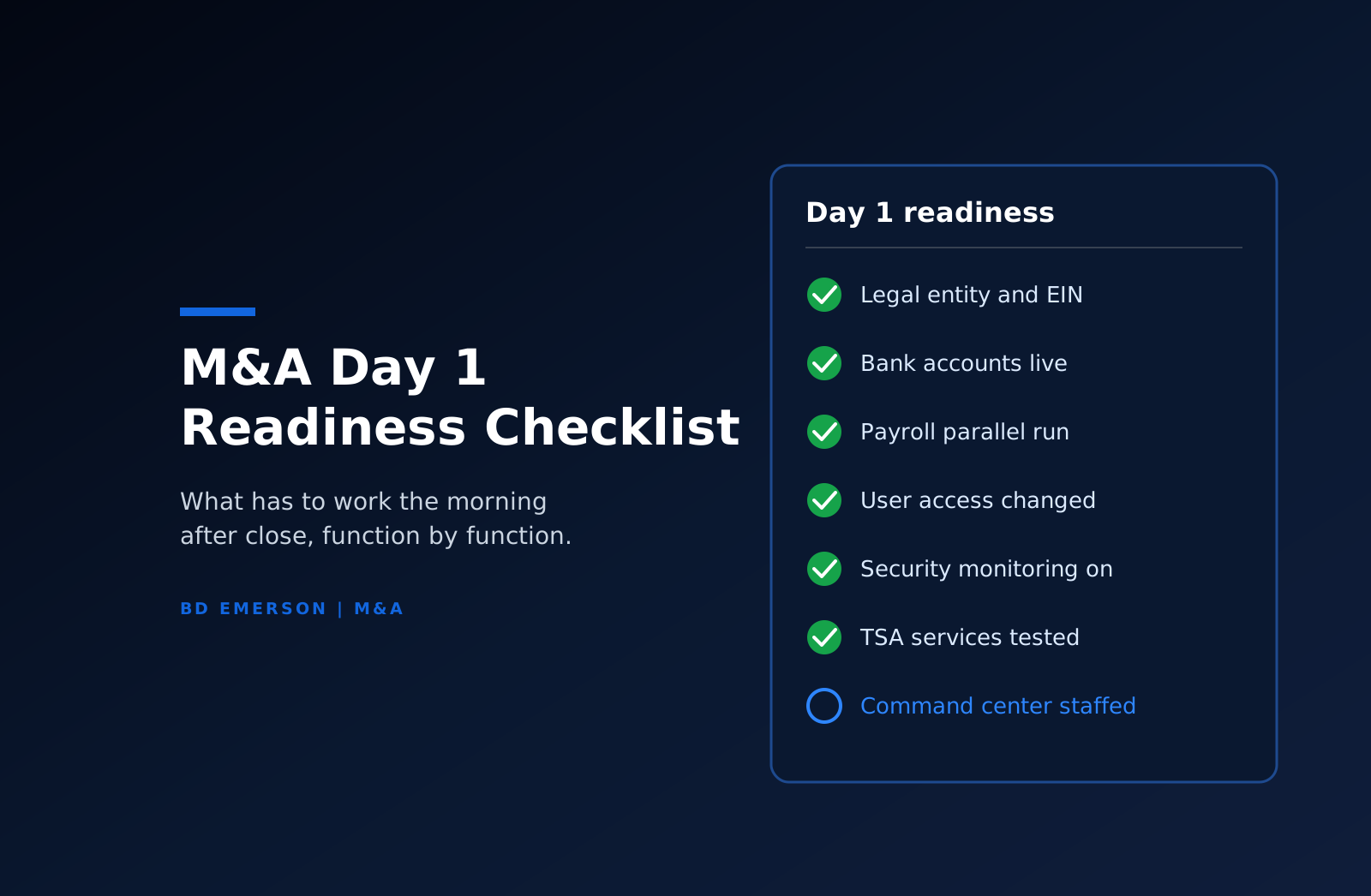
Day 1 readiness means a newly acquired or separated business can operate legally and safely from the first morning after close. It can invoice customers, pay suppliers and employees, close its books, give people access to the systems they need, and keep every license and permit it operates under. A Day 1 readiness checklist turns that goal into items, each with an owner, a test, and evidence, reviewed at readiness gates before the closing date. Carve-outs need the most preparation, because the business usually still depends on its former parent on Day 1: Deloitte's 2026 Global Divestiture Survey found that most businesses are far from fully separated at close (Deloitte, 2026).
This guide defines Day 1 readiness, separates Day 1 from Day 2 and the first 100 days, sets out the checklist by function, covers what changes in a carve-out, and explains readiness gates, the dress rehearsal, and the command center. You can download the checklist as an Excel workbook with a sheet for each function and a status summary. BD Emerson (now Andersen Consulting) runs Day 1 readiness for carve-outs and acquisitions, from the first checklist draft through the command center.
What does Day 1 readiness mean?
Day 1 readiness is the minimum set of capabilities a business needs to operate without interruption, comply with the law, and protect its people and data from the moment ownership changes. It is narrower than integration or separation. A buyer can close with a shared ERP still running under a transition services agreement, but it cannot close without a way to pay employees on the next payroll date, a bank account that can receive customer payments, and access rights that match the new ownership. The discipline is deciding what must work on Day 1 and what can wait, then testing the first list until every item passes.
Legal readiness and operational readiness run on separate tracks. Closing conditions in the purchase agreement, such as regulatory approvals and third-party consents, decide when Day 1 happens. Deloitte's 2026 survey found a median of about three months from signing to close for divestitures above $100 million, with some deals taking ten months or more, and it named regulatory scrutiny as the most common cause of delay. The operational checklist has to be ready for the earliest realistic close date and stay ready if the date moves.
How is Day 1 different from Day 2 and the first 100 days?
Day 1 protects continuity, the weeks after it stabilize the business, and the first 100 days start the longer integration or separation program. Keeping the three apart stops nice-to-have work from crowding the Day 1 list.
| Phase | Goal | Typical work |
|---|---|---|
| Day 1 | Continuity and compliance from the moment of close | Legal entity live, payroll and banking working, access changed, messages sent, TSA services running |
| Day 2 and the first weeks | Stabilize operations | First payroll and first month-end close, command center issue resolution, customer and supplier questions answered |
| First 100 days | Start the integration or separation program | TSA exit plan approved, IT separation underway, standalone roles filled, security program in the new company's name |
Our guide to the post-merger integration 100-day plan covers the period after stabilization.
What belongs on a Day 1 readiness checklist?
A Day 1 checklist lists each capability by function, names an owner, defines the test that proves the capability works, and records the evidence that the test passed. The table below is the core of the checklist, and the downloadable workbook carries the same items with columns for status, due date, and notes.
| Item | Owner | Test | Evidence |
|---|---|---|---|
| Legal entity: New entity formed, registered, and in good standing wherever it operates | Legal | Formation and foreign qualification filings accepted | Filed certificates and good standing letters |
| Legal entity: Federal and state tax identification numbers issued | Tax | EIN and state tax registrations confirmed | IRS EIN notice and state registration confirmations |
| Banking and treasury: Operating, payroll, and collection accounts open with authorized signatories | Treasury | Test deposit and test payment completed | Bank confirmations and signatory list |
| Banking and treasury: Customer remittance instructions updated | Treasury | Test customer payment lands in the new account | Updated remittance letters and bank statement |
| Finance and close: Chart of accounts and opening balance sheet ready | Controller | Opening entries posted in a test environment | Approved opening balance sheet |
| Finance and close: Order to cash works in the new entity's name | Finance operations | Test invoice shows the new legal name, tax ID, and remittance details | Sample invoice |
| Finance and close: Procure to pay works | Finance operations | Test purchase order and supplier payment processed | Sample purchase order and payment record |
| Finance and close: First month-end close calendar agreed | Controller | Calendar walked through with every owner | Approved close calendar |
| Payroll and HR: Employees set up in the payroll of the employing entity | Payroll | Parallel payroll run reconciles to the prior period | Parallel run reconciliation |
| Payroll and HR: Benefits continue for transferring employees | HR | Enrollment files accepted by carriers | Carrier confirmations |
| Payroll and HR: Form I-9 approach decided for transferring employees | HR and legal | Approach documented against USCIS guidance | Decision memo |
| IT and access: Accounts, email, and devices work for transferring employees | IT | Sample users from each function sign in and send email | Test log |
| IT and access: Access removed for people who stay with the seller | IT and security | Access review of shared systems completed | Signed access review |
| IT and access: Service desk routing defined for Day 1 | IT | Test tickets reach the right team | Ticket records |
| Security: Privileged accounts and shared credentials rotated | Security | Credential inventory shows rotation complete | Rotation record |
| Security: Monitoring, endpoint protection, and incident contacts in place | Security | Test alert reaches the on-call team | Alert test record |
| Security: Data access between buyer and seller restricted | Security and legal | Access tests confirm each side sees only its own data | Test results |
| Customers: Contracts that need consent identified and consents obtained | Commercial and legal | Consent tracker complete for Day 1 contracts | Consent letters |
| Customers: Customer notifications and FAQs ready | Commercial | Letters approved and scheduled | Approved letters |
| Suppliers: Critical suppliers can bill and ship to the new entity | Procurement | Supplier confirmations received | Updated contracts or confirmations |
| Suppliers: Each software license assigned, replaced, or covered by the TSA | Procurement and IT | License inventory shows a route for every license | License tracker |
| Communications: Employee, customer, supplier, and media messages approved | Communications | Legal and leadership sign-off | Approved message pack |
| Communications: Day 1 employee briefing scheduled | HR and leadership | Agenda and presenters confirmed | Invitation and briefing deck |
| Regulatory: Licenses, permits, and registrations transferred or reissued | Legal and compliance | Each license has a confirmed Day 1 status | License tracker |
| Facilities: Building access and occupancy agreements in place | Facilities | Badges work for transferring employees | Access test record |
| TSA cutover: Every Day 1 service has a named seller contact, service level, and escalation path | Separation management office | Service catalog walked through with the seller | Signed service catalog |
| TSA cutover: TSA invoicing and dispute process agreed | Finance | Test TSA invoice reviewed | Agreed process document |
| TSA cutover: Exit plan drafted for each TSA service | Separation management office | Exit dates and dependencies documented | TSA exit plan |
Two items on the list depend on rules outside the deal team's control. A new corporation or LLC has to be formed with the secretary of state before it applies for an employer identification number, and the IRS issues the number immediately online once an eligible application is approved (IRS, reviewed October 2026). Banks and payroll providers need that number, so entity formation sits on the critical path. For employees who change employers, USCIS lets the successor employer either treat them as new hires and complete new Forms I-9, or treat them as continuing in employment and keep the previously completed forms, in which case it accepts responsibility for any errors or omissions in them (USCIS).
What changes in a carve-out?
A carve-out adds three Day 1 requirements that most acquisitions of standalone companies do not have. The first is the transition services agreement. Every service the business will receive from the parent on Day 1 needs a named contact on the seller's side, a service level, an escalation path, and a test run before close, because a service that exists only on paper fails on the first payroll date. Our transition services agreement guide covers how to scope and price each service.
The second is identity. In most carve-outs the business starts inside the parent's IT environment, and on Day 1 its users either move to a new identity tenant or keep accounts in the parent's environment under the TSA with access restricted to the business's own systems. Either route has to be decided months before close, because it drives email, file storage, device management, and every application login. Our guide to IT carve-outs covers the separation patterns behind that decision.
The third is data access. Seller staff who run TSA services can usually see the business's data, and the business's users may still see parent data in shared systems. Day 1 controls include least-privilege access, logging of administrative activity, confidentiality and incident notification terms in the TSA, and tests that prove each side sees only what it should. Separation also reaches deep into the contract base: Bain notes that separating a carve-out can require amending hundreds or thousands of agreements (Bain, March 2025). Our carve-out cybersecurity work covers identity, access, and the security terms inside the TSA.
How do readiness gates and a Day 1 dress rehearsal work?
Readiness gates are scheduled reviews where each function shows its tests and evidence and leadership decides whether Day 1 is on track. As a BD Emerson planning practice, we hold gates at roughly 90, 60, and 30 days before the target close date, run a full dress rehearsal two to three weeks before close, and make the go or no-go decision in the final week.

The dress rehearsal simulates Day 1 with real transactions in test environments. The team processes an order and issues an invoice in the new entity's name, runs payroll in parallel, signs in as sample users from each function, triggers a security alert to confirm it reaches the right people, and calls the seller's service desk under the TSA. Every failure becomes a defect with an owner and a retest date, and the go or no-go decision looks at the open defects that would stop the business from operating on Day 1.
How should the Day 1 command center run?
The command center is a temporary team that runs from the evening before close through the first weeks after it. It keeps one issue log, one severity scale, a named owner for each function, and an escalation path to the seller under the TSA. In our experience it works best with frequent check-ins on Day 1 that taper to a daily stand-up as issues fall, and with a short list of indicators: orders and invoices processed, payments received, payroll accuracy, access requests resolved, and open TSA issues. The command center closes when issue volumes return to normal levels and the first month-end close is complete.
Frequently asked questions
What is Day 1 readiness in M&A? Day 1 readiness means a newly acquired or separated business can operate legally and safely from the first morning after close. It can invoice customers, pay suppliers and employees, close its books, give people the system access they need, and keep its licenses and permits, with each item tested before close.
What should be on a Day 1 readiness checklist? The checklist should cover legal entity setup, banking and treasury, finance and close, payroll and HR, IT and access, security, customers, suppliers, communications, regulatory licenses and permits, facilities, and, in a carve-out, the transition services agreement. Each item needs an owner, a test that proves it works, and the evidence that the test passed.
What is the difference between Day 1 and Day 2? Day 1 is about continuity and compliance at the moment ownership changes. Day 2 and the first weeks after close are about stabilizing the business: running the first payroll and month-end close, resolving issues through the command center, and answering customer and supplier questions.
How far in advance should Day 1 planning start? As a BD Emerson planning practice, Day 1 planning starts at signing or earlier, with readiness gates at roughly 90, 60, and 30 days before the target close date and a dress rehearsal two to three weeks before close. Deloitte's 2026 Global Divestiture Survey reported a median of about three months from signing to close for divestitures above $100 million.
What is different about Day 1 in a carve-out? A carve-out usually depends on its former parent on Day 1, so the transition services agreement has to be live and tested, users need either a new identity tenant or restricted access in the parent's environment, and data access between buyer and seller has to be controlled. Deloitte's 2026 Global Divestiture Survey found that most businesses are far from fully separated at close.
Do employees need new Forms I-9 after an acquisition? It depends on the approach the employer chooses. USCIS lets a successor employer either treat transferring employees as new hires and complete new Forms I-9, or treat them as continuing in employment and keep the previously completed forms. An employer that keeps the previous forms accepts responsibility for any errors or omissions in them.
If you are planning a close, our carve-out advisory team can build the Day 1 checklist with your function leads, run the readiness gates and the dress rehearsal, and staff the command center, and our post-merger integration team carries the work into the first 100 days.

About the author