What Is an Earn Out? How Earnouts Work in M&A
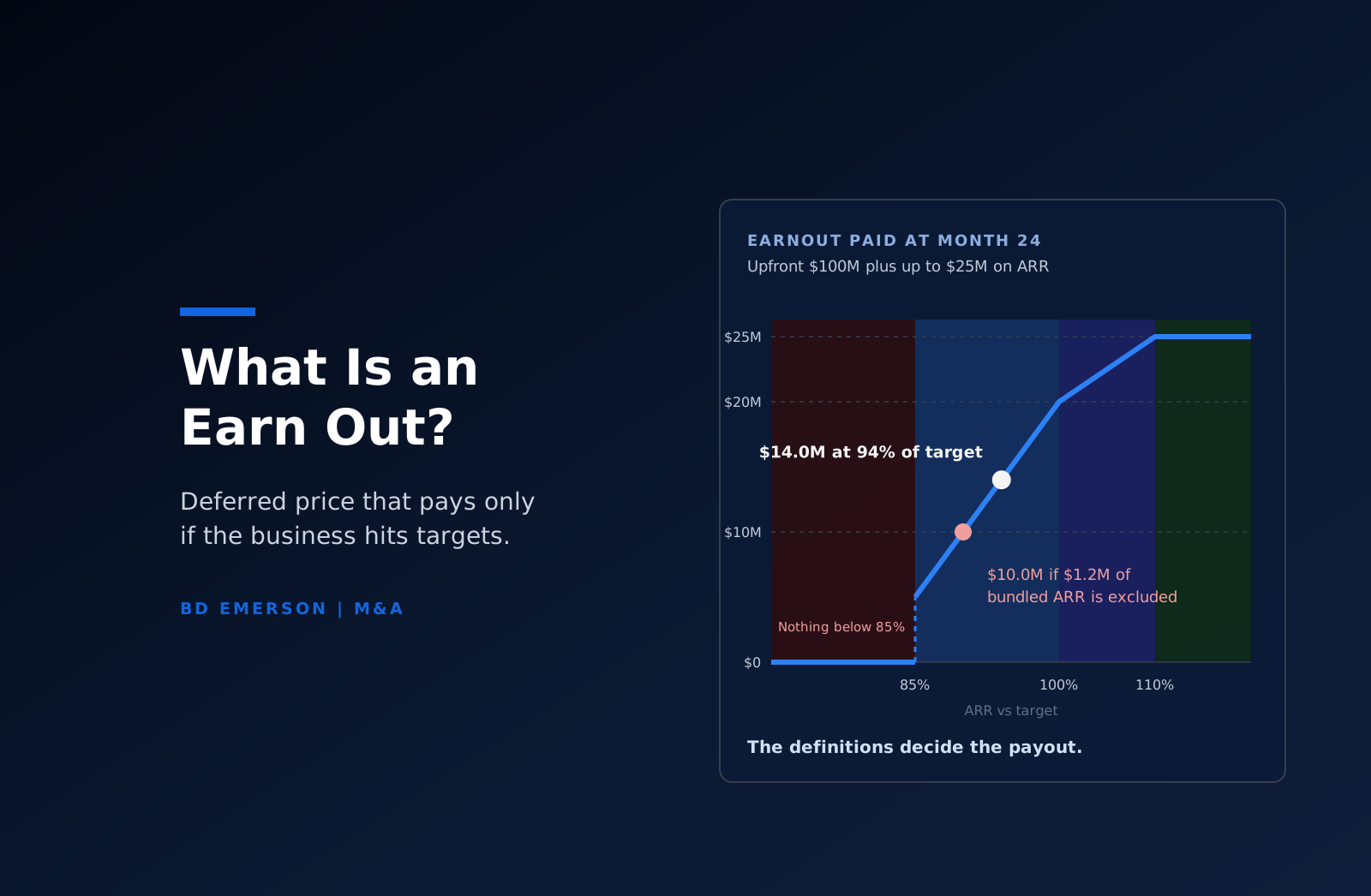
An earn out (also written earnout or earn-out) is the part of an acquisition price that the buyer pays only if the acquired business hits agreed targets after closing, such as revenue, EBITDA, annual recurring revenue (ARR), or a regulatory approval. Accountants call it contingent consideration. Buyers and sellers use earnouts to bridge a valuation gap: the seller is paid for the growth it forecasts, and the buyer pays for that growth only when it shows up. Earnouts are common, and most pay well below their maximum. SRS Acquiom found earnouts in 24% of 2025 private-target deals outside life sciences, and across deals with earnouts, sellers have collected about one in five potential earnout dollars.
On deals with earnouts, our M&A diligence teams test two things: whether the target's systems can produce the metric, and whether the buyer's integration plan leaves the target a fair chance to hit it. BD Emerson does not give legal or tax advice, so settle the final language with deal counsel and a tax adviser.
How common are earnouts?
SRS Acquiom's 2026 study covers more than 2,300 private-target deals that closed from 2020 through 2025 where it provided services. The American Bar Association's 2025 Private Target Deal Points Study covers 139 agreements signed or completed in 2024 and early 2025, priced from $25 million to $900 million. The figures below are current as of October 2026.
| Term | Latest figure | Source |
|---|---|---|
| Use, private targets outside life sciences | 24% of 2025 deals, up from 22% in 2024 | SRS Acquiom 2026 Deal Terms Study |
| Use, biotech and pharma targets | 78% of 2025 deals | SRS Acquiom 2026 earnout summary |
| Use, technology targets | 22% of 2025 deals, versus 14% for 2014 to 2022 | SRS Acquiom 2026 earnout summary |
| Use, ABA sample | 18% of deals, down from 26% in the 2023 study | ABA 2025 Deal Points Study |
| Size | Median potential earnout of 34% of the closing payment | SRS Acquiom 2026 Deal Terms Study |
| Length | 1 to 2 years in 38% of earnouts, 1 year or less in 23% | SRS Acquiom 2026 Deal Terms Study |
| Deals that paid anything | 59% of non-life-sciences deals with an earnout | SRS Acquiom claims data |
| Share of maximum paid | 21% of aggregate potential earnout paid to date | SRS Acquiom claims data |
| Payout when anything is paid | About 50 cents per potential dollar | SRS Acquiom 2026 earnout summary |
The samples differ because SRS Acquiom's includes many lower middle-market deals, where 30% of 2025 deals of $50 million or less carried an earnout. On payouts, the SRS Acquiom data is clear: an earnout's expected value is a minority of its face value, so a seller should not count the maximum as price. The figures come from SRS Acquiom's 2026 earnout and milestone summary and Fasken's review of the 2026 Deal Terms Study.
How does an earnout work?
An earnout has five working parts, and the purchase agreement defines each one: the metric, the measurement period, the payout formula, the buyer's obligations while it runs, and the events that accelerate payment.
Choosing the metric
Revenue is the most common earnout metric, followed by earnings or EBITDA, according to A&O Shearman's earnout memo on the Harvard Law School Forum on Corporate Governance. Sellers prefer revenue because the buyer's overhead allocations cannot move it, and buyers prefer EBITDA because it shows whether growth was profitable. Gross profit sits between them. Software deals often use ARR, and life sciences deals use milestones such as trial completion or FDA clearance.
Measurement periods
Outside life sciences, most earnouts run two years or less, while life sciences milestones often run three to five years or longer. Annual targets give the seller partial payments along the way. A single cumulative period reduces fights over revenue shifted between years but delays every payment. A catch-up clause pays a missed year's amount if a later or cumulative target is met.
Tiers, caps, floors, and catch-ups
A cliff pays a fixed amount if the target is met and nothing if it is missed. A linear formula pays nothing below a threshold, the maximum at the target, and a proportional amount between. A tiered formula uses different slopes for different bands. Dematic's 2015 acquisition of Reddwerks used the linear form, according to the Delaware Superior Court's 2022 opinion: nothing below $36 million of order intake and the full $10 million at $48 million. The cap sets the maximum payout, and the floor sets the level below which nothing is paid.
Acceleration
Acceleration makes the remaining earnout payable at once on a trigger such as a sale of the business, a breach of the buyer's operating covenants, insolvency, or termination of seller-employees without cause. Almost 25% of non-life-sciences deals closed from 2014 through 2023 included change-of-control acceleration, per the A&O Shearman memo. Settle what accelerates: the maximum, the target amount, or only amounts already earned.
A worked example: a tiered ARR earnout
A buyer acquires a software company with $20.0 million of ARR for $100.0 million in cash at closing, 5.0 times ARR. The seller expects ARR to reach $30.0 million within two years, so the parties add an earnout of up to $25.0 million, measured on ARR at month 24.
| Band | ARR at month 24 | Share of target | Earnout paid |
|---|---|---|---|
| Below threshold | Under $25.5 million | Under 85% | $0 |
| Tier 1 | $25.5 million to $30.0 million | 85% to 100% | $5.0 million rising to $20.0 million |
| Tier 2 | $30.0 million to $33.0 million | 100% to 110% | $20.0 million rising to $25.0 million |
| Cap | $33.0 million and above | 110% and above | $25.0 million |
The company finishes month 24 at $28.2 million of ARR, 94% of target. Tier 1 adds $15.0 million of earnout across $4.5 million of ARR, so each ARR dollar in that band is worth $3.33. The seller earns $5.0 million at the threshold plus $3.33 for each of the 2.7 million ARR dollars above it, or $9.0 million, for a $14.0 million earnout. Total consideration is $114.0 million, 5.7 times ARR at closing.
Now change one fact. In year two, the buyer moves 30 customers with $1.2 million of ARR onto bundled contracts for its own platform, and the agreement counts only ARR billed on the target's products. Measured ARR falls to $27.0 million, 90% of target, and the earnout falls to $10.0 million. One definition worth $1.2 million of ARR moved the payout by $4.0 million. The threshold is sharper still: $25.4 million of ARR pays nothing, and $25.5 million pays $5.0 million.
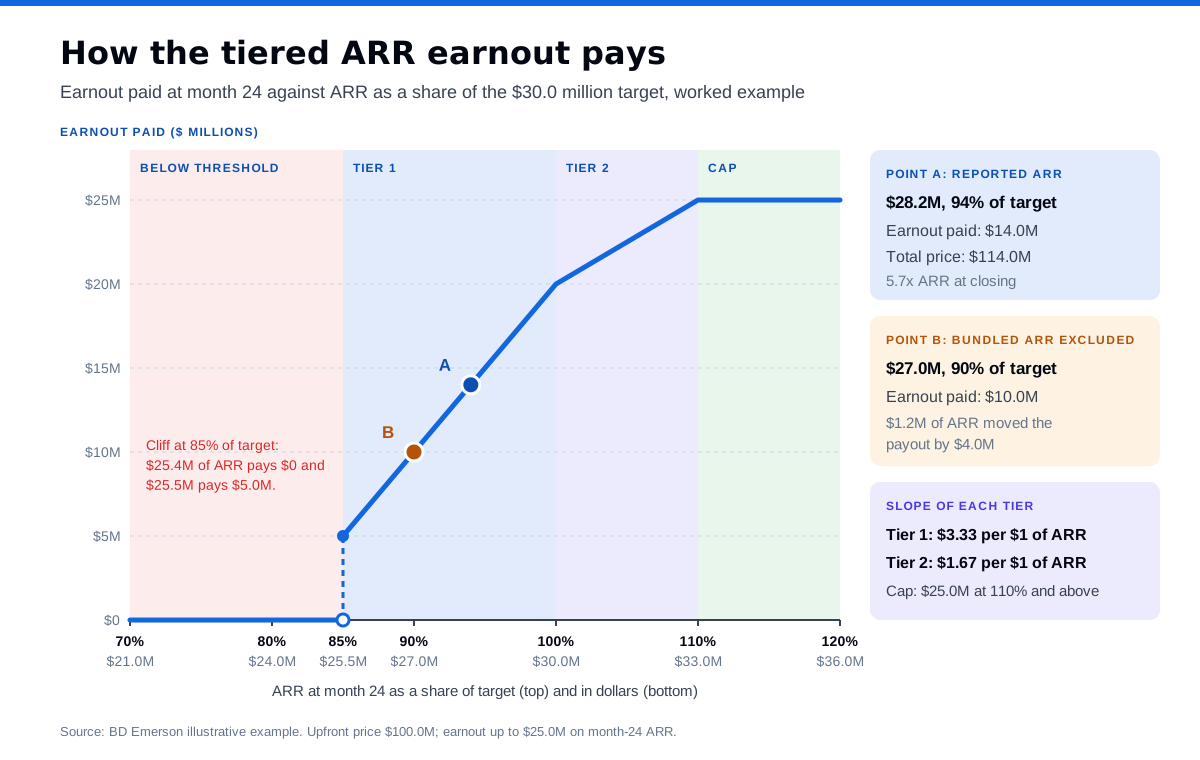
Our rule for any earnout is to compute the slope of every tier before negotiating the definitions. The slope prices each disputed dollar of the metric and shows where a cliff will draw the hardest fight. Here, every definitional question in tier 1 is worth 3.33 times its ARR value.
How are earnouts accounted for under ASC 805?
Under ASC 805, the US GAAP standard for business combinations, the buyer records an earnout as contingent consideration at its acquisition-date fair value, which becomes part of the purchase price allocation. Fair value reflects the probability and timing of each payout, so a $25.0 million maximum enters the books at a fraction of that amount. The buyer then classifies the obligation as a liability or as equity under ASC 480 and ASC 815-40, as Deloitte's roadmap on liabilities and equity explains. An earnout payable in cash is a liability.
Under ASC 805-30-35-1, a liability-classified earnout is remeasured to fair value at each reporting date until settled, with changes recognized in earnings. An equity-classified earnout is not remeasured. The result surprises operating teams: a successful earnout lowers the buyer's reported earnings. If the buyer in the example recorded the earnout at $9.0 million and the expected payment rose to $14.0 million, the $5.0 million difference would be charged to earnings over the earnout period.
Payments for future work are excluded from consideration. Under ASC 805-10-55-25, a contingent payment that is automatically forfeited if the seller's employment ends is compensation for postcombination services, as PwC's business combinations guide explains, and the buyer expenses it over the service period.
How are earnouts taxed?
Tax treatment turns on the same question: is the payment purchase price or pay for future services? Purchase-price earnouts generally increase the seller's amount realized on the sale. A sale whose total price cannot be determined by the end of the tax year is a contingent payment sale, and IRS Publication 537 explains how the installment method applies and when part of each deferred payment is unstated interest under Internal Revenue Code sections 483 or 1274. Payments tied to continued employment are generally taxed as compensation at ordinary income rates. Have a tax adviser review the earnout and employment terms together before signing.
Why do earnouts end in disputes?
Earnouts end in disputes because the buyer controls the business that produces the metric. The seller wants every decision to maximize the metric, and the buyer wants to run the combined company, which can mean redirecting the sales team, merging products, or ending a program. Delaware's recent decisions show how these cases end.
| Case | Court and year | What happened | Drafting lesson |
|---|---|---|---|
| Lazard Technology Partners v. Qinetiq | Delaware Supreme Court, 2015 | The buyer promised only not to act with the intent of reducing the earnout. The seller could not prove intent and lost. | Sellers who want more than an intent covenant need affirmative obligations. |
| Williams Cos. v. Energy Transfer Equity | Delaware Supreme Court, 2017 | The court held that a commercially reasonable efforts covenant in a merger agreement requires all reasonable affirmative steps. | Efforts language creates real duties, so define them. |
| Fortis Advisors v. Dematic | Delaware Superior Court, 2022 | Dematic folded Reddwerks functionality into its own products and excluded those sales. The court read "Company Products" broadly and held the targets met. | Say how integrated and bundled products count. |
| Shareholder Representative Services v. Alexion | Court of Chancery, 2024 and 2025 | After AstraZeneca acquired Alexion, Alexion ended a program bought from Syntimmune for $400 million plus up to $800 million in milestones. The court found a breach of an outward-facing efforts standard, held a $130 million milestone payable, and awarded $180.9 million more in damages. | A peer benchmark does not permit decisions driven by the buyer's own integration savings. |
| Johnson & Johnson v. Fortis Advisors (Auris Health) | Court of Chancery, 2024; Delaware Supreme Court, January 2026 | J&J paid $3.4 billion upfront with up to $2.35 billion in milestones. The trial court found breach of an efforts clause tied to J&J's practice for priority devices, plus fraud, and awarded about $1 billion. The Supreme Court affirmed those findings, reversed an implied covenant ruling, and remanded to recalculate. | Address foreseeable regulatory changes and anti-reliance in the contract. |
Three rules run through these cases. Courts enforce the words the parties chose, decline to rewrite deals through the implied covenant of good faith and fair dealing, and hold buyers liable for decisions made for reasons outside the acquired business when the efforts clause ties them to it. The Auris opinion also confirmed that an exclusive remedy clause does not bar a fraud claim over statements outside the contract unless the seller signed a clear anti-reliance provision.
Drafting protections that hold up
Three drafting choices decide how these disputes come out.
Efforts covenants and "commercially reasonable efforts"
Delaware courts read an efforts clause through its definition, so the definition matters more than the adjective. In Auris, the definition measured J&J against its own usual practice for priority medical device products, an inward-facing standard. In Alexion, it measured Alexion against similar biopharmaceutical companies, an outward-facing standard. Both buyers lost because their decisions served goals outside the acquired product. A durable clause names the benchmark, lists commitments on headcount, budget, sales coverage, and pricing, and states the factors the buyer may weigh, such as safety and regulatory risk. The Auris definition also barred J&J from weighing the cost of the earnout payments.
Operating covenants and information rights
Operating covenants list what the buyer may not do during the measurement period, such as folding the target's products into its own without credit, booking revenue in another entity, cutting the sales team below a floor, or selling the business without the purchaser assuming the earnout. Information rights let the seller check the math through monthly reports, read access to source systems, and an audit right.
Accounting principles and dispute resolution
Tie every financial metric to GAAP applied consistently with the target's historical policies, and name the policies that move the number, such as revenue recognition under ASC 606 and cost allocation. Attach a sample calculation on the last fiscal year. Send calculation disputes to a named independent accounting firm acting as an expert, limited to the disputed items, and keep efforts and fraud claims in court or arbitration.
Earnouts in technology and software deals
ARR has no GAAP definition, so the agreement must supply one. Specify which contracts count, how to annualize monthly plans and multi-year ramps, and how to treat usage fees, services, discounts, non-renewal notices, and foreign currency. Then add two clauses generic definitions leave out: how revenue counts when the buyer bundles the target's product with its own, and when it migrates the target's customers to its platform. Dematic turned on that gap.
Roadmap milestones, such as general availability of a release, need objective acceptance criteria, a named certifier, and the buyer's commitments on engineers and budget. Regulatory milestones need one more clause: in Auris, when the FDA changed the clearance pathway, the Delaware Supreme Court held that the contract left no gap for the implied covenant to fill, so name the alternative pathways that also count.
The integration plan is the biggest risk. Sunsetting the product, re-platforming it, bundling it, moving its engineers, or changing its pricing can make the target unreachable. How far a buyer integrates depends partly on the deal: a horizontal combination usually absorbs the target, while a conglomerate acquisition often leaves it standalone, as our guide to types of mergers explains. Before signing, test each action in the 100-day plan against the earnout metric. Each conflict has three fixes: change the plan, adjust the metric, or convert that part of the earnout into fixed deferred consideration. We run this test as part of M&A due diligence on deals with earnouts.
Earnout vs seller note vs rollover equity
An earnout is one of three common ways to defer part of the price, and each puts a different risk on the seller. Settle the structure at the letter of intent stage, because it is hard to reopen once exclusivity starts.
| Feature | Earnout | Seller note | Rollover equity |
|---|---|---|---|
| What the seller receives | Cash or stock later, if targets are met | Fixed principal and interest | Equity in the buyer or its holding company |
| Payment depends on | The acquired business's results | The buyer's ability to pay, usually behind senior lenders | The whole company's value at the next sale |
| Seller's main risk | Definitions and buyer control of operations | Credit risk and subordination | Minority position and exit timing |
| Buyer's US GAAP treatment | Contingent consideration at fair value | Debt at fair value | Equity or noncontrolling interest at fair value |
Earnout checklists for sellers and buyers
Seller checklist
- Choose a metric the buyer cannot easily move, such as revenue or ARR.
- Attach a sample calculation on last year's numbers.
- Name the accounting policies that apply.
- Get an efforts clause with a stated benchmark and specific commitments.
- Get credit for bundled and migrated revenue, plus a floor on sales resources.
- Secure monthly reporting, system access, and an audit right.
- Negotiate acceleration triggers and what accelerates.
- Limit setoff of indemnity claims against earnout payments.
Buyer checklist
| Protection | Why it matters |
|---|---|
| Express operating discretion alongside any efforts clause | Delaware courts enforce discretion the contract grants and will not add duties the buyer refused in negotiation, as in Lazard. |
| A defined efforts standard with listed factors | Undefined language lets the court supply a benchmark, as in Alexion. |
| Treatment of regulatory pathway changes | Courts will not fill a foreseeable gap after the fact. |
| Anti-reliance language that binds the seller | Without it, statements outside the contract can support fraud claims. |
| Earnout terms separate from employment terms | Payments forfeited on termination are compensation under ASC 805-10-55-25. |
| Documented reasons for major decisions | The record is the defense when a seller claims the buyer defeated the earnout. |
Frequently asked questions
What is an earn out in mergers and acquisitions? An earn out is the part of an acquisition price that the buyer pays only if the acquired business meets agreed targets after closing, such as revenue, EBITDA, ARR, or a regulatory approval. It bridges the gap between the seller's view of value and what the buyer will pay at closing. The buyer records it as contingent consideration at fair value under ASC 805.
How long do earnouts last? Most earnouts outside life sciences run two years or less. In SRS Acquiom's 2026 Deal Terms Study, one to two years was the most common length at 38% of earnouts, followed by one year or less at 23% and two to three years at 20%. Life sciences milestones often run three to five years or longer because they track clinical and regulatory events.
How often do earnouts pay out? Earnouts usually pay something, but well below the maximum. SRS Acquiom data on non-life-sciences deals shows that 59% paid at least part of the earnout, while only 21% of the aggregate maximum had been paid. When an earnout pays anything, sellers typically receive about 50 cents per potential dollar, with a median of 43 cents in deals with upfront payments of $50 million or less.
Are earnout payments taxed as capital gains or ordinary income? It depends on what the payment is for. Earnout payments that are purchase price for the business generally increase the seller's amount realized on the sale, can qualify for installment reporting, and may include an imputed interest portion. Payments tied to continued employment are generally taxed as compensation at ordinary income rates. Have a tax adviser review the earnout and employment terms together before signing.
What does "commercially reasonable efforts" mean in an earnout? It means what the agreement's definition says, measured against the benchmark the parties chose. The Delaware Supreme Court held in Williams v. Energy Transfer (2017) that the phrase requires affirmative reasonable steps. In the Auris and Alexion cases, courts measured buyers against their own practices or against similar companies and found breaches where the buyers acted for reasons outside the acquired product.
Can a buyer avoid an earnout by integrating the acquired business? Integration decisions that defeat the earnout create legal exposure. In Fortis Advisors v. Dematic (2022), the buyer folded the target's software into its own products and excluded those sales, and the court read the earnout definition broadly and found the targets met. Address bundling, customer migration, and pricing changes in the agreement before closing.
If you are selling a company and the buyer has proposed an earnout, our sell-side M&A advisory team can model the payout bands, test the definitions against your systems, and review the buyer's integration plan for conflicts before you sign. Buyers can get the same analysis through our buy-side M&A advisory team.

About the author