OneTrust vs Transcend: How They Differ and What Switching Takes
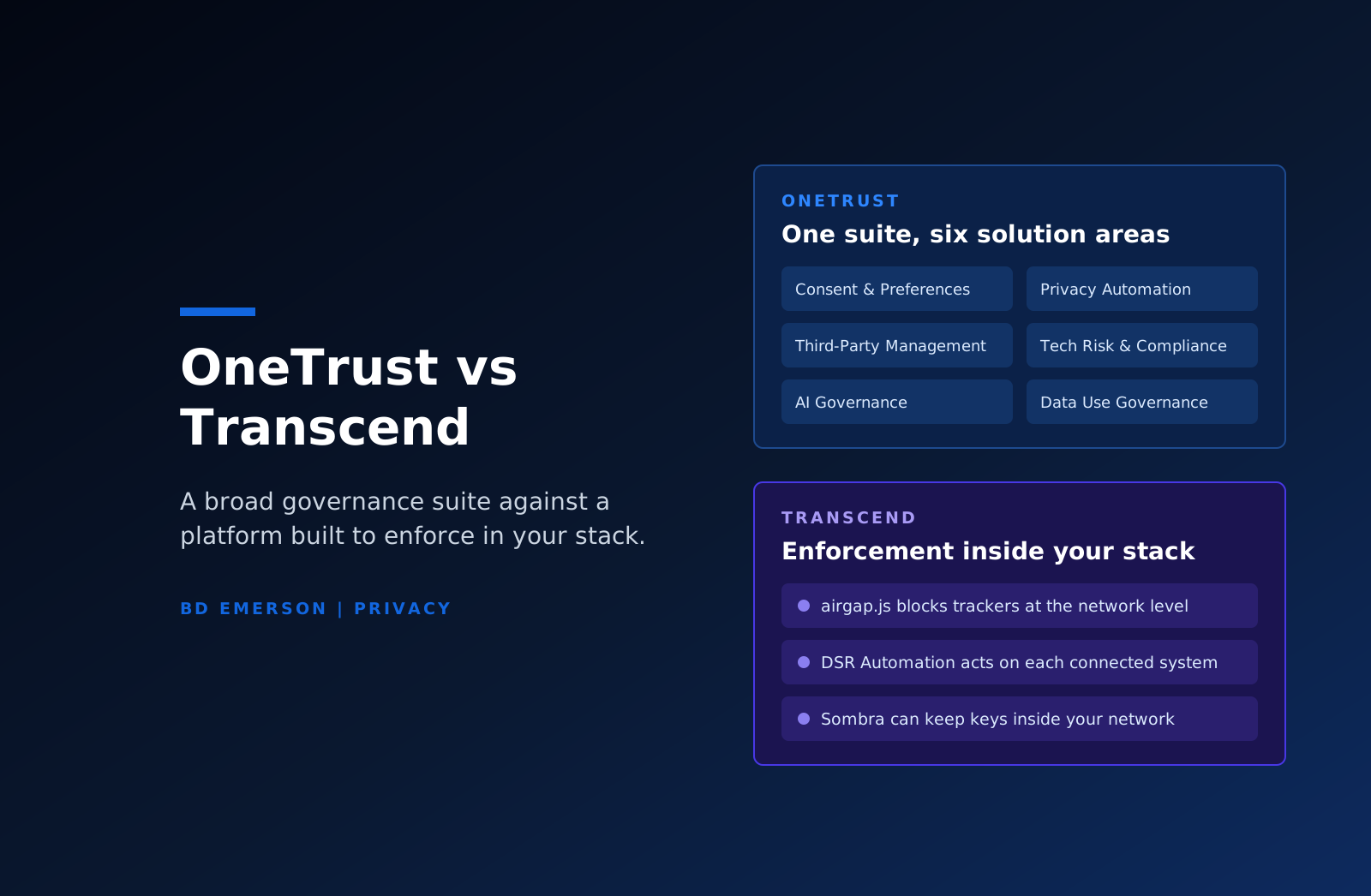
OneTrust and Transcend both automate privacy work, but they are built for different jobs. OneTrust is a broad governance suite: consent, privacy automation, third-party risk, technology risk and compliance, and AI governance under one vendor, with DataGuidance regulatory research alongside. Transcend is narrower and engineering-led. Its products enforce privacy rules inside your systems: airgap.js regulates trackers at the network level, DSR Automation acts directly on your databases and SaaS tools, and a gateway called Sombra can keep your keys and system credentials in your own network. Choose OneTrust when breadth and a single vendor matter most. Choose Transcend when enforcement is the problem you are trying to solve. If you are switching, the records move quickly, and the project is rebuilding consent, request handling, and the syncs around them.
A disclosure before the detail: BD Emerson has implemented Transcend for clients, including migrations off OneTrust, and we also work in OneTrust. We resell neither product and take no margin on licenses. Product facts below come from each vendor's own site and documentation as of November 2026.
OneTrust vs Transcend at a glance
| Dimension | OneTrust | Transcend |
|---|---|---|
| How the vendor describes it | The OneTrust AI-Ready Governance Platform, sold across six solution areas | The Transcend Agent & Data Control Platform, a governance and decision layer for how data may be used |
| Product scope | AI Governance, Consent & Preferences, Data Use Governance, Privacy Automation, Tech Risk & Compliance, Third-Party Management | Consent & Preference Management, DSR Automation, Data Discovery & Classification, Data Inventory, Assessments, Privacy Center, AI Governance, Transcend Rails for AI agents |
| How consent is enforced | Site scans matched against a database of more than 45 million pre-categorized cookies, then auto-blocking, tag manager integrations, or script rewriting | airgap.js regulates network requests and cookies on each page, configured from sampled telemetry of real visits, starting in Reporting Only mode |
| Mobile and connected TV | SDKs for Android, iOS, Flutter, React Native, Cordova, Ionic, Unity, and MAUI, plus six connected TV platforms | SDKs for iOS, Android, and React Native, plus headless consent SDKs |
| DSR fulfillment | Automated intake, identity verification, data discovery and deletion, redaction, legal hold checks, and a secure response portal | Preflight identity checks and enrichment, integrations that act on each system, and automated vendor emails for systems with no API |
| Where keys and credentials sit | Hosted by OneTrust; ask which connectors or scanners run inside your network | Sombra gateway, self-hosted in your network or hosted by Transcend |
| Developer tooling | JavaScript API, mobile and connected TV SDKs, developer documentation | Terraform provider, CLI, GraphQL and REST APIs, MCP server |
| Pricing | Not published; each package is priced on usage meters | Not published; quoted through sales |
Scope: one suite or a focused platform
The first question is how much of OneTrust you use. OneTrust's product catalog spans six areas, and privacy is only two of them. Its Third-Party Management area alone holds third-party risk management, third-party due diligence, and a third-party risk exchange, and Tech Risk and Compliance covers compliance automation and IT risk management. If your security and procurement teams run vendor reviews in OneTrust, moving consent and DSRs to Transcend does not retire OneTrust. You either keep part of the contract or replace those products too, and the business case has to say which.
Transcend concentrates on enforcing data decisions. Its platform covers consent and preferences, DSR Automation, data discovery and classification, a data inventory, assessments, and a Privacy Center for self-service requests. Its newer products point at AI: AI Governance encodes data permissions and Do Not Train rules into the systems your models and agents use, and Transcend Rails applies policy as code to what AI agents can browse, spend, and deploy at runtime. OneTrust sells AI governance too, including agent permissions across MCP environments, so AI coverage alone will not decide this choice.
Consent: classifying what a scan finds or regulating what the browser sends
The two platforms start consent from different evidence. OneTrust's Cookie Consent scans your websites, categorizes cookies and trackers against a database of more than 45 million pre-categorized cookies, and blocks them through auto-blocking, tag manager integrations, or script rewriting. Each scanned website gets a testing script and a production script served from OneTrust's CDNs.
Transcend starts from the browser. airgap.js loads first on every page and regulates at the network level, so it can hold back a pixel or an API call that never sets a cookie; Transcend's documentation says this lets it manage more than 200 tracking technologies. Its configuration comes from telemetry, collected from a random subset of visitors and available in Transcend for the previous seven days, with new data flows suggested for review in a triage queue. Two defaults matter in practice. Consent starts in Reporting Only mode, which collects telemetry without blocking anything, and unknown cookies and data flows are allowed by default until someone classifies them. airgap.js also reads Global Privacy Control signals natively and opts those visitors out of sale and sharing.
Both support the IAB's TCF and GPP frameworks, and Transcend is registered with the IAB as a consent management platform. The difference that settles some decisions is app coverage. OneTrust lists SDKs for eight mobile frameworks and six connected TV platforms, including Roku, Apple TV, and Samsung, while Transcend documents iOS, Android, and React Native. A streaming or gaming business should test that gap before anything else.
Neither model runs itself. OneTrust's accuracy depends on scan coverage and on someone checking the category each cookie lands in. Transcend's depends on telemetry seeing your real traffic and on someone working the triage queue. A consent program fails on either platform when nobody owns the classification.
DSR automation and where your data sits
Both platforms automate data subject requests from intake to response. OneTrust's DSR Automation covers request intake, identity verification, personal data discovery and deletion, redaction, legal hold checks, and a secure customer portal, and it connects intake to OneTrust's consent platform and Trust Center.
Transcend's DSR Automation runs each request through four modules: ingestion, preflight checks and identity enrichment, jobs that act on each connected system, and report delivery. Preflight checks include email verification, SMS phone verification through Twilio, government ID verification through Stripe Identity, legal hold checks, and wait periods. For a vendor with no API for a request type, automated vendor coordination emails the request to the vendor, and the Prompt a Person integration routes requests to an internal team that has to act by hand.
The larger architectural difference is Sombra. Transcend's Sombra documentation describes a containerized gateway that encrypts data with AES-256 before it leaves your firewall and holds the API keys to your business systems, so Transcend does not. You can self-host Sombra, in which case Transcend's cloud has no access to your data systems, or let Transcend host it, in which case Transcend's KMS holds the keys. Whichever vendor you evaluate, ask the same three questions: where connector credentials are stored, who can decrypt request data, and how a deletion reaches a system with no API. Our DSAR guide covers the deadlines and identity checks a DSR tool has to support under each law.
Pricing: compare the meters before the quotes
Neither vendor publishes prices. OneTrust's pricing page explains that each package carries one or more usage meters: average daily visitors across all channels and properties for its consent management platform, total data subject profiles for Universal Consent and Preference Management, and users plus privacy asset inventory for Privacy Automation. Transcend quotes through its sales team.
Meters make year three more expensive than year one if your traffic or customer base grows, so compare a three-year cost for the same scope. Include licenses at the meter levels you expect to reach, implementation, the internal hours for tracker triage and integration testing, and, if you are switching, the months when both contracts run.
What switching from OneTrust to Transcend involves
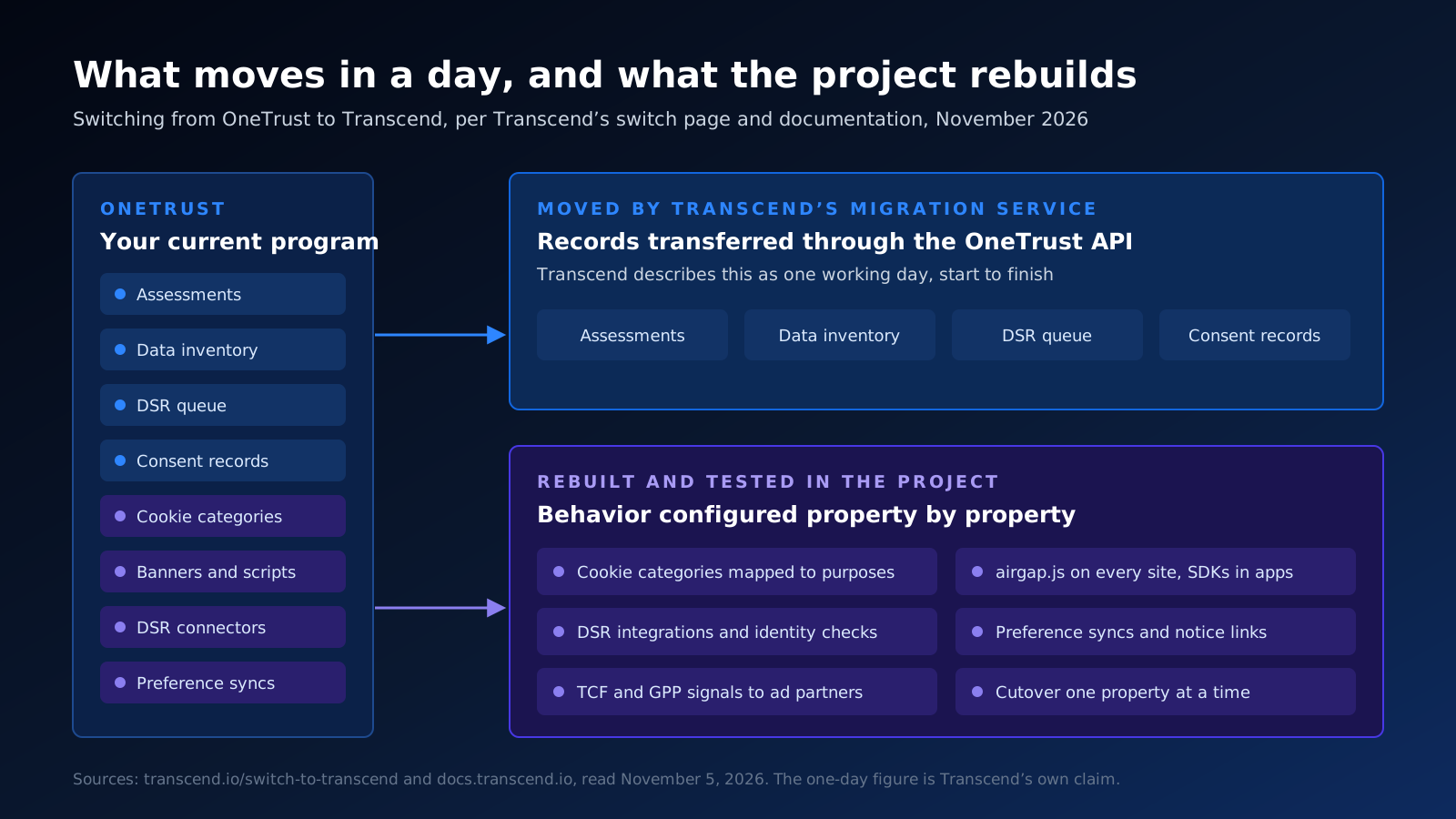
Transcend markets the move directly. Its switch page offers a free consultation with its migration engineers and a data transfer that starts with "Point us at your OneTrust API key" and moves assessments, data inventories, DSR queues, and consent records in what it describes as one working day. That covers the records. The migration project is everything that has to be rebuilt and tested around them:
- Cookie categories become purposes. Map each OneTrust category to a Transcend purpose, then triage the data flows that telemetry finds and the OneTrust scan never categorized.
- The consent script changes on every property. Remove OneTrust's scripts, load airgap.js first on every page, and ship SDK changes in each app release. Two consent managers on one page will conflict, so cut over one property at a time.
- Existing consent has to be checked against the new purposes. Consent covers the purposes and wording people agreed to, so where a purpose or the notice text changes, decide with counsel whether to ask again.
- DSR integrations and identity checks are rebuilt. Connect each system through Sombra, configure the preflight checks, and run a test access request and a test deletion against every system before real requests depend on it.
- Everything downstream is repointed. Move preference syncs for your email platform and CRM, update the request links in your privacy notice, and confirm that TCF and GPP signals still reach your ad partners.
The figure shows the split between what the transfer moves and what the project rebuilds.
Which one fits
OneTrust fits a program that wants privacy, third-party risk, and technology risk under one vendor, a compliance-led privacy team that uses DataGuidance research and assessment workflows every week, and a business with many mobile frameworks or connected TV apps. Transcend fits a program where engineering owns enforcement, DSRs have to reach many systems and warehouses, security requires keys and credentials to stay in your network, and you want consent applied to network requests and configuration kept in code through Terraform and a CLI.
Both tools carry out decisions someone else has to make: which purposes need consent, how long data is kept, and how to answer a disputed request. A platform cannot make those calls, and a project that starts configuring before they are made usually reconfigures later. If no one in your organization owns them, our DPO as a Service team can.
How BD Emerson helps
Our Transcend implementation services cover Sombra deployment, airgap.js rollout, DSR integrations, data discovery, preference syncs, and OneTrust migrations through cutover. If you have not picked a platform yet, our consent management practice compares OneTrust, Transcend, and the other platforms against your stack before you sign.
Frequently asked questions
Is Transcend cheaper than OneTrust? Neither vendor publishes prices, so the answer depends on scope and usage. OneTrust prices each package on usage meters, such as average daily visitors for its consent platform and data subject profiles for preference management, and Transcend quotes through sales. Compare a three-year cost for the same scope, including implementation and internal time.
How long does a OneTrust to Transcend migration take? Transcend says its migration service moves assessments, data inventories, DSR queues, and consent records in one working day. The project takes longer, because consent scripts, purposes, DSR integrations, identity checks, and downstream syncs have to be rebuilt and tested property by property. The number of sites, apps, and connected systems sets the timeline.
Does Transcend replace OneTrust's third-party risk management? Not product for product. OneTrust sells third-party risk management, due diligence, and a risk exchange as separate products. Transcend's Assessments product runs AI, DPIA, and vendor risk reviews in one workflow, so check whether it covers your vendor program before planning to retire OneTrust entirely.
Which is better for cookie consent? It depends on your properties. OneTrust categorizes cookies from site scans against a large database and supports more mobile and connected TV platforms. Transcend's airgap.js regulates network requests as well as cookies, using telemetry from real visits, which helps on sites where trackers send data without setting a cookie. Both support the IAB's TCF and GPP.
Do we have to collect consent again after switching? Not automatically. Consent covers the purposes and wording people agreed to. If OneTrust categories map one to one onto Transcend purposes and the notice people saw stays the same, each consent record describes the same choice, and Transcend says its migration service moves consent records across. If purposes or wording change, settle the question with counsel before cutover.

About the author