What Does Palantir Do? Products, Customers, and Business Model
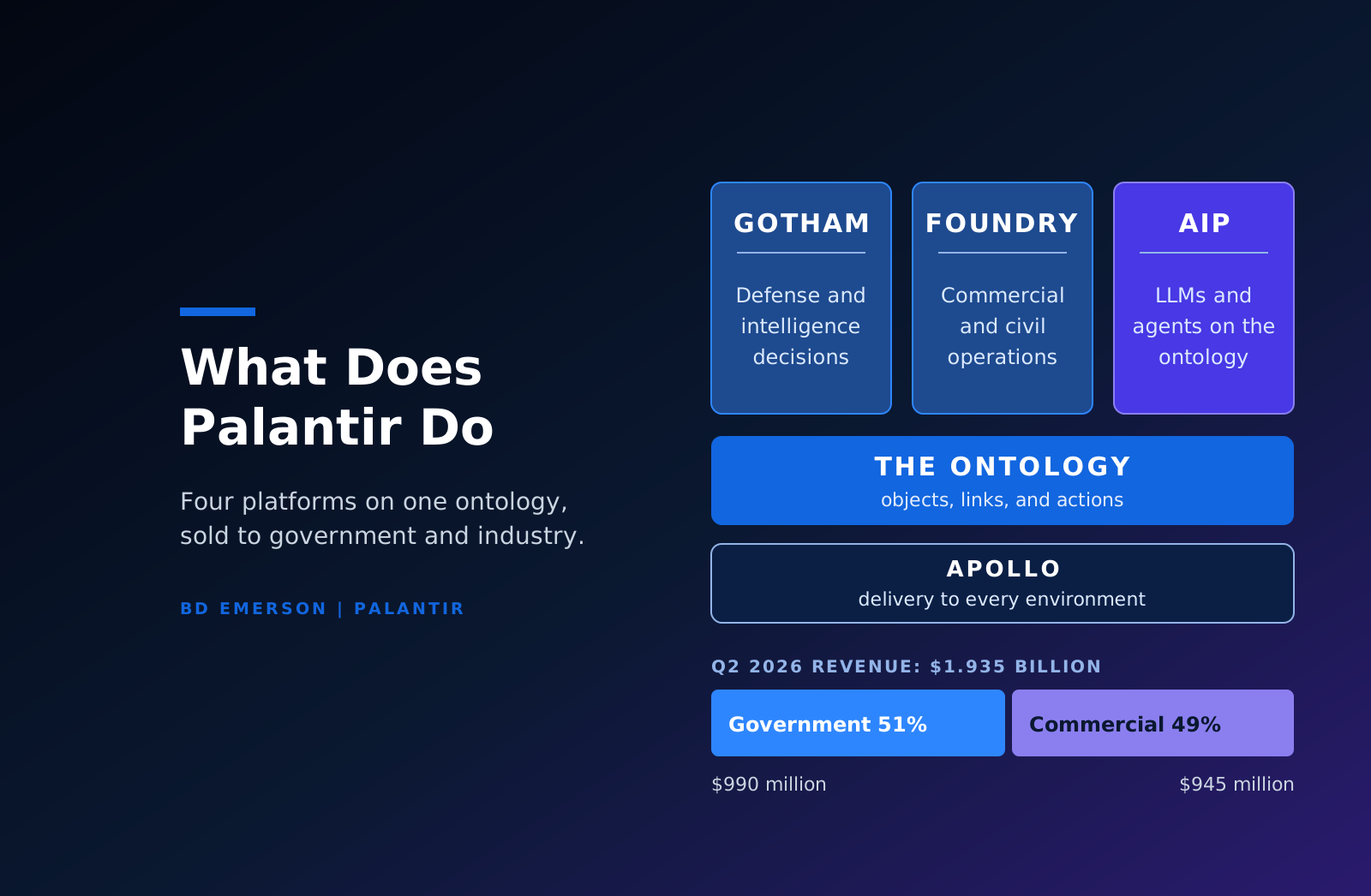
Palantir Technologies is a US software company that builds platforms for integrating an organization's data, modeling it as an ontology of real-world objects and actions, and running decisions and AI on top of that model. Founded in 2003, it sells four core platforms: Gotham for defense and intelligence agencies, Foundry for commercial and civil operations, AIP for large language models and AI agents, and Apollo for delivering software to any environment. Government and commercial customers each supply about half of its revenue: in the quarter ended June 30, 2026, Palantir reported $990 million from government customers and $945 million from commercial customers, out of $1.935 billion. Palantir does not sell data, and its 2025 annual report states, "We are not in the business of collecting, mining, or selling data."
This page is the overview, and each product has its own deep dive linked below. Every figure links to the filing or announcement it came from. Facts are current as of October 2026, when the most recent quarter Palantir had reported was the one ended June 30, 2026.
Palantir's products and services at a glance
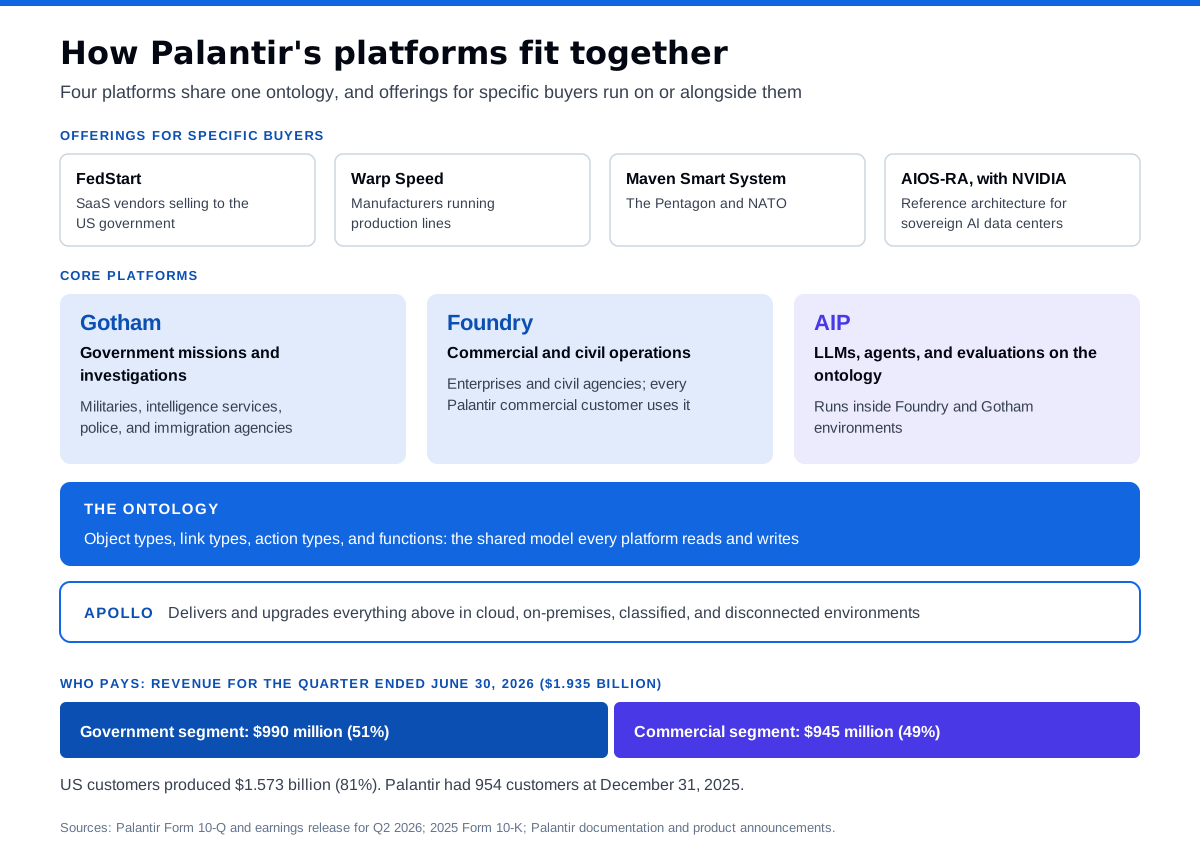
Palantir sells a small set of platforms that share one ontology and one delivery layer, plus offerings built for specific buyers that run on or alongside those platforms. The table lists each current offering, what it does, who buys it, and how it is deployed.
| Offering | What it does | Who buys it | How it is deployed |
|---|---|---|---|
| Gotham | Integrates intelligence, sensor, and case data for investigations, targeting, and mission planning | Militaries, intelligence services, police forces, and immigration agencies | Government clouds, classified networks, on-premises, tactical edge |
| Foundry | Connects enterprise systems, models them as an ontology, and runs operational applications that write back to source systems | Commercial enterprises and civil agencies; Palantir says all of its commercial customers use it | Typically Palantir-hosted SaaS; government cloud, on-premises, and edge where required |
| AIP | Connects large language models to ontology data, with tools for building agents, automations, and evaluations | Foundry and Gotham customers | Inside Foundry and Gotham environments, including private networks |
| Apollo | Delivers and upgrades software across cloud, on-premises, classified, and disconnected environments | Palantir uses it to deliver its own platforms and also markets it for other software | A control layer of hubs and spokes in each environment |
| FedStart | Hosts a software vendor's product inside Palantir's accredited government environment so the vendor inherits its authorizations | SaaS companies selling to US government | Palantir Federal Cloud Service, with on-premises and edge options since February 2026 |
| Warp Speed | A manufacturing operating system for production scheduling, engineering changes, visual quality inspection, and inventory | Manufacturers, starting in December 2024 with Anduril, L3Harris, Panasonic Energy of North America, and Shield AI | Alongside Foundry and AIP, as in Lear's 2025 deployment |
| Maven Smart System | AI-enabled battlespace awareness, targeting, and logistics software for the Pentagon's Maven program | US Department of Defense and NATO | Defense networks |
| AI OS Reference Architecture | A design with NVIDIA, announced in March 2026, for running Palantir's full software suite on a dedicated AI data center | Organizations building sovereign AI infrastructure | Dedicated data centers on NVIDIA systems |
| Developer tier | Limited access to Foundry and AIP in the United States and select countries, per the 10-K | Individual developers and small teams learning the platform | Palantir-hosted |
Two points in the table are easy to miss. Commercial buyers get AIP as part of a Foundry deployment, so a commercial AIP decision is a Foundry decision. And the offerings in the lower rows are aimed at one kind of buyer each, which is why a software vendor, a manufacturer, and a combatant command can all be Palantir customers without using the same product.
The ontology is the common core
Every Palantir platform rests on the ontology, Palantir's model of an organization as typed objects, the links between them, and the actions that change them. Palantir's documentation calls it "the digital twin of an organization." An object type might be a customer, an aircraft, an insurance claim, or a suspect. A link type records that a claim belongs to a policy. An action type defines a governed change, such as approving that claim, with validation rules and an audit record.
The ontology explains how one company sells into such different markets. Gotham applied the model to intelligence data, and Palantir's patent on storing data against an ontology traces to a November 2006 filing. Foundry applied the same model to commercial operations. AIP uses it to give language models structured, permission-filtered context and a governed way to act. Apollo keeps all of it running and current across environments. Our Foundry guide covers the ontology layer in detail.
What is Palantir AI?
Palantir's AI product is AIP, the Artificial Intelligence Platform, which Palantir launched in April 2023. The 2025 10-K describes AIP as Palantir's generative AI platform: it provides secure connectivity to third-party large language models, tools for building AI agents and automations, and an evaluations framework for governing AI workflows in production. Palantir's AIP page summarizes the pitch as the ability to "Run LLMs and other models on your private network with full control."
Inside Foundry, AIP shows up as named tools. AIP Logic builds LLM-powered functions without code, AIP Chatbot Studio (formerly AIP Agent Studio) builds assistants grounded in ontology data, AIP Evals tests prompts and functions against defined cases, and AIP Assist helps builders inside the platform, according to Palantir's AIP documentation, which also covers bringing your own model. The design choice that matters is grounding: an AIP agent reads typed, permission-filtered objects and acts through the same action types a human operator uses, so its changes are validated and logged the same way. Our AIP guide covers what teams build first and how to measure it.
How does Palantir make money?
Palantir makes money by selling subscriptions to its software platforms, usually under multi-year contracts, to government agencies and commercial companies. It reports revenue in two segments, government and commercial, and discloses US results separately. The table draws on the Q2 2026 earnings release, the Form 10-Q for that quarter, the Q4 2025 earnings release, and the 2025 Form 10-K.
| Measure | Quarter ended June 30, 2026 | Full year 2025 |
|---|---|---|
| Total revenue | $1.935 billion, up 93% year over year | $4.475 billion, up 56% |
| Government segment | $990 million, 51% of revenue | 54% of revenue |
| Commercial segment | $945 million, 49% of revenue | 46% of revenue |
| US revenue | $1.573 billion, 81% of revenue | 74% of revenue |
| US government revenue | $809 million, up 90% | $1.855 billion, up 55% |
| US commercial revenue | $764 million, up 149% | $1.465 billion, up 109% |
| Revenue outside the US | $362 million, 19% of revenue (total minus US revenue) | 26% of revenue |
Two patterns stand out. Commercial revenue is catching up with government revenue: the commercial segment produced 49 percent of revenue in the June 2026 quarter, up from 45 percent a year earlier, driven by US commercial growth of 149 percent. And the business is concentrated in the United States, which produced 81 percent of revenue in that quarter.
A worked example shows what those numbers mean for a buyer's budget. Palantir ended 2025 with 954 customers, a count that grew 34 percent during the year, against $4.475 billion of revenue. Dividing one by the other gives about $4.7 million per customer, and the true average is higher because the customer count was lower for most of the year. In the June 2026 quarter alone, Palantir closed 220 deals of at least $1 million. Those averages describe a base weighted toward large government programs and enterprise-wide deployments, and they are a poor guide to a first commercial contract, which BD Emerson typically sees starting in the low to mid six figures a year for a single use case. Our guide to what Palantir costs breaks down the variables.
Who uses Palantir?
Palantir's customers are large government bodies and large companies, and there are relatively few of them: 954 at the end of 2025 for $4.475 billion of revenue. Palantir names some customers itself, and many customers announce their own deployments. The table lists public examples by sector.
| Sector | Customer | What is public | Product named |
|---|---|---|---|
| Defense | US Army | An enterprise agreement dated July 31, 2025, with a $10 billion ceiling over up to 10 years, consolidating 75 contracts | Palantir's commercial products |
| Defense | US Department of Defense and NATO | Maven Smart System; the Pentagon raised its contract ceiling to nearly $1.3 billion through 2029 in May 2025, and NATO acquired MSS NATO in March 2025 | Maven Smart System |
| Law enforcement | Police in Hesse, North Rhine-Westphalia, and Bavaria | Gotham in use since 2017, 2019 to 2020, and 2024, according to The Local | Gotham |
| Public healthcare | NHS England | The Federated Data Platform, built on Foundry under a contract valued at £330 million over seven years | Foundry |
| Aviation | Airbus | The Skywise aviation data platform, launched with Palantir in June 2017 | Palantir |
| Energy | bp | Palantir software in oil and gas production since 2014 and a five-year agreement in September 2024 that adds AI capabilities | Palantir, AIP |
| Reinsurance | Swiss Re | A core data platform on Foundry since a 2018 decision to partner with Palantir | Foundry |
| Automotive | Lear | More than 11,000 employees on Palantir software, with a September 2025 expansion | Foundry, AIP, Warp Speed |
| Mortgage finance | Fannie Mae | A Crime Detection Unit for mortgage fraud, announced May 28, 2025 | Palantir AI and machine learning technology |
Government users, and the civil liberties debate around them, are covered in our Palantir Gotham guide.
How does Palantir sell?
Palantir sells directly, puts its own engineers on a customer's data early, and grows accounts once a first workflow proves itself. Its 2020 S-1 described this as its "Acquire, Expand, and Scale business model," and the motions below are how that model works today. The right-hand column is BD Emerson's view of what each motion means for the buyer.
| Sales motion | How it works | What it means for a buyer |
|---|---|---|
| AIP bootcamp | Palantir engineers and the customer's team build working use cases together; Palantir says bootcamps take teams "from zero to use case in just one to five days," and the 10-K says they deliver real workflows on actual customer data in days | A fast, concrete test of fit. Treat the output as a prototype, because production adds data engineering, security review, and change management. |
| Forward deployed engineers | Palantir engineers embed with customers to build solutions and identify new use cases, a role the S-1 describes | Faster discovery, plus a dependency to plan for: decide early who maintains what those engineers build. |
| Acquire, expand, scale | A narrow first contract grows as more workflows move onto the platform | Your first contract is a starting point, so negotiate expansion pricing before you need it. |
| Enterprise agreements | Large customers consolidate many contracts into one, as the US Army did with 75 contracts in July 2025 | Simpler buying at scale. The Army notes that the $10 billion figure is the maximum potential value and carries no specific obligation. |
| FedStart | Software vendors run their products inside Palantir's accredited government environment, a program Palantir introduced in June 2023 | A shorter path to FedRAMP and Defense Department authorization, with Palantir as the host. |
| Developer tier | Individuals and small teams get limited access to Foundry and AIP | Useful for learning, and a poor pricing anchor for an enterprise business case. |
How do buyers engage Palantir?
Buyers contract for the software and then choose who does the implementation work: Palantir's own engineers, an internal team, an independent implementation firm, or a combination. Government buyers sometimes reach Palantir through prime contractors: the Army's 2025 agreement consolidated 75 contracts, including 60 in which Palantir was a subcontractor, as Breaking Defense reported. The implementation choice matters because the license is rarely the largest cost in year one. Somebody has to connect source systems, build pipelines, design the ontology, build applications, configure security, and change how operators work, and that effort is measured in months.
BD Emerson is an independent implementation firm. We are not Palantir, we do not resell licenses, we take no resale margin, and we claim no Palantir partner tier or badge. That independence lets us recommend a narrower first contract, a different platform, or no Palantir at all when the workload does not need it.
Common misconceptions about Palantir
Most misconceptions about Palantir come from mixing up the software with the missions customers use it for. The public record on each is clear.
| Misconception | What the record shows |
|---|---|
| Palantir sells personal data | Palantir sells software. Its 2025 10-K states, "We are not in the business of collecting, mining, or selling data," and describes platforms that let customers integrate data they already have access to. |
| Palantir owns the data in its platforms | Customers control their data. In NHS England's Federated Data Platform, each trust and integrated care board is the data controller for its instance, and the supplier may not access, use, or share the data for its own purposes. |
| Palantir is only a defense contractor | Commercial customers produced $945 million, or 49 percent, of revenue in the quarter ended June 30, 2026, and Palantir's commercial customers all use Foundry. |
| AIP is Palantir's own language model | AIP connects to third-party large language models and to models customers bring, and adds the ontology, tools, and evaluations around them. |
| Gotham and Foundry are the same product | They share an ontology and a delivery layer. Gotham serves government missions and investigations, and Foundry serves commercial and civil operations. |
| Palantir is a consulting firm | Palantir is a software company that embeds engineers to get its platforms into production. Customers can also build with internal teams or independent firms. |
Where BD Emerson fits
BD Emerson implements Palantir Foundry and AIP for enterprises. Our work starts with the decision a client wants operators to make differently, then builds the data connections, pipelines, ontology, applications, and security controls that decision needs, with one workflow in production before a second begins. Because we take no margin on Palantir software, the size of the license has no bearing on what we recommend.
Frequently asked questions
What does Palantir do in simple terms? Palantir builds software that pulls an organization's data together into one model of its real-world objects, such as customers, aircraft, or claims, and lets people and AI agents make and record decisions on that model. Government agencies use its Gotham platform for intelligence and military work, companies use Foundry to run operations, AIP adds large language models, and Apollo keeps the software deployed and updated.
Does Palantir sell data? No. Palantir sells software, and its 2025 Form 10-K states, "We are not in the business of collecting, mining, or selling data." Customers bring their own data into Palantir's platforms and control who can see it. In NHS England's Federated Data Platform, for example, each NHS organization is the data controller for its instance, and the supplier may not use the data for its own purposes.
Who are Palantir's customers? Palantir had 954 customers at the end of 2025, split between government agencies and commercial companies. Public examples include the US Army, the Department of Defense and NATO through the Maven Smart System, police forces in three German states, NHS England, Airbus, bp, Swiss Re, Lear, and Fannie Mae. Government customers produced 51 percent of revenue in the quarter ended June 30, 2026, and commercial customers produced 49 percent.
How does Palantir make money? Palantir sells subscriptions to its software platforms, usually under multi-year contracts, and grows each account as more workflows move onto the platform. In the quarter ended June 30, 2026, it reported $1.935 billion of revenue, with $1.573 billion from US customers. It often starts new commercial customers with short AIP bootcamps that build working use cases on the customer's own data.
Is Palantir an AI company? Palantir is a software company whose products now center on AI. Its Artificial Intelligence Platform, launched in April 2023, connects third-party large language models to an organization's ontology and lets agents act through governed actions with audit trails. Palantir's value sits in the data integration, ontology, security, and deployment layers that make those models usable on real operations.
Do you need Palantir engineers to implement Palantir software? No. Palantir attaches its own forward deployed engineers to many deployments, but customers can also build with internal teams or independent implementation firms. What matters more than who does the work is that one workflow reaches production with security configured, operators using it, and a measured baseline before the program expands.
If you are working out whether a Palantir platform fits your organization, and which one, our Palantir consulting team can map your first use case to the right product and a realistic scope before you discuss pricing with Palantir.

About the author