Maven Smart System: What Palantir's Military AI Platform Does

Maven Smart System (MSS) is Palantir Technologies' AI-enabled software platform for the US Department of Defense's Maven program. It fuses intelligence, surveillance, and reconnaissance (ISR) data, computer-vision detections, and operational data into one shared map and a set of decision tools for commanders and analysts. Palantir's Maven Smart System one-pager defines it as "Palantir's AI-enabled platform for Combined Joint All Domain Command and Control (CJADC2)," the Pentagon's effort to connect sensors, systems, and allies. The program began as Project Maven in April 2017. The Pentagon raised the ceiling on Palantir's main MSS contract to nearly $1.3 billion through 2029 in May 2025, NATO bought a version called MSS NATO in March 2025, and a March 2026 memo directed that MSS become a formal program of record run by the Chief Digital and Artificial Intelligence Office (CDAO).
Facts in this guide are current as of October 2026, and each links to its source. The Department has used "Department of War" as a secondary title since Executive Order 14347 of September 5, 2025, so several official links below point to war.gov. For Palantir's products as a whole, see our overview of what Palantir does.
Maven Smart System at a glance
The table collects the facts people ask about first, and each row names its source.
| Item | Fact as of October 2026 | Source |
|---|---|---|
| What it is | Palantir's AI-enabled platform for CJADC2, built for the Pentagon's Maven program | Palantir one-pager, 2025 |
| Program origin | Project Maven, created by a Deputy Secretary of Defense memo dated April 26, 2017 | Defense Department memo |
| Who administers it | The CDAO MSS Program Office, under a March 9, 2026 memo that moved administration from NGA | DefenseScoop, April 2026 |
| Users | 20,000 active users in May 2025 and more than 100,000 in September 2026 | NGA; DefenseScoop |
| Main contract | W911QX-24-D-0012: a $480 million award in May 2024 plus a $795 million modification in May 2025, running to May 2029 | Defense Department contract notices |
| License contract | W911QX-24-D-0026: up to $99,804,561 for user licenses across the military services, running to September 2029 | Defense Department contract notice |
| NATO version | MSS NATO, acquired for Allied Command Operations on March 25, 2025 | NATO Communications and Information Agency |
| Budget request | $2.3 billion for MSS and the Joint Fires Network in the fiscal 2027 request | Defense Department budget overview |
What is the Maven Smart System?
MSS is the software that commanders and analysts work in, and Maven is the wider program it belongs to. The Center for Strategic and International Studies (CSIS) draws that line in its June 2026 explainer: Maven also includes computer-vision model production at the National Geospatial-Intelligence Agency (NGA). NGA describes its part, NGA Maven, as computer vision that works "to automatically detect, identify, characterize, extract, and attribute features and objects in imagery and video," and its GEOINT artificial intelligence page says "Maven data and detections are fed into multiple other platforms." MSS is where those detections meet the rest of a command's data.
Palantir's September 2024 announcement calls the software "the connective tissue between operators and sensor feeds" and the platforms and algorithms around them, supporting battlespace awareness, force management, contested logistics, and joint fires and targeting workflows. CJADC2, the concept MSS serves, connects US assets across space, air, land, sea, and cyberspace and links them with allies, as the Government Accountability Office summarizes it in GAO-25-106454.
What does Maven Smart System do?
Official sources describe MSS as data fusion and decision support: it brings many feeds into one common operating picture, adds AI detections and language-model tools, and gives commanders a shared view in which to plan and decide. The table maps each capability to its source.
| Capability | How official sources describe it | Source |
|---|---|---|
| Data fusion and a common operating picture | NATO says MSS NATO "enhances intelligence fusion and targeting, battlespace awareness and planning, and accelerated decision-making" | SHAPE |
| Computer vision | NGA Maven models detect and label objects in imagery and video, and the detections feed MSS | NGA |
| Mapping | "Real-time collaborative mapping through Gaia" | Palantir one-pager |
| Generative AI and agents | "LLM-powered workflows via the Model Catalog with AIP Assist and AIP Threads," plus Agent Studio | Palantir one-pager |
| Logistics and readiness | CDAO's chief described MSS integrating logistics, force readiness, supply chain, and budget data | Defense One, September 2026 |
| Application building | No-code and low-code tools, including Workshop and Slate | Palantir one-pager |
The value sits in integration. Cameron Stanley, the Pentagon's chief digital and AI officer, said MSS replaced "six, eight, ten" separate IT systems that personnel had used to analyze data, according to Defense One. The AI comes in layers: computer-vision models from NGA, language models through the Model Catalog, and one workflow that puts both in front of a person.
Where Maven came from: Project Maven to MSS
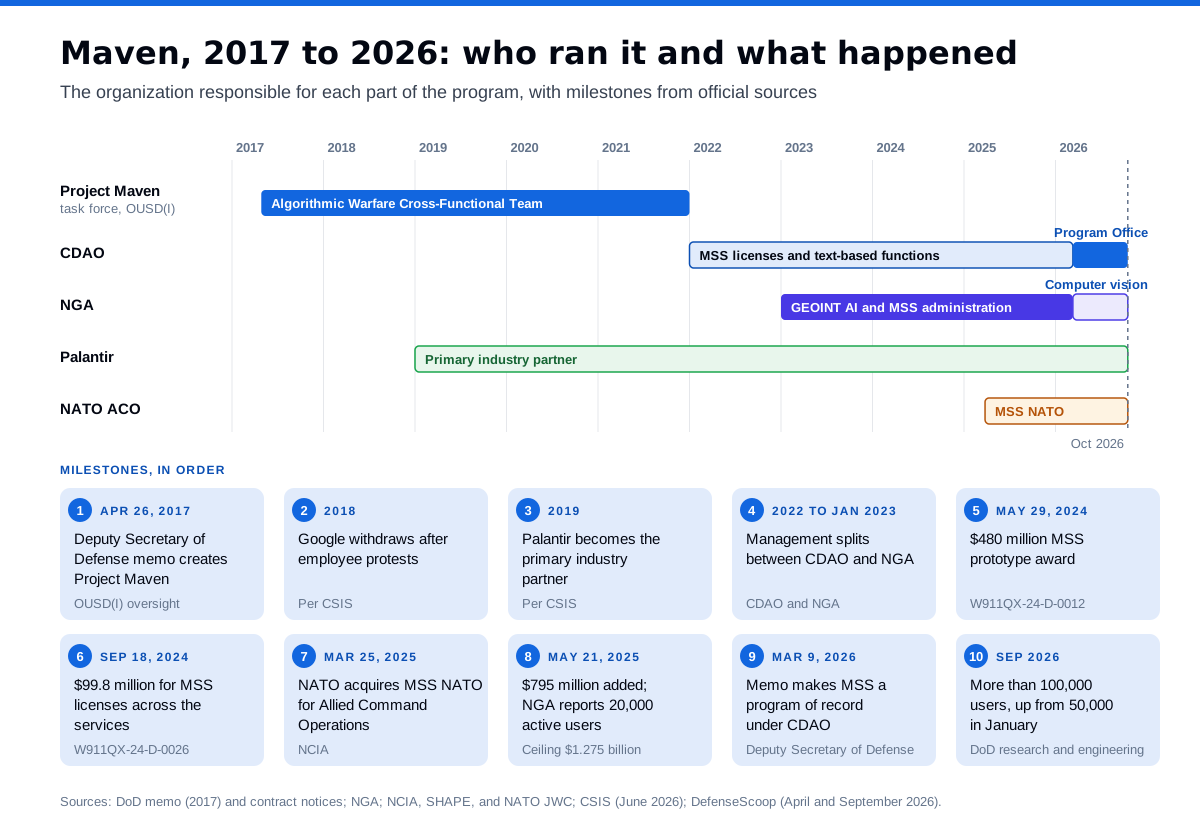
Maven started as a Pentagon task force for drone video and grew over nine years into the Department's main AI data platform. On April 26, 2017, the Deputy Secretary of Defense signed the memo establishing the Algorithmic Warfare Cross-Functional Team (Project Maven) to "accelerate DoD's integration of big data and machine learning." Its first task was to "field technology to augment or automate Processing, Exploitation, and Dissemination (PED)" for drone and full-motion video in the campaign against ISIS. The team worked under the Under Secretary of Defense for Intelligence, and DoD News reported that then-Deputy Secretary Bob Work signed the memo and Marine Corps Col. Drew Cukor led the team.
Google, an early technology partner, withdrew in 2018 after employee protests, and Palantir became the primary industry partner in 2019, according to CSIS. In 2022 the Department split management: CDAO paid for MSS licenses and managed text-based functions, and NGA took geospatial intelligence, including computer-vision models. NGA says "the GEOINT aspects of Maven were entrusted to NGA in January 2023," and its director called NGA Maven "our marquee targeting program of record" in a May 21, 2025 keynote. The timeline shows who held each part of the program.
Who runs Maven Smart System?
CDAO runs MSS through a dedicated program office under a memo that Deputy Secretary of Defense Steve Feinberg signed on March 9, 2026. The four-page memo, which DefenseScoop obtained, makes MSS a program of record, the status that gives a program its own budget line and a place in the Future Years Defense Program, the Department's five-year spending plan. Feinberg wrote that the change "will provide the stable funding and resourcing necessary" for sustained development, and the memo set the end of fiscal year 2026 as the target.
The memo moves MSS system administration, oversight, and support from NGA to the CDAO MSS Program Office. It makes the Under Secretary for Research and Engineering the authorizing official for MSS and its commercial cloud infrastructure, the official who formally accepts the system's security risk and approves it to operate. And it asks that Under Secretary, Emil Michael, for a "CJADC2 Acceleration Plan" that weighs whether MSS belongs under a future CJADC2 program office. In August 2026, DefenseScoop reported that Army Col. Molly Solsbury had been named MSS program director at CDAO.
Who uses Maven Smart System?
MSS users span the US military services and combatant commands, NGA's analysts, and NATO's operational command.
| User | What official sources say | Source |
|---|---|---|
| Military services | A September 2024 license contract extends MSS to the Army, Air Force, Space Force, Navy, and Marine Corps | Defense Department; Palantir |
| Combatant commands and the Joint Staff | Production deployments at INDOPACOM, EUCOM, CENTCOM, NORAD and NORTHCOM, SPACECOM, TRANSCOM, AFRICOM, and the Joint Staff, with more at CYBERCOM, STRATCOM, and SOUTHCOM | Palantir one-pager, 2025 |
| NGA | NGA Maven is "now available to all Services and all Combatant Commands," and a $28 million contract expands MSS access for NGA analysts | NGA, May 2025 |
| National Guard Bureau | A Pentagon official said MSS is spreading to all the commands and to the National Guard Bureau | DefenseScoop, September 2026 |
| NATO Allied Command Operations | MSS NATO, acquired on March 25, 2025 | NCIA; SHAPE |
The user count grew fivefold in about 16 months. In May 2025, NGA's director reported "20,000 active users through more than 35 service and combatant command tools" across three security domains. In September 2026, James Mazol, deputy under secretary of defense for research and engineering, said Maven had about 50,000 users in January 2026 and more than 100,000 by September, according to DefenseScoop.
NATO's adoption has its own milestones. SHAPE called the six-month procurement "one of the most expeditious in NATO's history" and said ACO would begin using the system within 30 days. NATO's Joint Warfare Centre reports that MSS NATO was first used in exercise STEADFAST DETERRENCE 2025 in May 2025, that more than 100 participants joined the centre's training on it in August 2025, and that STEADFAST DUEL 2025 would be ACO's first real test of the system on the way to full operational capability.
Maven Smart System contracts and funding
The public record shows a $1.275 billion ceiling on the main MSS contract and a separate $99.8 million license contract. Army Contracting Command at Aberdeen Proving Ground, Maryland, awarded both.
| Date | Action | Amount | Contract and term |
|---|---|---|---|
| May 29, 2024 | Firm-fixed-price award to Palantir USG for the "Maven Smart System prototype," one bid received (notice) | $480,000,000 | W911QX-24-D-0012, to May 2029 |
| September 18, 2024 | "User licenses for the Maven Smart System AI tool, ancillary software support and hardware" (notice) | $99,804,561 | W911QX-24-D-0026, to September 2029 |
| March 25, 2025 | NATO's agency acquires MSS NATO for Allied Command Operations (NCIA) | Not disclosed | NATO contract |
| May 21, 2025 | Modification P00005 "for Maven Smart System software licenses" (notice) | $795,000,000 | W911QX-24-D-0012, to May 2029 |
| April 2026 | Fiscal 2027 request: "$2.3 billion for the Maven Smart System (MSS) and Joint Fires Network (JFN)" (budget overview) | $2.3 billion, shared with JFN | Budget request |
The two awards on the main contract add up to $1.275 billion, the "nearly $1.3 billion" in press coverage. A ceiling is the most the government can order under an indefinite delivery, indefinite quantity (IDIQ) contract, so it caps orders and does not measure spending. Palantir reports revenue by segment, so its filings do not isolate MSS revenue.
How Maven Smart System relates to Gotham, Foundry, and AIP
Palantir markets MSS as its own product, and the components it names come from across its platforms. Palantir's documentation describes Workshop as a Foundry tool for "interactive and high-quality applications for operational users" and calls the Model Catalog "an AIP application in Foundry." CSIS reports that unpublished Palantir documentation states "MSS is powered by the Palantir Platform," and that MSS reaches large language models through AIP, with model choice limited on classified networks.
| Palantir platform | What it is | Where it shows up in MSS |
|---|---|---|
| Gotham | Palantir's platform for defense, intelligence, and law enforcement analysis | Palantir has not said publicly that MSS runs on Gotham; its March 2026 MSS blog post describes detections stored as Ontology objects, the data model all its platforms share |
| Foundry | Palantir's data integration and operations platform | Application builders documented in Foundry, such as Workshop |
| AIP | Palantir's platform for connecting language models and agents to ontology data | AIP Assist, AIP Threads, Agent Studio, and the Model Catalog |
For a buyer, MSS packages the building blocks commercial customers license as Foundry and AIP, configured for military workflows and accredited for defense networks. Our Palantir Gotham guide explains how Gotham and Foundry differ, and our explainer on what Palantir AIP is covers the language-model layer.
The rules that frame Maven: ethical principles, DoD Directive 3000.09, and human judgment
Four sets of rules frame how the Department and NATO use AI such as MSS, and each holds people responsible and accountable for how that AI is used.
| Rule | What it requires | Date and status |
|---|---|---|
| DoD AI Ethical Principles | Responsible, equitable, traceable, reliable, and governable AI. Personnel "will exercise appropriate levels of judgment and care," and systems need "the ability to disengage or deactivate deployed systems that demonstrate unintended behavior" | Adopted February 24, 2020 |
| DoD Directive 3000.09, Autonomy in Weapon Systems | Autonomous and semi-autonomous weapon systems must "allow commanders and operators to exercise appropriate levels of human judgment over the use of force"; senior officials review a system before formal development and again before fielding | Updated January 2023, per CRS In Focus IF11150; NSPM-11 ordered an update within 90 days |
| NSPM-11, AI in the National Security Enterprise | Commanders, directors, and heads of agencies "shall remain responsible and accountable" for ensuring the memo's obligations are met at every level of command, including its bars on using AI to censor free speech, embed ideological bias, or conduct unauthorized or unlawful surveillance; rescinds National Security Memorandum 25 | Signed June 5, 2026 |
| NATO Principles of Responsible Use | Lawfulness; responsibility and accountability; explainability and traceability; reliability; governability; bias mitigation | Published October 22, 2021 |
MSS is decision-support software, and DoDD 3000.09 governs weapon systems that, "once activated, can select and engage targets without further intervention by a human operator," in CRS's summary of its definition. CRS notes that the human-judgment standard does not require manual control of a weapon. The directive still frames the Maven debate, because AI-assisted targeting workflows feed human decisions about force. NGA's director said in May 2025 that Maven's models need people to train them and check their output, and that positive identification of a target remains "the prerogative of the Commander-in-Chief, Secretary of Defense" and the authorities they delegate. NGA also runs an accreditation program for GEOINT AI models, launched as a pilot on September 3, 2024.
The public debate over Maven
The debate turns on two questions: how far AI should go in decisions about force, and how much the public can see of a program growing this fast. Both sides are on the record.
| Position | Argument on the record | Source |
|---|---|---|
| Ban advocates | About 30 countries and 165 nongovernmental organizations call for a preemptive ban on lethal autonomous weapon systems, citing operational risk, accountability, and the law of war's distinction and proportionality rules | CRS IF11150 |
| Technology workers | Google withdrew from Project Maven in 2018 after employee protests | CSIS |
| Congressional oversight | Senator Ruben Gallego wrote on June 12, 2026 that "Any update that significantly reduces safeguards and disrupts rigorous reviews risks friendly fire and civilian harm incidents" | Senate letter |
| Transparency concerns | A former senior defense official told DefenseScoop "there's a lack of transparency" around the program | DefenseScoop, April 2026 |
| US government | A 2018 US white paper argues automated target identification, tracking, selection, and engagement "can allow weapons to strike military objectives more accurately," and the United States does not support a ban | CRS IF11150 |
| Defense Department | CDAO's Stanley: "we need to make better decisions faster with data" | Defense One |
| NATO | SHAPE's chief of staff said ACO adopts technologies that make NATO "more agile, adaptable, and responsive to emerging threats" | NCIA |
What commercial and civilian buyers can learn from Maven
Maven is a large, public test of the problems commercial Palantir buyers face: integrating data from many systems, getting software accredited, and keeping people accountable for what AI recommends. In BD Emerson's view, five lessons transfer to a bank, insurer, manufacturer, health system, or civil agency.
| Lesson | What Maven shows | What it means for your deployment |
|---|---|---|
| Integrate before you automate | MSS replaced "six, eight, ten" separate analysis systems | Build the pipelines and the ontology for one decision first, because AI on unintegrated data repeats its errors faster |
| Treat accreditation as part of the build | The 2026 memo named an authorizing official for MSS and its cloud, and NGA accredits AI models | Plan FedRAMP, SOC 2, and model-risk reviews before production data arrives |
| Design the human decision point | DoDD 3000.09, NATO's principles, and NGA's positive identification standard keep commanders accountable | Write approval thresholds for any agent action that moves money, changes coverage, or edits a customer record, and log the approver |
| Fund it as a program | Program of record status gives MSS its own budget line | Budget run costs, model evaluation, and support as a standing line after the pilot ends |
| Measure adoption | Officials report active users, from 20,000 in May 2025 to more than 100,000 in September 2026 | Track weekly active operators and decisions supported against a baseline |
Our guide to Palantir FedStart and FedRAMP shows how software vendors inherit Palantir's government authorizations. BD Emerson is an independent Palantir implementation consultancy for commercial and public sector clients. We are not Palantir, we do not resell licenses, we take no resale margin, and we claim no partner tier or badge. We apply these lessons to Foundry and AIP deployments: one decision in production first, security designed before data arrives, and human checkpoints in each agent workflow.
Frequently asked questions
What is the Maven Smart System? Maven Smart System is Palantir's AI-enabled software platform for the US Department of Defense's Maven program. It fuses intelligence, surveillance, and reconnaissance data, computer-vision detections, and operational data into a shared map and decision tools for commanders and analysts. A March 2026 memo directed that it become a program of record run by the Chief Digital and Artificial Intelligence Office.
What is the difference between Project Maven and Maven Smart System? Project Maven is the Pentagon AI program that a Deputy Secretary of Defense memo created on April 26, 2017, first to automate the analysis of drone video. Maven Smart System is the Palantir software platform that grew out of it, where detections, sensor feeds, and other data come together for commanders. NGA runs Maven's computer-vision work, and the Chief Digital and Artificial Intelligence Office administers MSS.
Who uses the Maven Smart System? The US Army, Air Force, Space Force, Navy, and Marine Corps have access under a September 2024 license contract, and Palantir lists production deployments at combatant commands including INDOPACOM, EUCOM, CENTCOM, and NORTHCOM. NATO's Allied Command Operations uses MSS NATO, acquired in March 2025. A Pentagon official said in September 2026 that MSS had more than 100,000 users, up from about 50,000 in January.
How much is the Maven Smart System contract worth? The main contract, W911QX-24-D-0012, has a ceiling of $1.275 billion running to May 2029: a $480 million award on May 29, 2024, plus a $795 million modification on May 21, 2025. A separate September 2024 contract for user licenses is worth up to $99,804,561. The fiscal 2027 budget request includes $2.3 billion for MSS and the Joint Fires Network. A ceiling caps orders and does not measure spending.
Does NATO use the Maven Smart System? Yes. The NATO Communications and Information Agency acquired MSS NATO for Allied Command Operations on March 25, 2025, after a six-month procurement. NATO first used it in exercise STEADFAST DETERRENCE 2025 in May 2025, and its Joint Warfare Centre is building it into the exercises it directs. The centre calls it NATO's first AI-enabled warfighting command and control system.
Does the Maven Smart System make decisions on its own? Official sources describe MSS as decision support: its models detect objects and its tools organize data and options, and people decide. DoD Directive 3000.09 requires that weapon systems allow appropriate levels of human judgment over the use of force, NSPM-11 holds commanders, directors, and heads of agencies responsible and accountable for meeting its obligations at every level of command, and NGA's director said positive identification of targets is the prerogative of the Commander-in-Chief, the Secretary of Defense, and the engagement authorities they delegate.
If you are weighing Palantir for a commercial or public sector workload and want these lessons applied to your own deployment, our Palantir consulting team can scope the first decision, the data it needs, and the controls around it before a license conversation starts.

About the author