

Insurity: Products, Ownership, and How It Compares With Other P&C Core Vendors
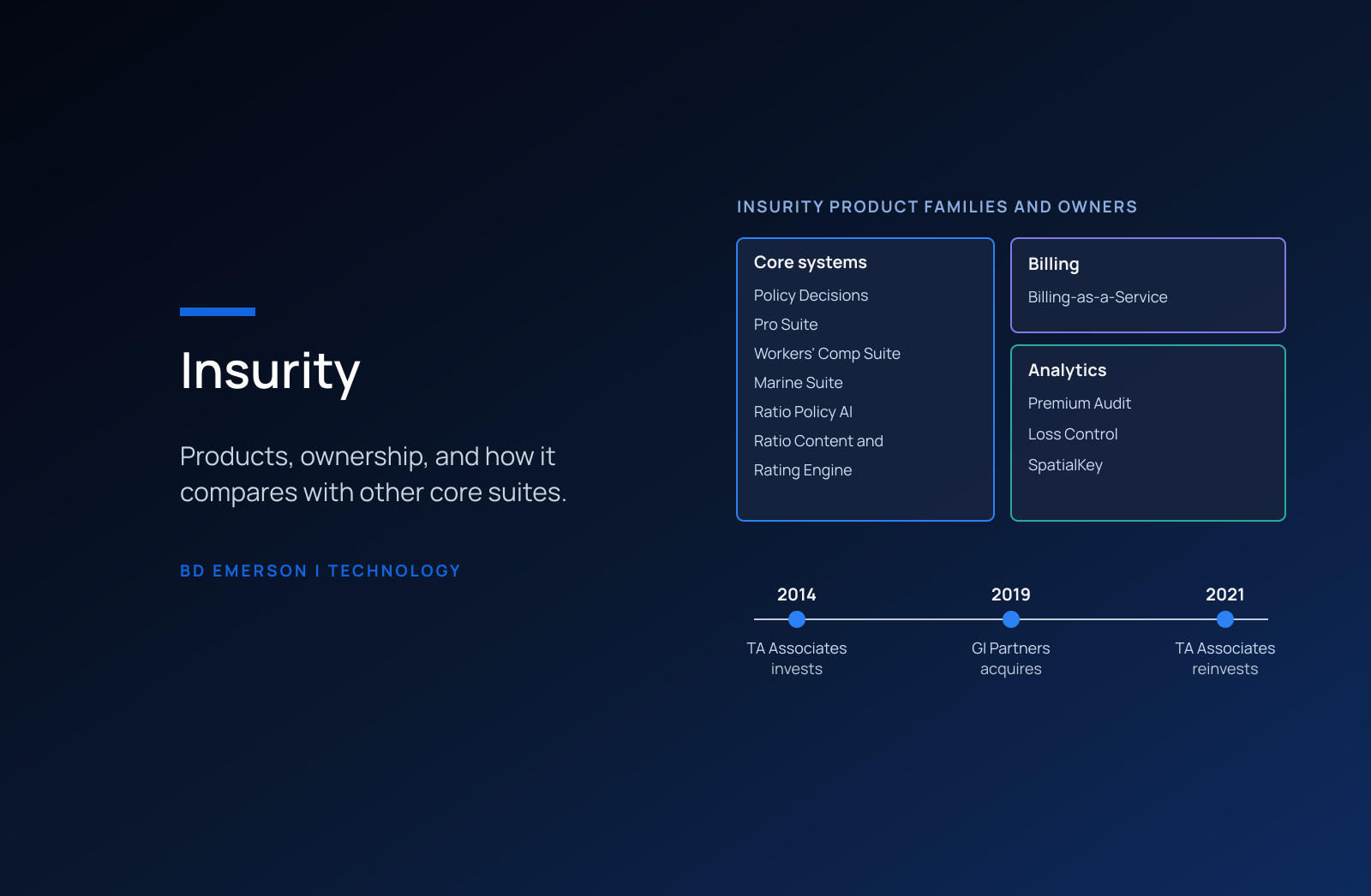
Insurity is a property and casualty insurance software company, founded in 1985 and headquartered in Hartford, Connecticut, that sells cloud-based policy administration, rating, billing, and claims systems plus analytics to commercial and specialty carriers, managing general agents (MGAs), and Lloyd's managing agencies. It is privately owned: GI Partners has been its lead investor since July 2019, and TA Associates, which first invested in 2014, reinvested in November 2021. Insurity says more than 500 customers run on its software. Much of its product line came through acquisitions, so a buyer should evaluate the specific suite or engine that would serve each line of business it writes, and confirm how those products connect.
What does Insurity sell?
Insurity's company page groups its products into core systems, analytics, and billing and payments. The core systems are Policy Decisions, Pro Suite, Marine Suite, Workers' Comp Suite, Ratio Policy AI, and the Ratio Content & Rating Engine. Analytics covers Premium Audit, Loss Control, and SpatialKey, a geospatial analytics product. Billing is offered as Billing-as-a-Service. The same page claims 22 of the top 25 P&C carriers, 12 of the top 15 Lloyd's managing agencies, and 7 of the top 10 US MGAs as customers. Insurity's own one-line descriptions, taken from its Policy Decisions product page, show how the suites divide the market:
| Product | How Insurity describes it | Where it fits |
|---|---|---|
| Policy Decisions | "Policy admin built for regulatory complexity," for commercial lines | Commercial auto, property, general liability, workers' compensation, inland marine, and specialty commercial lines |
| Pro Suite | "Modular core software for growing carriers & MGAs" | Growing carriers and MGAs that want a modular core they can add to |
| Workers' Comp Suite | "Core software designed specifically for workers' comp" | Monoline and specialist workers' compensation writers |
| Marine Suite | "Configurable marine cargo insurance software for global growth" | Cargo and marine underwriters |
| Ratio Policy AI | "AI-native policy administration for complex commercial insurance" | Large, complex commercial accounts |
Policy Decisions carries the broadest scope. Insurity's product page lists commercial auto, property, general liability, commercial package, workers' compensation, umbrella and excess, inland marine, crime, and boiler and machinery, plus specialty lines such as professional liability, cyber, and farm. It also lists "fully managed bureau content that supports major bureau lines" and cloud deployment options, and says the product integrates through an API library, custom web services, and prebuilt connections to third-party data services.
Who owns Insurity?
Insurity is private, so it files no annual report with the SEC and publishes no audited financials. Its ownership history sits on its investors' websites. TA Associates says it first invested in Insurity in 2014, sold the company to GI Partners in July 2019, and reinvested in November 2021. GI Partners lists itself as lead investor with an initial investment in July 2019 and a status of current, and describes Insurity as a provider of "policy administration, ratings, billings, claims, and data analytics software" to carriers in the commercial and specialty property and casualty markets.
Private equity ownership gives a buyer two things to check. The first is financial durability, which you test by asking for audited statements under a nondisclosure agreement, because there is no public filing to read. The second is continuity through a future sale: sponsors usually hold a company for several years and then sell it, and a core system relationship usually outlasts that holding period, so the contract should protect your data rights, source code escrow, and support terms if the company changes hands.
How did Insurity build its product line?
Insurity built much of its catalog by buying companies. In April 2021 it completed its acquisition of Instec, which it described as a provider of cloud-based software to mid-size P&C carriers, MGAs, and specialty writers, with "out-of-the-box ISO and NCCI content, delivered 90 to 120 days ahead of the effective date." Insurity said the deal expanded it into the "$40 billion program business," the market in which MGAs and program administrators write specialized books on a carrier's paper. Its analytics products for premium audit, loss control, and geospatial risk sit beside the core systems in the current catalog.
The practical consequence is that Insurity sells several products with different histories, and a carrier should not assume they behave as one system. Policy Decisions serves broad commercial lines, Pro Suite targets growing carriers and MGAs, separate suites serve workers' compensation and marine cargo, and Ratio Policy AI is positioned for complex commercial accounts. A carrier that writes commercial auto, workers' compensation, and inland marine should ask which product would run each line, whether those products share a data model, and how billing, claims, and reporting connect across them.
How does Insurity compare with other P&C core vendors?
Insurity competes for core system decisions with Guidewire, Duck Creek, Majesco, Sapiens, EIS, Socotra, and others; our guide to Guidewire alternatives compares those vendors on ownership, deployment, and pricing model. Three differences stand out from Insurity's own materials. It concentrates on commercial and specialty lines, MGAs, and Lloyd's managing agencies, which is where its customer claims cluster. It sells line-specific suites, so a workers' compensation or marine cargo writer can buy a product built for that line instead of configuring a general platform. And it delivers bureau content as a managed service inside Policy Decisions, which moves the work of keeping ISO and NCCI changes current from the carrier to the vendor.
Vendors that sell one suite across all lines trade that line-specific fit for a single data model and a single upgrade path. Neither approach wins in general. The right choice depends on how many lines you write, how much of the book is bureau-based, whether you need personal and commercial lines on one platform, and how much of your product you want to configure yourself.
Is Insurity a fit for MGAs and program business?
MGAs are a stated focus. Insurity claims 7 of the top 10 US MGAs as customers, markets Pro Suite to growing carriers and MGAs, and bought Instec to reach program business. For an MGA, the core system serves a second customer besides the MGA itself: every carrier whose paper it writes on. Each carrier wants premium and claim data on its own schedule and in its own format, usually as bordereaux, and the NAIC's model act for MGAs calls for monthly accounting and timely electronic claim data in the contract between the MGA and its carrier. An MGA evaluating Insurity, or any core vendor, should test three things with its own data: whether one policy system can write the same product for two carriers with different rates, forms, and commission terms; whether each carrier's bordereaux come out of the system without spreadsheet work; and whether moving a program to a new carrier at renewal is a configuration change or a second implementation.
What should you check in an Insurity evaluation?
These six questions separate a product demonstration from a decision you can defend to a board:
- Which Insurity product would run each of your lines and states, and do those products share a data model?
- How is bureau content licensed and delivered, and what is the lead time from an ISO or NCCI circular to production?
- How does the product integrate with the systems you keep, and which integrations are prebuilt versus custom work?
- How often do platform releases ship, are they mandatory, and how much regression testing falls on your team?
- Who converts your policy, billing, and claims history, and how will reconciliation be proven before cutover?
- What is the pricing basis (premium, policy count, or users), and how does cost scale as the book grows?
Ask each question for the product that would run your largest line first. The answers for that product decide most of the program's cost and risk, and they are where vendor descriptions and production reality most often diverge. Our policy administration system guide sets out the broader scoring criteria and implementation ranges that apply to any vendor on the shortlist.
When does a custom core fit better than a vendor suite?
A vendor suite is the right answer when your products look like the market's products and speed matters more than control. A custom core fits better when the product is the differentiator: a specialty line the bureau content does not cover, a distribution model the suites handle only through workarounds, or a pricing approach the vendor's engine cannot run. BD Emerson does not implement or resell Insurity or any other core suite, so we can score Insurity against a build with no commission riding on the answer, and we can build a working prototype of one of your products on a custom core before you commit to either path. Our insurance team includes people who helped lead a Guidewire implementation practice of thousands of professionals at a Big Four firm, so the comparison draws on suite implementation experience as well as custom builds.
To compare Insurity with other platforms and with a build, see our policy administration system services, which cover selection, build vs buy analysis, and data migration from the system you run today.

About the author













